Omaha Air Bombardment - Part III: Execution
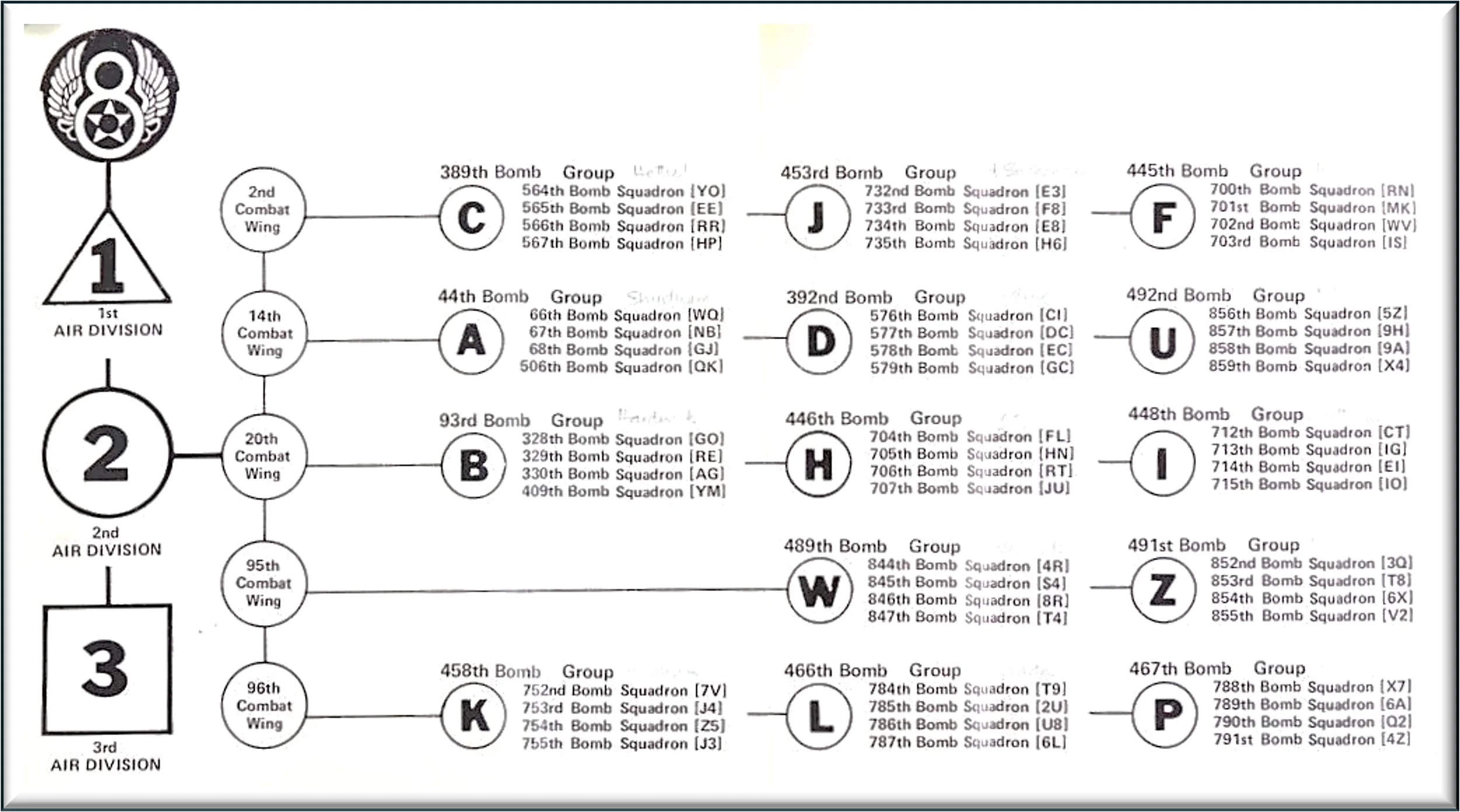
Figure 1. The organization of the 2nd Bombardment Division on D-Day. The newly forming 95th Combat Wing was not employed in the beach defense neutralization mission due to the inexperience of its aircrews.
Wheels Up
In the lead up to the 6 June bombing missions of the 2nd Bombardment Division, many of the activities had the feel of routine, if not quite normalcy. Aircraft were fueled, ammunition loaded for the gunners, bombs trundled out to the aircraft, engines checked and pilots, navigators and bombardiers briefed. Preparations were carried out in much the same manner as on dozens of previous days, despite the special significance of this mission.
But that was about to change as Colonel Jacob Brogger of the 446th Bomb Group taxied his aircraft onto the runway at Attlebridge airfield, gunned his engines and began his takeoff roll. Brogger’s was the first of the 2nd Bombardment Division’s roughly 450 aircraft to leave the ground, doing so at 0155 hours. According to the plan, the division was supposed to launch its aircraft starting at 0220 hours with all aircraft in the air by 0250 hours.[1] But plans are seldom executed precisely, and as Brogger lifted off early, the 44th Bomb Group would take off late, not launching until 0300 hours. During that period, the 2nd Bombardment Division would dispatch either 448 or 446 bombers, depending on source.
Once in the air, the bombers entered a world of near-blind chaos as the planes climbed into the dark, overcast sky. Assembly proved difficult. Aircraft were provided precise routes, with bearings, airspeed and rate of climb specified for each leg. If followed exactly as they climbed through the clouds, these instructions should have enabled individual aircraft to close on their formation leaders by the time they reached certain points, despite the dark and the clouds. But that kind of precise ‘blind’ navigation could go wrong in a thousand different ways, and frequently did that night. Breaking above the overcast, the planes found a moonlit night, which made assembly a bit easier. But it was still as scary as hell.
Twenty-one year old John W. McClane, Jr. was the lead navigator for a squadron of six B-24s from the 44th Bombardment Group. His aircraft was flying, he believed, on its prescribed heading and climbing at the prescribed rate as it passed through the overcast. Visibility was between 50 and 100 feet. Suddenly the tail of the aircraft plunged 30 degrees downward and the intercom was flooded by excited chatter. When the panic was brought under control, crewmen at the back of the aircraft stated that an RAF bomber had suddenly appeared, clipped the B-24 and disappeared into the night. At his pilot’s order, McClane peered through the astrodome and discovered the top 24 inches of the right vertical stabilizer and rudder had been hit and folded down 180 degrees. It was an incredibly fortunate near miss. The pilot had every right to abort the mission, but a little experimentation disclosed he still had full control. Knowing how important the D-Day mission was, he elected to carry on with the job.[2]
The 392nd Bombardment Group had its own brush with statistical absurdity, one that pushed good luck to the absolute limits.
“During the 392nd's assembly, an unknown formation of bombers flew through the 392nd's lead, high and low squadrons, the lights of the errant formation suddenly appearing out of the darkness, coming from the one o'clock level position and passing through the formation from the front to the rear and then, just as quickly, disappearing into the night. Lt. Col. Gilbert remarked later: ‘There was a stunned silence in the cockpit after they were gone as we realized that an horrific multi-aircraft mid-air collision had been narrowly avoided.’"
During the assembly, the aircraft were supposed to form up in ‘box’ formations of three squadrons, which was difficult under the circumstances. Many aircraft could not link up with their squadron leaders and several squadrons could not find their pathfinder aircraft. Other formations took so long to assemble that they left the assembly areas late and had to try to overtake the stream of bombers to take their proper slots. Stray aircraft were continuously ‘wedging’ into formations, looking for a home, whether it was their group or not. It wasn’t pretty, and it never got completely sorted out.
Many mission reports and navigator’s reports were critical of the assembly.
“Weather not at [as] briefed, ceiling high. PFF [Pathfinder] A/C went off 8 min early.” “Assembly: Ragged. 7 A/C of 448th on other Wing’s A/C.” - 448th Bomb Group’s commander’s post-strike telephonic report.[3]
“According to comments of the crews, assembly was very confused with much interchange of places in the formation plan. In fact, most of the flights were scattered and not in good shape when Bu. 7 [Buncher 7 – a navigational beacon] was left. Combinations of various flares was also very confusing.” “All along route after departing Bu. 7, planes were tacking onto whatever bunch they could find. The 4th flight departed Bu. 7 10 minutes late – thus necessitating cutting off some control points and ended up as lead flight.” “Weather was a handicap in forming. 10/10 over target [complete overcast]. Six ships aborted because they could not find formation. Some ships tacked on with B-17’s who were firing green flares.” – From Lt Milton Nelson’s (448th Bomb Group) summary of the 20th Combat Wing’s critique [4]
“Assembly: Group had difficulty in forming due to heavy cloud layer just off Great Yarmouth. All ships joined some squadron on bomb run.” – 93rd Bomb Group Mission Summary [5]
“Six ships flights did not assemble as briefed due to darkness, therefore, group could not be determined. Data presented is for navigator scheduled to lead group.” – 467th Bomb Group lead navigator’s report [6]
And yet, there were several other reports that were positive, such as:
“A “razzle-dazzle pre-dawn assembly was used . . . darkness made navigation difficult, but the maneuver worked out well.” - 44th Bomb Group lead navigator’s report [7]
Although weather and night were blamed for the confusion during assembly, there was another factor that was at least as much to blame, though it wasn’t mentioned in the reports: the nature of the formations used by the 20th and 14th Combat Wings.
Self Sabotage
As you will recall from the previous installment, the basic bombing formation consisted of a box of three squadrons of six aircraft each, for a total of 18 aircraft. [Figure 2] Each squadron consisted of two Vees of three aircraft, with the second Vee flying closely in trail behind the first. Normally the three squadrons would assemble in the standard lead, high and low positions.
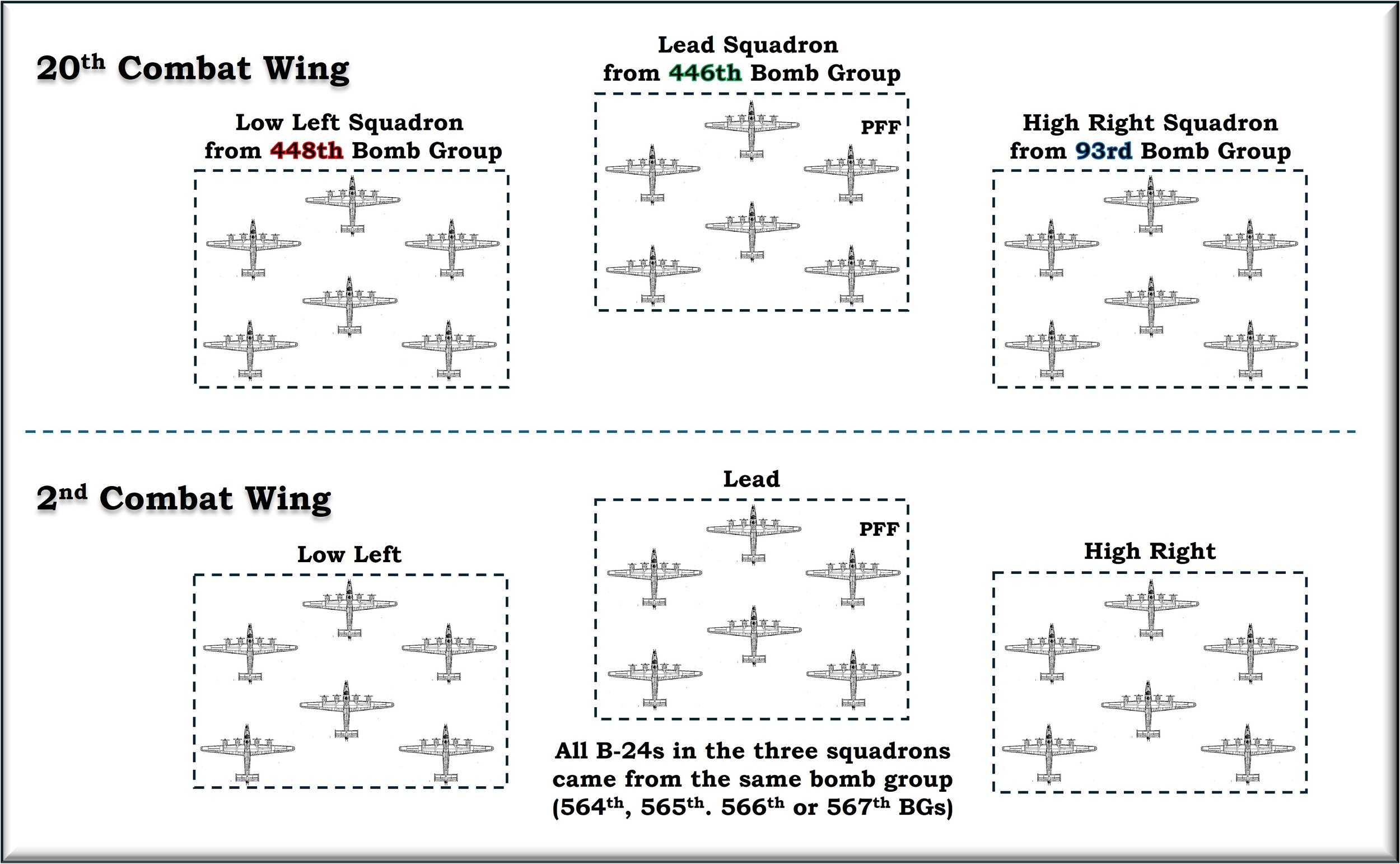
Figure 2. Two methods of forming squadrons for assembly. The 20th Combat Wing drew aircraft for each squadron in the formation from different bomb groups flying from different bases. The 2nd Combat Wing formed each formation from a single bomb group flying from the same airbase.
Since the authorized aircraft strength of a bomb group consisted of 36 aircraft, it would seem logical that all 18 aircraft of a three-squadron formation would be drawn from a single bomb group, with all 18 aircraft taking off from the same airfield. This method greatly simplified assembly, especially at night, and was used by the 2nd and 96th Combat Wings whenever possible.
But the 20th and 14th Combat Wings opted for a more complicated solution. Each of the three squadrons in a formation was drawn from a different bomb group, with each bomb group flying from a separate airfield. In the 20th Combat Wing, for example: the lead squadron belonged to the 446th Bomb Group (based at Bungay/Flixton); the high squadron belonged to the 93rd Bomb Group (based at Hardwick); and the 448th Bomb Group (based at Seething) would fly as the low squadron. So, each formation required three squadrons from three airfields to locate each other at night after climbing through an overcast. As bad as it was to assemble one of these formations under those conditions, the 20th Combat Wing actually formed six formations that evening (two for Pointe de la Percee, and four for Vierville), resulting in a cumulative complexity that would virtually guarantee confusion and error. The 14th Combat Wing used similar procedures.
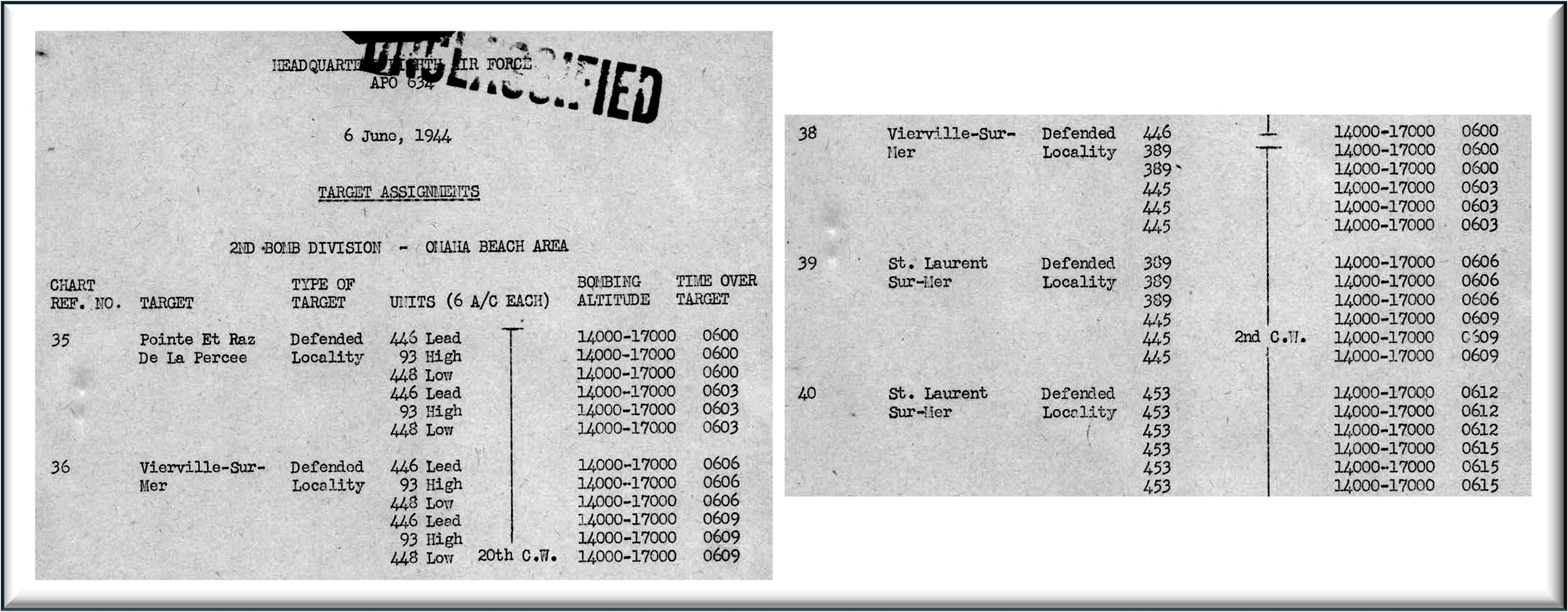
Figure 3. This extract from the Eighth Air Force Tactical Operations report shows how six-aircraft squadrons were combined into formations for the bombing. Note that in the 20th and 14th Combat Wings, the lead, high and low squadrons came from different bomb groups. The 2nd and 96th Combat Wings drew all 18 aircraft in a formation from the same bomb group wherever possible.
Perhaps it comes as no surprise that the previously cited incidents of near misses and most of the critical comments on assembly came from units within the 20th and 14th Combat Wings. Given this bizarre task organization, there is small wonder confusion reigned in their assembly zones. I have found no documents that explain why those wings chose such a method.
Despite some mixed views among the wings regarding the efficiency of the assembly, the general opinion was that it was an experience best not repeated. The higher you rise in an organization, however, the greater the tendency to overlook or minimize the difficulties on the ground—or in this case, in the air. So, it isn’t surprising that by the time this topic was covered in the Eighth Air Force special report, Tactical Operations in Support of Allied Landings in Normandy, 2 June – 17 June 1944, (hereafter referred to as the Tactical Operations Report), the problems had been minimized or simply had fallen out of the narrative.
“The pre-dawn assembly which involved the forming of 225 flights of six aircraft each was eminently successful, with all flights executing the prescribed assembly except three, which did not make contact with the H2X leader. In climbing through the overcast, a number of aircraft became separated from their units but they were able to form on other flights.”[8]
That judgement was rather inaccurate—at least as concerns the 2nd Bombardment Division—as we will see later in this article. The Eighth Air Force staff had been convinced their plan for nighttime assembly was sound, based on the “completely successful” experiment conducted on 1 May 1944 as part of an actual bombing mission. But that experiment was limited in scale, with the 2nd Bombardment Division launching just 189 bombers, (as opposed to the 450 for the actual invasion) so the congestion and confusion aloft was far less than what would be present on 6 June.[9] The direct impact of these assembly problems was the failure of three squadrons to bomb as a result of not being able to link up with Pathfinder aircraft.[10] The indirect impact is more difficult to quantify as some squadrons without Pathfinders diverted to secondary targets and many individual aircraft did not bomb at all. Also, the many lost aircraft that linked up with random formations meant that the actual number of bombers attacking any given target might vary widely from the planned concentration.
Formation Shift
The D-Day beach bombardment mission would see a modification of the typical formation. After assembly, the 96th Combat Wing specified its three-squadron formations would fly in trail with one minute intervals between squadrons.[11] The 20th Combat Wing specified that for visual conditions, the three squadrons would assemble and fly to the in the standard Lead-High-Low formation; however, in the event of bomb-through-overcast conditions, they would reform in a squadrons-in-trail formation (in the order of Lead, High then Low squadrons) at “minimum interval.”[12] As a result of the overcast conditions on 6 June, all of the bomber formations should have used three squadrons flying in trail. One Pathfinder aircraft was allotted for every three squadrons, and it was positioned with the lead squadron. The Pathfinder would fire a marking rocket when it released its bombs, and all aircraft of the lead squadron would release their bombs when the Pathfinder did. The second and third squadrons following in trail would drop when they reached the location of the marker rocket.
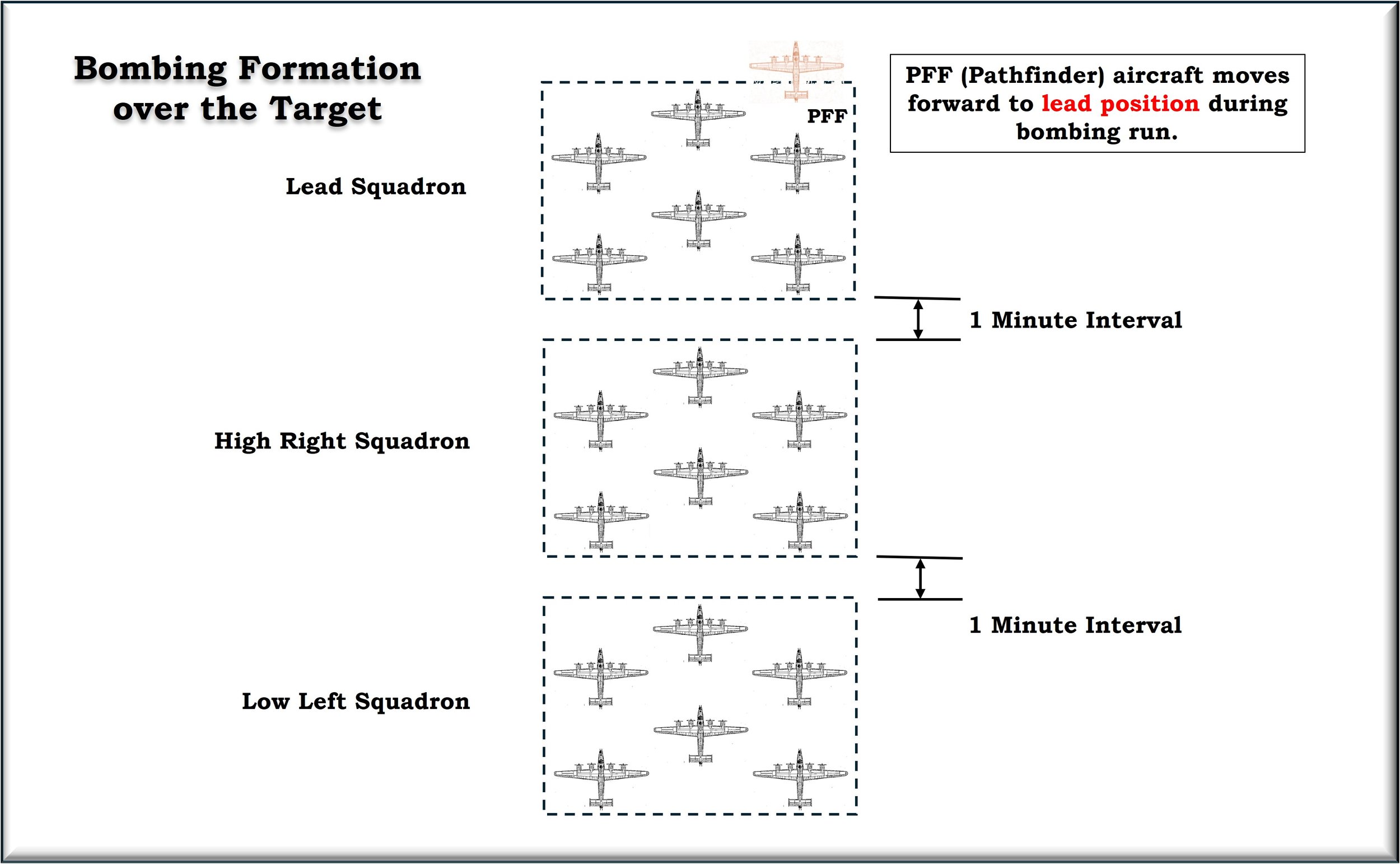
Figure 4. As directed by the various combat wings’ field orders, each formation of three squadrons was to bomb with squadrons following in trail at one-minute intervals or less. Most of the targets were to be hit by two of the ‘box’ formations, or about 36 bombers.
Eighth Air Force’s Plan “B” (the order covering a bomb-through-overcast contingency) would have changed all of this. It envisioned the aircraft flying in the usual lead-high-low formation during bomb-through-overcast conditions. It only slightly modified this formation by specifying the wing squadrons would “fly slightly below and abreast” of the lead squadron to more easily see the Pathfinder’s bomb release.[13] Since none of the units stated they followed this on 6 June, it is another indication that Plan “B” was not put into effect.[14]
Each of the four combat wings had its own assembly zone, though the wings did not assemble in a single formation, per se. At a given time, the three-squadron formations passed in order over the wing’s designated Point B, which was the start point for the flight to Normandy. There their flight paths slightly diverged as they headed to their individual targets. Most of the Omaha targets would see two of the three-squadron formations headed their way. From above, one theoretically could see 13 separate columns of B-24s headed to the Omaha Assault Area on 13 different headings, with the lead squadrons of all streams attempting to reach the beach at the same time: 0600 hours.
Crossing the Channel and the First Aborts
With no flak and no enemy fighters, the actual approach was remarkably terror-free. A heavy covering force of fighters guarded them from above, but most bombers saw few of them. The jockeying for position continued by lost aircraft and out-of-sequence squadrons, while other formations struggled to make up time. The winds at altitude were stronger than predicted, pushing several formations ahead of schedule. They tried to slow their air speed or make lazy S turns to get back on schedule, but the press of aircraft following behind made this difficult, resulting in several formations arriving early. Fortunately, there was no friendly fire reported from the fleets below. A few reports indicated the clouds over the English Channel were broken and scattered, giving the crews spectacular views of the invasion armada, but most formations reported solid overcast. Formations used the Gee-H navigation systems to maintain bearings to target, with the H2X systems ready to provide ranging as they neared the Normandy coast. The specified bombing speed was 160 knots (indicated air speed), and altitudes ranged from 14,000-17,000 feet depending on unit. The intervalometers were set to minimum, which meant there would only be a 1/20 of a second delay between each bomb’s release, and should result in the most compact bomb pattern (about 250 yards in length for an aircraft carrying 52 of the100-pound bombs). Everything seemed ready, except the weather.
All reports agreed there was a complete overcast as the bombers approached the targets. Unfortunately, the H2X equipment on the Pathfinder aircraft leading five squadrons failed, and as a result, the 30 aircraft in those squadrons did not release their bombs (these were in addition to the three squadrons that didn’t bomb when they could not find a Pathfinder). The 2nd Bombardment Division’s Field Order 328 instructed individual aircraft without Pathfinders were to proceed to bomb the secondary targets. While the order gave no instructions for squadrons in such circumstances, it would seem obvious they, too, should proceed to the secondaries. Why these eight squadrons elected to abort rather than proceed to the secondary targets isn’t clear. Thus, a little more than 10% of the 2nd Bombardment Division’s aircraft were out of the mission before reaching the Normandy coast.
Bombs Away
The actual bomb drops were generally uneventful, at least as far as enemy opposition was concerned. It was a much different story if you were the navigator/bombardier team in a Pathfinder aircraft struggling to find the correct drop point hidden beneath clouds. None of the reports stated that they could observe their targets, but the Flash Report from the 2nd Combat Wing stated, “PFF believe best run they ever had. Saw flashes on ground.” The 14th Combat Wing’s Flash Report made no mention of targets, but noted 30-40% of aircraft did not drop bombs. It also mentioned that the Germans fired bursting rockets that resembled the marker rockets used by Pathfinders to indicate release points. The 96th Combat Wing’s Flash Report revealed little, merely stating they bombed the primary targets, and the results were not observed.[15] But that report probably isn’t accurate. The 96th Combat Wing bombed the eastern set of Omaha targets, and thus 11 of its 18 squadrons were equipped with 500-pound bombs, and the 2nd Bombardment Division had ordered these to be diverted to the secondary targets as a safety measure (as discussed in the previous installment). So, did they divert or did they bomb their primary targets?
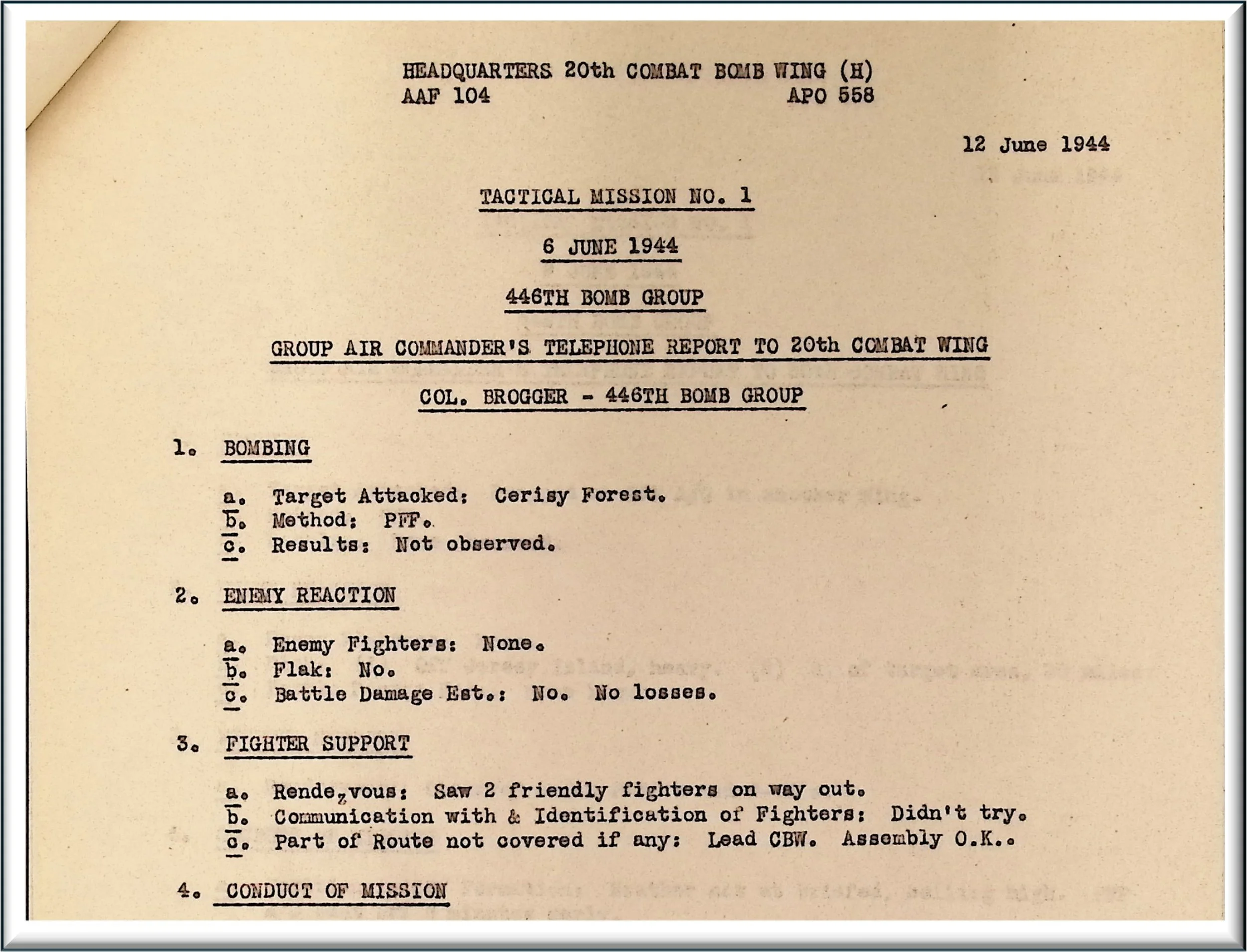
Figure 5. COL Brogger’s Telephone Report for Tactical Mission No.1 on 6 June 1944, as transcribed on 12 June. Although just a bomb group commander, his squadrons contained the Pathfinder aircraft and formed the lead squadron for every formation flown by the 20th Combat Wing. As this report indicates his group bombed the secondary target (Cerisy Forest) instead of Pointe de la Percee and Vierville, then in all likelihood the rest of the 20th Combat Wing’s bomb groups followed the lead of his squadrons and Pathfinders.
The matter of the 500-pound bombs was just as confused in the 20th Combat Wing. COL Brogger called in that wing’s Flash Report and stated they had bombed their secondary targets. In a typed follow-up report, Brogger confirmed they bombed the Cerisy Forest instead of the Pointe de la Percee and Vierville targets.[16] And this fits, as five of the squadrons were equipped with 500-pound bombs for the attacks on Pointe de la Percee and Vierville, and they (along with the accompanying squadrons with smaller bombs who were following the same Pathfinders) had been ordered to divert to the secondary target. But these accounted for only six of the wing’s 18 squadrons. The wing’s other 12 should have bombed their primary targets, yet Brogger’s report indicates they did not. Brogger’s 446th Bomb Group provided the Pathfinder aircraft for every squadron in the 20th Combat Wing; did all of his Pathfinder aircraft divert to the secondary targets, regardless of bomb loads? His reports would seem to indicate so, as do the reports of other squadrons in that Wing (see the discussion of Photo Analysis Reports below). Adding to this confusion, Brogger’s deputy lead navigator’s report for the very squadron Brogger led, stated they did bomb Pointe de la Percee, noting they dropped 3-500 yards to the east of their target.
In fact, any attempt to determine where the formations dropped is fruitless. As noted above, few reports accurately indicate whether the targets they bombed were the original planned locations, or the targets they had been diverted to. Neither did they distinguish between where they actually dropped their bombs as compared to where they thought they dropped or intended to hit. The various lead navigator’s reports provided latitude and longitude data, but only to the nearest minute, making for a very imprecise locations, and at least one set of target coordinates plots out to 40 miles to the east. Further, in almost every case, the navigators’ lat/long data merely mimicked the planned drop coordinates, not the actual drop coordinates (neither the GEE-H nor H2X provided bomb released lat/long data). In all instances, the results of the bombings were listed as ‘unobserved’, with little or no indication where the bombs struck.
Working under difficult conditions, the crews felt they did as well as they could have, and they probably did. Without making any unwarranted assumptions, however, all that can be fairly stated is that they bombed the fields and villages of Normandy, generally on the correct bearing for their assigned targets (provided by Gee-H) but at an indeterminate range behind the coastline.
The Problem of Plan “B”
And this brings us back to the major issue from the last installment: Plan “B” and the bomb-release delay schedule. As you will recall from the previous installment, the Eighth Air Force Plan “B” included a scheme which dictated a variable delay for bomb-release based on the time each squadron reached the target area. One flaw with this is that Plan “B” was sent out late, at 0020 hours on 6 June, but even then it was issued only as a warning order. One of the last lines in that message stated that the final decision would be made at 0100 hours, 6 June whether to go with Plan “A” (which presumably was the visual bombing method) or Plan “B”. The 2nd Bombardment Group did not acknowledge receipt of that message until 0106 hours—just 44 minutes before their first aircraft took off—so it isn’t at all certain this was ever disseminated to the aircrews. To confuse matters more, there is no message traffic that indicates Eighth Air Force ever issued the scheduled decision to go with Plan “A” or “B”. The Eighth Air Force archives do not indicate they issued such a decision, and the files of the 2nd Bombardment Division do not show they received such an order. Perhaps it was issued telephonically, but there is no record of that, either.
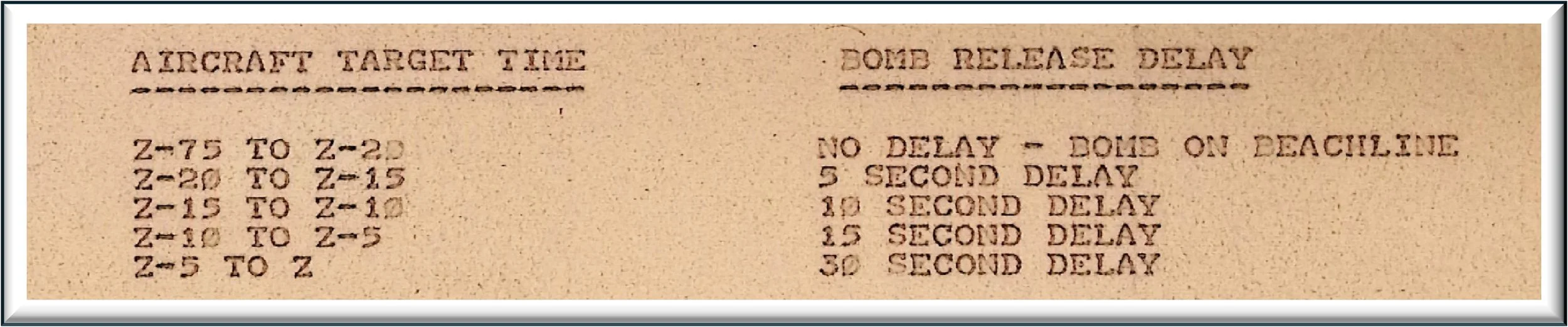
Figure 6. The Bomb-Release Delay Schedule that was part of the Eighth Air Force’s Field Order 727 “B” (Plan B). Given the tendency to bomb early in the bomb window—and before it—this schedule should have had minimal effect in delaying the bomb releases. (Note: Eighth Air Force used ‘Z’ instead of ‘H’ for H-Hour.)
So, was it ever actually issued?
I think not. One thing that is consistent across all the many reports that were filed after the mission is that there is not a single reference to the use of the bomb-release delay schedule. Not a single one. The reports merely mention bombing by PFF. It is possible the Pathfinders incorporated those delays and didn’t bother to mention it; but it is highly unlikely that all of the navigators’ and commanders’ unit reports would omit references to such an important last-minute change to their orders. It simply appears that bomb-release delay schedule had not gone into effect, at least as far as the aircraft of the 2nd Bombardment Division were concerned.
And even had it gone into effect, it was largely irrelevant. Figure 7 is a page from the 2nd Bombardment Division’s Tactical Report of Mission for this strike, listing the times the targets were bombed.[17] Thirty-one of the 45 squadrons dispatched reportedly dropped their bombs before 0610 hours (H-20), meaning no delay should have been used, and their bombs should have been dropped as close to the planned coordinates as the H2X system could manage. Fourteen other squadrons dropped between 0610 and 0615 hours, which should have incurred just a 5 second delay (or 450 yards displacement). Not a single squadron bombed after 0615 hours, meaning no bombers incurred more than the five second delay. From this it would appear that even if Plan “B’s” bomb-release delay had been distributed and obeyed, it had little role in misdirecting the bombing.
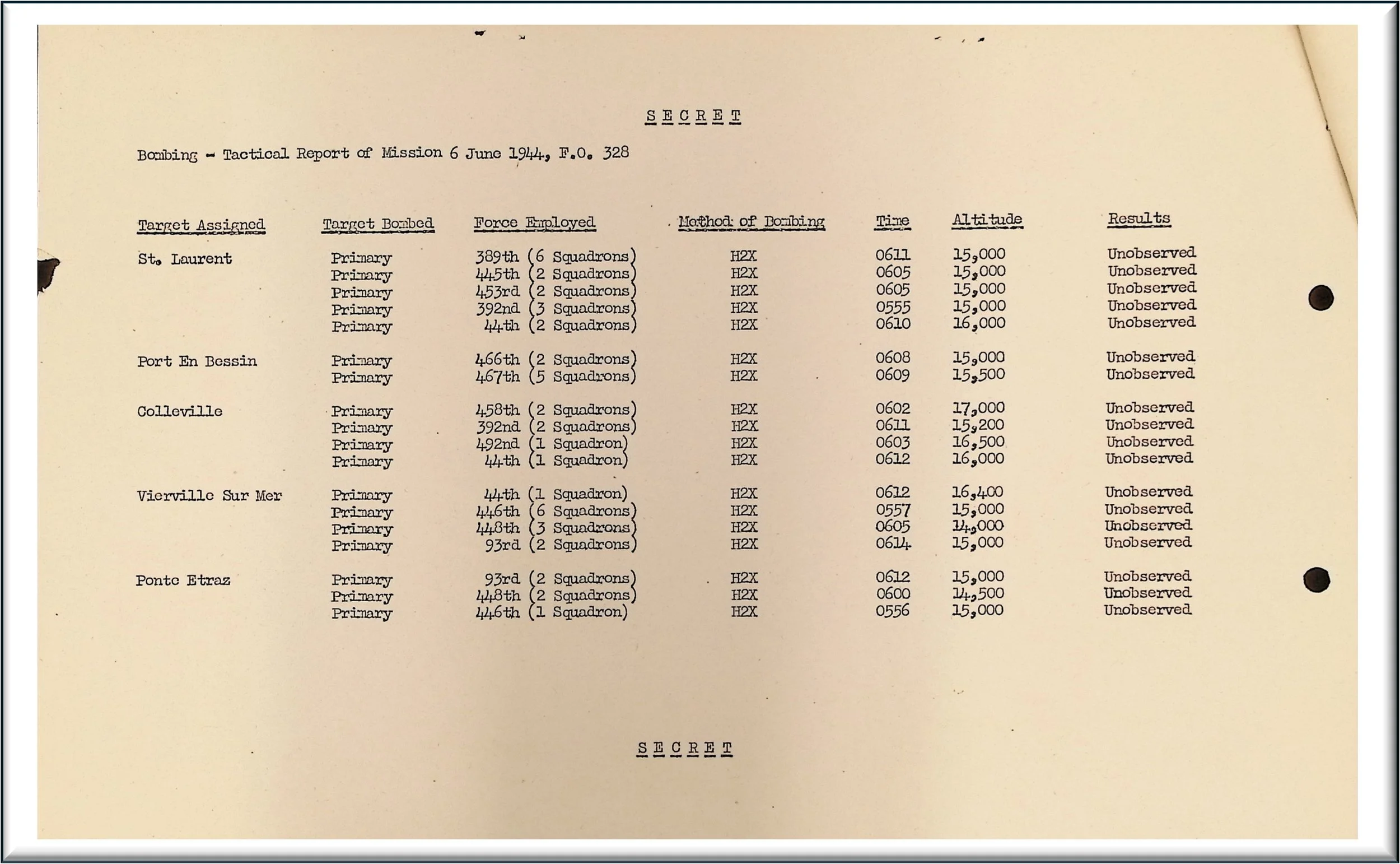
Figure 7. This chart, from the 2nd Bombardment Division’s ‘Tactical Report of Mission, 6 June 1944, F.O. 328’, shows only 45 of the division’s 75 squadron actually attacked, and the times they dropped their bombs.
There are some problems with Figure 7, however. It conveys a deceptive impression of regularity and accuracy, but, as with many higher-level reports, it glossed over the outlier occurrences which defy simplistic summary. Multiple reports stated the last squadron of the 2nd Combat Wing (the 389th Bomb Group) released its bombs at 0626 hours, much later than Figure 7 reflects.[18] Despite this, the general import of the chart remains clear: most of the aircraft that did drop, did so early enough not to delay their bomb releases, and should have hit on or near their targets.
That chart raises other questions as well. It states that five of six squadrons slated for Point de la Percee bombed that target, whereas Brogger led at least six of those to the secondary target. Similarly, the chart shows five squadrons (of the nine scheduled) attacked Port en Bessin, when seven of those nine squadrons should have been diverted to their secondary target for the same reason. As with many of the subordinate unit post-strike reports, the 2nd Bombardment Division’s report did not accurately specify where the bombs were actually delivered.
More importantly, the chart fails to even acknowledge the most glaring issue hidden in plain sight in the data: it accounts for only 45 of the 75 squadrons involved. Those figures indicate 40% of the 2nd Bombardment Division did not release bombs. We’ve already accounted for five squadrons with broken H2X devices, and three more that could not link up with their Pathfinder aircraft, but what of the remaining 22 squadrons?
The Eighth Air Force’s Tactical Operation Report addressed the matter from a different angle.[19] It stated that the 2nd Bombardment Division dispatched 446 B-24s for the mission, with only 329 actually attacking (i.e., dropping bombs). We’ve already noted that this report had a tendency to minimize the bad news, so it is not a surprise that the 40% mission failure rate the 2nd Bombardment Division reported was portrayed as only a 26% mission failure rate by the Eighth Air Force. Despite the absence of enemy flak or fighters, the friction of war still managed to take a 40% (or 26%) bite out of the attacking force. A small percentage of these failures were attributed to maintenance problems (inoperable oxygen or intercom systems), one accident and at least one unknown personnel issue that prevented a bomber taking off. Still, the vast majority of these mission failures had to be attributed to the interrelated issues of assembly problems and bad weather over the targets.
As disappointing as that figure is, it is generally in line with what the planners may have expected. In the first installment of this series, I noted that the 2nd Bombardment Division had recorded an average ineffective sortie rate of 37.5% over the months January through May 1944. So, the 6 June ineffective sortie rate—whatever the actual number may have been—might not seem abnormal. Except, that is, for the fact that none of it could be attributed to enemy actions. That must raise an eyebrow, if not serious questions. Nevertheless, this significant attrition of combat power has been omitted from most histories.
Withdrawal
After leaving the target areas, the bombers continued south for about 7 minutes, unaware they were flying directly over the flak 88mm flak batteries that were, thankfully, rendered impotent by the clouds. Then most of the columns turned west for about another 10 minutes. That carried them beyond the Cherbourg Peninsula and west of German-occupied Guernsey Island, whereupon the squadrons turned north and returned to the UK. The withdrawal was almost completely uneventful. During the entire mission, the only enemy reaction that was noted included light flak near Pointe de la Percee (noted in the Eighth Air Force report but not by any 2nd Bombardment Division reports) and light flak near the Channel Islands. The only loss in the division was a bomber that exploded shortly after takeoff. In addition, two other aircraft were damaged slightly in a mid-air collision, but both completed their missions. This was, of course, McClane’s incident, and the ‘RAF’ bomber that supposedly hit them turned out to be another B-24 from the 2nd Bombardment Division.
As far as enemy opposition was concerned, it was a milk-run mission. Some crews reported being back in bed by 1000 hours. Others volunteered for one of the three additional missions conducted later that day, racking up additional easy mission credits on relatively short flights without enemy interference. Those missions were also largely fruitless due to overcasts.
Bombing Analysis
There was virtually no data produced during the mission that could be used to analyze bombing effectiveness. Bomb groups submitted photographic analysis reports the evening of 6 June, but the cloud cover was so thick that all the film analysis resulted in the same findings: unobserved.[20] Similarly, the bomb groups submitted Bomb Group Plot Reports, but the data and diagrams provided no data as the bomb strikes were not observed due to cloud cover. Unfortunately, details in both the Photographic Analysis and Plot Reports added yet another layer of conflicting data on where the bombs were released. For instance, the 448th Bomb Group (20th Combat Wing) reported that all six of its squadrons bombed St. Lo (another secondary target) even though all of those squadron had been guiding on COL Brogger’s Pathfinder-led squadrons that bombed the Cerisy Forest (7 miles away).
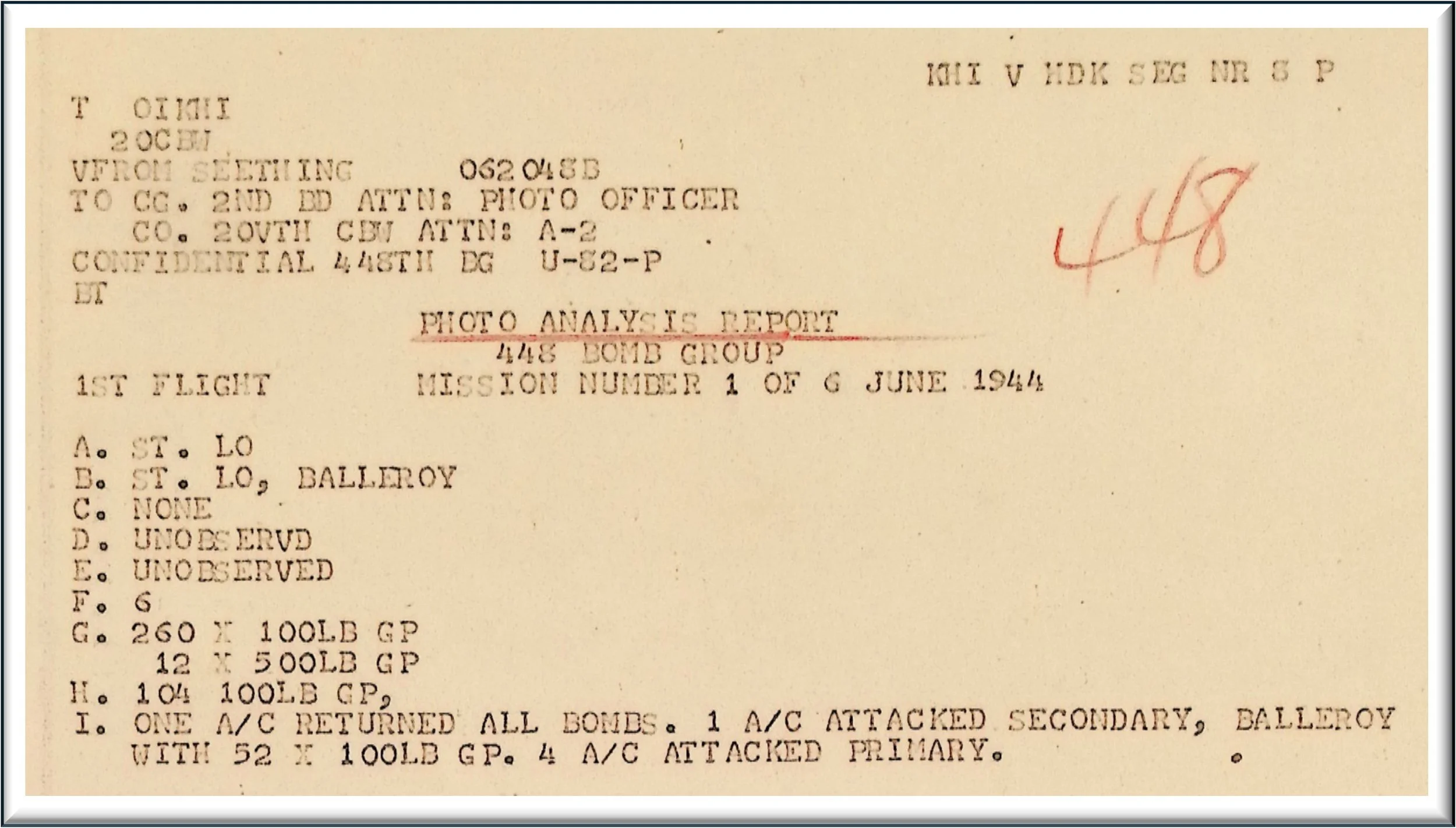
Figure 8. An extract from the 448th Bomb Group’s Photo Analysis Report. Due to the cloud cover, these reports provided no detail on the bomb impacts. Note that it lists St. Lo as the group’s primary target, but St. Lo was originally one of the secondaries. This indicates the group had its original primary target changed to St. Lo as a result of Annex 4 to F.O. 328 (the annex that directed squadrons with 500-pound bombs not to bomb primaries, even though only one of the group’s six squadrons—termed “flights” here—carried 500-pound bombs). Balleroy was another secondary target, adjacent to Cerisy Forest.
Without observed bomb-falls or having post-strike photos (both foiled by the weather), it is impossible to analyze the bomb drops in the normal sense.
Several days after the landings, a USAAF field team arrived to survey the effects of the bombing. They found no evidence of bomb hits on any of the targets at Omaha. The only report of a ‘short’ drop was outside of the Omaha area. If there had been any at Omaha, the tides, storm or beach party bull dozers had eliminated all traces of them by the time the field team arrived. No bomb craters were identified immediately behind the beach, and the field team thought this might have been due to the many naval and field artillery impacts, and other factors. By the time the field team arrived, numerous supply dumps, assembly areas, foxholes and other activities had obscured any craters that might have been present at one time. The most the field team could claim was:
“Since bombs fell in many towns and villages adjacent to the beaches, it seems probable that the enormous weight of bombs that was concentrated in this area also helped demoralize enemy reserves.”[21]
Without identifying which villages were hit or specifying how close to the beaches they meant by ‘adjacent’, there is little here to indicate success, and the reference to demoralizing the reserves is tacit acknowledgement the that the beach defenses were spared. The field team further stated:
“Some idea of the blast effect, noise and confusion resulting from heavy bombing operations can be gathered from the fact that some 1365 bombers dropped more than 40,000 bombs in a short period of time on the morning of D-Day. This was more than 1100 bombs per mile length of beach.”[22]
While those numbers sound impressive, those bombs were not concentrated on each ‘mile length of the beach’, where, not so coincidentally the enemy defenses were concentrated; they were dropped inland, mostly uselessly. And that was the best that the field team could claim at Omaha.
As Figure 7 illustrated, there was an overwhelming tendency to bomb early. Unexpected winds apparently contributed to this tendency. Ten squadrons actually bombed earlier than 0600 hours, and no squadron bombed after 0615 hours (at least according to Figure 7). These figures flew in the face of the orders to bomb “as near the later limit” of the window as possible, and gave the enemy vital minutes to recover from any neutralization effects they may possibly have suffered.
And that calls most of the official air histories into question. For decades the USAAF/USAF have explained that the inland bombing was due to the decision to delay bomb release from 5 to 30 seconds (per Plan “B”). But Figure 7 demolishes those claims. As discussed earlier, 31of 45 squadrons bombed at or prior to H-20 (0610 hours). According to Plan B’s bomb release schedule, there should have been no delay for these squadrons at all and they should have delivered their loads on or near the targets, depending on H2X inaccuracies. The other 14 squadrons supposedly dropped in the timeframe that required only a five second delay, which would have shifted the bomb patterns just 450 yards inland (again allowing for H2X inaccuracies). I previously noted that at least one squadron of the 389th Bomb Group bombed much later than Figure 7 indicates, so there is some error in that table. Nevertheless, the overwhelming tendency was to bomb early. Given that, it is difficult to explain why the bomb patterns were displaced so far inland that none of them landed among the beach defenses and instead reached as much as 3 miles inland (which would represent almost a full minute delay).
Historically, the single most controversial aspect of the air bombardment has been the Plan “B” bomb-release delay schedule. But as we’ve established, the evidence in the records raises great doubt that it was ever ordered to be put in effect, that it was distributed to the aircrews or that it was implemented by any Pathfinder aircraft. While the displacement of the bomb patterns inland appears to correlate with the provisions of the Plan “B”, it is clear there was no causative relationship since the vast majority of squadrons would not have needed to use any delay.
The various post-mission reports seem to support these doubts. I could find no report from a squadron of group indicating they used any delay, even though 14 squadrons should have incorporated a five-second delay based on their arrival times, assuming Plan “B” had been implemented. Nor did a single one mention Plan “B” or using any of the other Plan “B” provisions. Most stated they bombed on PFF (the H2X Pathfinder) and a few stated they bombed on the ‘aimpoint as briefed’. But nothing indicates the 2nd Bombardment Division’s squadrons applied Plan “B’s” bomb-release delays. At the risk of beating this dead horse, there is no evidence—at least that I have found—that indicates any bomb releases were actually executed as dictated in Plan “B”.
I confess this was a surprise. I began this investigation with the working hypothesis that Plan “B” was the order that caused the mission to jump the rails. But there simply is not a causative link.
But that still leaves the fundamental question: if not as a result of Plan “B”, why then were the bombs dropped so far beyond the beach?
A New Mystery
Having seemingly demolished the role of Plan “B” in the displaced bomb drops, I feel obliged to reveal a ‘stunning new explanation’ which has been ‘suppressed for decades’ . . . or some other such exaggerated claim. Unfortunately, I don’t have that kind of answer.
The problem is that virtually the entire 2nd Bombardment Division (at least those not already aborted or diverted to secondary targets) acted in the same manner: bombing too far inland. That’s why historians have found Plan “B” to be such an attractive excuse. It neatly explained a common set of actions across a large group of people. It was the simplest, most obvious reason, and generally those are usually the correct ones. But not in this case. Plan “B” was just not a factor. But if not Plan “B”, is there another factor that could have resulted in nearly uniform actions across the 2nd Bombardment Division?
One that comes to mind might be the inherent inaccuracies in using the H2X navigational radar as a bombing aid, especially when the operators had little actual experience in its use. But if that were the case, the resulting bomb-release errors almost certainly would have caused a similar number of ‘shorts’ as they did ‘longs’. This was especially likely due to the jury-rigged process of feeding the H2X data into the Nordon bombsight. Yet Omaha was notable for the absence of short bomb drops. All the bombs from dozens of squadrons fell long.
Perhaps it can simply be explained by the 2nd Bombardment Division being bad at their jobs? This can be rejected out of hand. Whatever variations in proficiency there may have been throughout the division, it was a seasoned, competent organization, with dedicated and valiant aircrews. And again, incompetent performance would have seen a representative number of short drops, which did not occur.
And that leaves me with just one other possible theory, unspectacular though it may be. I suspect that the constant emphasis in the orders and in the commanders’ personal messages had a common effect on the crews: avoid short drops. True, the need to hit the targets was also stressed, but there was significantly more emphasis on caution. Further the relative consequences of the two options were not comparable. In the final analysis, people will almost always choose the option that will avoid an immediate, direct harm (hitting your own troops) and choose instead the option that may cause subsequent indirect harm (sparing the fortifications which your troops must assault). To use an analogy from everyday life, it is something like the driver who will instinctively swerve out of his lane to avoid hitting a deer, even at the risk of perhaps forcing another driver off the road and into a tree. I suggest this all-too-human response was compounded by the fact they were using the H2X bombing technique, with which they had very little experience, and perhaps just as little confidence. When it came to hitting the bomb-release switch, caution won out.
The bomb survey field team addressed this question and made this observation:
“Crews which bombed previous to H-hour minus 20 minutes, who were not ordered to delay their bombs, were still cautioned not to drop short because of ships off shore and there was a natural tendency to bomb slightly over the target.”[23]
Aside from the excessively loose use of the word ‘slightly’, I would agree with this observation. The many confused and conflicting warnings in the orders induced a collective mindset of caution, one that abandoned ‘tonnage on target’ in favor of safety considerations. The natural result was to err on the side of caution, perhaps even to the point of extreme caution.
That was far from what the ground commanders asked for, wanted or expected. They were willing to accept reasonable risk in exchange for greater damage done to the enemy. In the end, the bombers’ decisions in favor of safety created a far more lethal beach for the men about to step into the surf.
The Still Dangerous Beach
To anyone even slightly interested in the Omaha Landings, it comes as no surprise that the preparatory bombardment of the beach defenses by the heavy bombers was a failure. That has never been one of history’s mysteries. The tragedy is that this failure, along with the naval bombardment’s failure to fire 40% of its allotted bombardment ammunition, resulted in a joint fire plan that significantly failed the assault troops.
It was never expected that these bombardments would totally, or even largely, destroy the fortifications and the men manning them. But they should have had much greater effect, even if effects were limited to neutralization. German defenders on Omaha stated the naval bombardment—truncated as it was—was worse than anything they faced on the Eastern Front. Yet it should have been almost twice the scale. And how much greater the effect had the bombers added their vast tonnage anywhere near the fortifications?
It’s true that both the air and naval force were faced with some daunting challenges. The air was hamstrung by overcast which prevented aimed bombing. And the Navy was hindered by dust and smoke that quickly obscured observation of fire. But both of those factors are endemic to the combat environment and must be taken into account. To its credit, the Eighth Air Force anticipated this problem and tried to overcome it, even though tactical support was not its normal mission and they were neither equipped nor sufficiently trained for it. The Navy, on the other hand, did not anticipate or take measures to mitigate the smoke and dust they kicked up, despite at least one senior officer predicting those conditions.
But the cautionary lesson to be learned from the Omaha bombardment is one of application of firepower. The fog of war tends to turn the spear thrust away from its target, and the friction of war weakens the power of the thrust. And we have ample examples of that at the Omaha landings. Four hundred and forty-eight B-24s were dispatched. A quarter of those did not successfully drop their bombs; 19 squadrons were needlessly diverted to secondary targets; and the remainder missed their targets.
If anything, the Omaha landings underscore one of the great challenges of a commander. Once the bullets begin to fly, most of the conduct of the operation is in the hands of his subordinates, yet it remains the commander’s responsibility to ensure the maximum weight of his firepower is properly applied. And that takes far better Battle Command than was present at and above Omaha.
Moving the Goal Posts
In light of the disappointing result of the D-Day bombing, COL Todd (of the Eighth Air Force Air Operations staff section) faced the knotty problem of how to portray those events. As he was both a key player in the Plan “B” fiasco, and the man charged with writing the report to the Commanding General of the US Army Air Forces, he was in the unique position to filter the facts, or at least recast them in the best light.
But his report also demonstrated a fundamental disconnect between the actual landing plans and Eighth Air Force’s perception of those plans. For instance, he wrote that the air plans were based on the belief that the assault craft would be held 1,000 yards offshore until H-Hour, when in fact the DD tanks should have driven ashore at H-20.
Further, his description of the events of 5/6 June left much unsaid and falsely claimed the bomb delay scheme had been promulgated in conjunction with AEAF. There isn’t a hint about the rushed and uncoordinated release of Plan “B” or the failure to inform any of the key leaders outside the Eighth Air Force. He also claimed the attack formation had been changed to have six squadrons flying abreast of each other for the attacks on individual targets, a point contradicted in both Pan “B” and by post-strike reports.
Todd’s report started the revision of history. As quoted earlier, paragraph 2 of Plan “B” stated the objective of the attack was:
“The Eighth Air Force will attack enemy beach batteries and strongpoints and other coastal objectives designated below by through the overcast bombing technique to cause maximum destruction and neutralization of these objectives in support of assault troops landing in the target area.”[24]
Yet by the time Todd had written his report, the objective of the operation had been distorted to read:
“The basic purpose of heavy bombardment on D-Day, to neutralize enemy fire, was accomplished more through the demoralizing effect of a large concentration of bombs than destroying the actual targets by direct hits, and contributed materially to the success of the landing operations.” [25]
While this was true up to a point, the objective was to demoralize the troops in the beach defenses, not in the rear, and in that respect, they certainly did not contribute materially to the success of the landing operations. The report had merely redefined the mission to what they accidentally did accomplish on D-Day, and proclaimed success for the effort. The Official Story had been born.
The first publication of the events aimed at an external audience was the 1945 Sunday Punch at Normandy - The Tactical Use of Heavy Bombardment in the Normandy Invasion, the second publication in the USAAF’s Wings of War series. It was a publicity piece trumpeting the service’s role in winning the war, and it was largely a condensed and exaggerated version of Todd’s report. It completely passed over the origins of Plan “B”, only obliquely referred to the bomb-release delay instructions, and, of course it claimed stunning success. Although acknowledging the bomb drops ranged from 3-400 yards to as far as 3 miles behind the beach, it nevertheless proudly claimed:
“If the decision to bomb ahead of our troops through overcast was breath-taking in its boldness, the results were epochal . . .”[26]
“Exactly on schedule the first wave of bombers came over, laying its bombs on the shoreline and proceeding inland. The entire force of bombers had to clear the attack point within 5 minutes or run the risk of dropping bombs on friendly forces. Absolutely according to plan the heavy bombers performed their mission, laying their carpet of bombs before the attacking Allies. So effective was their bombing, and with such a minimum of damage to friendly forces was the operations carried out that many lived were saved. Another milestone of modern warfare had been passed.”[27]
The story was then taken up by the US Air Force Historical Study No. 70, Tactical Operations of the Eighth Air Force, 6 June 1944 – 8 May 1945 (referred to hereafter as AAFHS No. 70), prepared by the Historical Division of the Air University at Maxwell AFB. While discussing the alternate plan for bombing through overcast, the study includes this passage:
“Similarly, in conjunction with AEAF headquarters it was decided that if cloud cover should prevent visual synchronization, bomb release for the formation would be delayed after the Pathfinders’ drop signals so that the mean point of impact would be no less than 1,000 yards from the forward wave of the assault force.” [28]
Anyone reading this would have the impression Plan “B” (though that name was not used here) had been developed deliberately, in advance, and approved as a contingency by Eighth Air Force and AEAF, when none of that was true. The AEAF was not a party to the bomb delay decision. That passage omitted the last-minute machinations of the staff to cobble together Plan “B”, the fact that no senior commander had approved that order, and that apparently it had not even been implemented. It also omitted the fact that those delays, if executed would have resulted in a safety margin at least twice that cited. The study then passed very lightly over the next key event in this saga, the actual effects of the bombing. At best, that is a highly misleading passage intended to give the impression that everything had been minutely planned and executed precisely.
By the time the Air Force had published its major history of World War Two,[29] its position on the Omaha bombardment had evolved. The poor performance was excused on the basis that they never wanted to do the mission in the first place—as it was unsuited to their capabilities—and they had been dragged into it against their will. Yet at the same time, they tried to portray the displaced bombing as a key component of victory. In the forward to Volume III (Europe; ARGUMENT to VE Day), it was characterized in these terms:
“The one air operation on D-day that proved unsuccessful was the bombardment of defense positions on OMAHA beach by Eighth Air Force heavies, an attack laid on at the insistence of ground commanders and against the better judgment of AAF leaders.”[30]
Later, in Chapter 7, it provided a more detailed apologia.
“The cost of taking OMAHA made inevitable the keen disappointment of V Corps that the beach had not been softened by air action, and some of the resulting criticism was sharp. But the prior agreement on the necessity for avoiding all risk of short bombing provides an obvious explanation, and it seems fair to insist that the air forces had realized their expectation of contributing heavily to the demoralization of enemy garrisons and to the destruction of their communications. The combined sea and air bombardment, which German prisoners rated as worse than anything they had experienced on the eastern front, appears to have produced both of these results. And if German morale was shattered by the sustained bombardment, to which air made its signal contribution, that of our own troops was heightened. Everywhere, save on the beaches themselves, there was evidence of air's interest in and protection of them. "The moral effect was perhaps of greater value than [the] material results."[31][Emphasis added]
This assertion that there was a prior agreement for avoiding all risk is a blatant distortion of facts, as the ground commanders specifically stated their willingness to accept the risk entailed by a 1,000 yard safety margin. It is a fiction intended to justify their failure.
This passage from the AHS Study No. 70 proves it:
“The Eighth Air Force insisted on a 1,000-yard clear zone, with landings on the beaches to begin five minutes after completion of the bombing. Under these conditions, the air forces informed the Army, as many as 8 per cent of the bombs might fall in the area of the assault boats; the risk was accepted by the Army.”[32]
As for the reference to a combined air and sea bombardment, well, that was the plan, but it was not the reality. As the two bombardments struck no common targets, due to the failure of the air, it is disingenuous to speak of them as a combined action or to claim the air bombardment contributed meaningfully to shattering German morale. Their tenacious defense of the beach mocks such claims. Nor was the morale of the US troops ‘heightened’ when they discovered the bombers had missed their targets; dismayed would have been more accurate. By deceptively linking those two bombardments, the authors attempted to imply the inland bomb strikes somehow affected the beach defenses in the moments immediately before the troops landed. That was not the case.
There is, however, a point to be granted to the Air Force, and an important one at that. This article has focused narrowly on the air strikes planned for Omaha in the early hours of 6 June. As such it has not covered the extremely broad range of other vital missions the AEAF performed in support of Neptune. Some of these included the defeat of the German Air Force, the bombing of railroads, airfields, submarine pens, bridges and road chokepoints, and attacks of radar installations to name just a few. So, in the larger sense of Neptune, the Allied Air Force absolutely did prove essential to the success of the campaign – and it is right that we keep this in mind. All credit to them for these achievements.
But as to the case at hand—Omaha—bombs landing miles behind the beach defenses, 15 to 35 minutes prior to H-Hour, did little to neutralize the defenders in the resistance nests. And there is no hiding that fact.
Conclusions
There are several lessons evident from the failure of the air bombardment at Omaha. At the most general level, it illustrates the frustrating battle every commander wages as he tries to bring the maximum weight of combat power to bear, despite the attritional efforts of the fog of war, the friction of war and especially the human element. Between the 129 bombers that did not drop their bombs and the 19 squadrons that were diverted to secondary targets as a result of confused staff work, roughly half of Doolittle’s Omaha force was lost to the beach neutralization mission.
The other half of his force bombed too far inland, and this appears to have been a result of confusion about the relative priorities of lethality and safety. This failure can be directly laid at the feet of the various commanders, from Doolittle downward. There was no clear commander’s intent to guide the pilots and bombardiers. Instead, they were deluged with conflicting guidance which ultimately resulted in an overly cautious hesitation when it came time to flip the bomb-release switches. But this hesitation was merely the symptom of the larger failure, which was a failure in command – not in the cockpits.
Criticism of the 2nd Bombardment Division’s performance must be tempered by the reality that this was a mission unsuited for the equipment, training and doctrine of the heavy bombers. Despite these obstacles, Doolittle deserves credit for vigorously taking steps to try to make it work anyway. And the fact is, he largely succeeded in adapting his forces for the mission, despite having to simultaneously conduct a heavy tempo of bombings leading up to D-Day which precluded sufficient time to retrain his force.
Recognition of Doolittle’s success in this regard makes it even more tragic that the potential combat value he had produced in his force would be frittered away, lost not to enemy action, but by staff confusion and the inability of Doolittle and his commanders to make their intent sufficiently clear and aggressive.
As for Plan “B”, it holds a bizarre place in history. It began as a well-intentioned act of subversion (or initiative, depending on one’s perspective) by a staff that had gotten cold feet. It was issued at the last moment, but apparently was never put into effect and apparently had no actual influence on the conduct of the bombings. The histories then seized upon it as the rationale/scapegoat for the delayed bomb releases, while simultaneously cloaking it in the virtuous robes of being a necessary safety precaution. And finally, as this article argues, Plan “B” ultimately stands as little more than a curious footnote to history, whose only role was to cause confusion in the two hours before the 2nd Bombardment Division lifted into the skies.
In the next and final installment of this bombardment series, I will analysis some of the parallel and not so parallel lessons of the naval and air bombardments, and highlight how their mutual failures affected the fate of the assault.
If you would like to be notified by email when new installments of these series are posted, you may leave a comment below requesting notification, or contact me directly at cherrickbooks@gmail.com
Footnotes:
[1] Eighth Air Force special report, Tactical Operations in Support of Allied Landings in Normandy, 2 June – 17 June 1944, dtd 6 November 1944. Referred hereafter as Tactical Operations Report. Combined Arms Research Library, Ft. Leavenworth, KS, Call # N4947. [https://cgsc.contentdm.oclc.org/digital/collection/p4013coll8/id/4859/rec/1 ], pg. 237 of .pdf.
[2] McClane, John, Jr., “A Navigator’s View of D-Day”, Military, August 1991.
[3] 448th Bomb Group, Group Air Commander’s Telephone Report to 20th Combat Wing, dtd. 12 June 1944. NARA, RG 18, Box 5057, Entry 7.
[4] 20th Combat Wing, Tactical Missions #1, 6 June 1944, 448th Bomb Group Report, dtd. 12 June 1944. NARA, RG 18, Box 5057, Entry 7.
[5] 20th Combat Wing, Tactical Missions #1, 6 June 1944, 93rd Bomb Group Report, dtd. 12 June 1944. RG 18, Box 5057, Entry 7.
[6] 467th Bomb Group msg U-67-D, subj: Mission No. 1, dtg: 061545June1944. NARA, RG 18, Box 5006, Entry 7
[7] 44th Bomb Group msg U-114-E, subj: Lead Navigators Teletype Report, dtg: 072220June1944. NARA, RG 18, Box 5006, Entry 7.
[8] Op cit: Tactical Operations Report, pp 56-57.
[9]Wings at War Study No. 2: Sunday Punch at Normandy - The Tactical Use of Heavy Bombardment in the Normandy Invasion, HQs, Army Air Forces, 1945, pg. 16. Also, Tactical Operations Report, pp. 7-8 (or 10-11 in .pdf).
[10] 2nd Bombardment Division, Tactical Report of Mission, 6 June 1944 - F.O. 328, dtd 3 July 1944, para 4. NARA, RG18, Box 5743, Entry 7.
[11] 96th Combat Wing message U-41-E, subj: Field Order 81, dtg: 052012June1944, para 3.A. NARA, RG18, Box 4971, Entry 7.
[12] 20th Combat Wing message U-31-E, subj: Field Order 127, dtg: 052000June1944, para 3.B. NARA, RG18, Box 4971, Entry 7.
[13] Eighth Air Force message D-60/787, subj: Field Order No. 727 “B” (Plan B), dtg: 060020June1944, para X.(8). NARA, RG18, Box 4971, Entry 7.
[14] Note: There has been of confusion over the formations as the term ‘abreast’ was frequently used. Within a single 18-ship formation, the squadrons flew in trail. However, several bomb groups reported they flew abreast in their reports, but that was in response to a line in the report format which asked where they flew within the combat wing’s formation, and since the four bomb groups were striking multiple targets simultaneously, these groups were effectively positioned in abreast of each other in the wing’s formation.
[15] The following combat wing flash reports are located in NARA, RG 18, Box 4971, Entry 7: 2nd Combat Wing Flash Report, dtg: 061055June1944; 14th Combat Wing Flash Report, dtg: 060950June1944; 96th Combat Wing Flash Report, dtg: 060915June1944; and 20th Combat Wing Flash Report, dtg: 061030June1944.
[16] 446th Bomb Group, Group Commander’s Telephone Report, Tactical Mission No. 1, 6 June 1944, dtd: 12 June 1944. NARA RG 18, Box 5057, Entry 7.
[17] Op. cit. 2nd BD, Tactical Report of Mission, 6 June 1944 - F.O. 328.
[18] Op. cit: 2nd CW Flash report. Also, the Combat Diary of Lt Walter E. Rosson, navigator in the 389th Bomb Group (2nd Combat Wing). Rossen placed bombs away at 0627 hours. Second Air Division Digital Archive, (https://digitalarchive.2ndair.org.uk/digitalarchive/ImageBrowser?catNum=mc_376-081-1#mc_376-81-1x001), pg. 11.
[19] Op. cit. 8AF Tactical Operations Report, pg. 57 of .pdf.
[20] See for example 448th Bomb Group message U-82-P, subj: Photo Analysis Report, dtg 062045June1944, and 446th Bomb Group message U-92-D, subj: Photographic Photo Analysis, dtg 062125June1944. Both in NARA RG 18, Box 5057, Entry 7.
[21] Op. cit. 8AF Tactical Operations Report, pg. 268 of .pdf.
[22] Ibid. Pg 267
[23] Ibid. Pg 266.
[24] Op. cit. Field Order No. 727 “B” (Plan B), pg. 8.
[25] Op. cit. 8AF Tactical Operations Report, pg. 268 of .pdf.
[26] Op. cit. Sunday Punch, pp. 25-6
[27] Loc. cit.
[28] Op. cit. AAFHS No. 70, pg. 18.
[29] Craven, W. and Cate, J., ed. The Army Air Forces in World War II, Vol III, Europe; ARGUMENT to VE Day, January 1944 to May 1945. Office of Air Force History, Washington, DC, 1983
[30] Ibid. Pg. xviii.
[31] Ibid. Pg. 191-192.
[32] Op. cit. AAFHS No. 70, pg. 17.