Omaha Air Bombardment - Part II: Plans, Orders and Preparation
A Short Note on Sources and Perspectives
The story of the air bombardment of the beach defenses came down to us through at least three USAAF or USAF official sources.[1] From those three documents, scores of academic and popular histories have drawn material for their own retellings or interpretations of events. But the key details contained in most of these histories trace back to a single report produced by the Eighth Air Force in November 1944. It was titled US Air Force Historical Study No. 70: Eighth Air Force Tactical Operations in Support of Allied Landings in Normandy, 2nd June to 17th June 1944, (hereafter referred to as ‘AFHS70’) and took 417 pages to document those 16 days. The author was Colonel Walter Todd, who served as the deputy to the Assistant Chief of Staff for Air Operations for the Eighth Air Force. He was one of the key figures in the planning and decisions that led up to the events of early morning on 6 June over Omaha. As such, that part of his report effectively stands as a first person account. His text has been extensively copied, often exaggerated, sometimes wrongly interpreted and frequently altered in the retelling over the years, but the original report is a valuable historical document. The question is, how much of that account leading up to the 6 June bombardment of the beach defenses was a dispassionate statement of facts? How much was organizational spin? And how much was an apologia? Using that document as a baseline, we’ll compare its passages to other planning documents, orders and operational reports to hopefully separate the grain from the chaff.
Safety or Lethality?
We closed out the last installment with the Eighth Air Force trying to come to grips with the potential problem of ‘short’ bomb releases which might result in bombs landing among the assault craft or producing craters on the beach. This stemmed from a difference in priorities between the ground and air commanders: the ground commanders wanted as little time as possible between the end of the bombing and the troops stepping ashore, while the air commanders wanted to ensure an adequate safety distance between bombs and assault craft. After witnessing the beach bombing during Exercise Tiger with key ground and air commanders, General Dwight Eisenhower, the Supreme Allied Commander, decided that a 1000-yards safety zone was an acceptable compromise. The airmen warned that even then, as many as 8% of the bombs might fall among the assault craft. The ground commanders accepted that risk.[2] Note that even at this early stage, before adverse weather planning had begun seriously, the Eighth Air Force intended to use a bombing run perpendicular to the beach.
To achieve this physical safety margin, the air planners imposed a time separation, with the aircraft halting bomb releases at H-5 minutes (0625 hours). The first craft scheduled to hit the beach would be the LCTs carrying in wading tanks at H-Hour. Their speed running into the beach would be 6 knots, meaning they would theoretically be 1013 yards off the beach when the bombing stopped at H-5. Good. Half of the 60 assault craft carrying the first infantry troops (H+01) were British LC(A)s, and they should beach 6 minutes after the bombs stopped. Their speed for the run into the beach was 6 knots, so these craft would theoretically be 1215 yards off the beach at the bomb cutoff time. Better. The other 30 assault craft were US LCVPs, and with their speed being 8 knots, they would be 1620 yards off the beach. Even better. The five minute delay between bomb cutoff and first troops ashore should indeed provide the 1,000-yard safety distance.
While the five-minute cutoff appeared to serve Eisenhower’s 1000-yard decision, one important point seems to have been overlooked. The DD tanks were planned to beach at H-10 minutes, which meant bombs could continue to fall for another five minutes after the DD tanks swam ashore. Was this overlap understood by both air and ground commanders? Was this a conscious decision to risk the 64 DD tanks, relying on the assumption that only a few bombs would fall short and the armor of the tanks would minimize harm? Or was this a fundamental misunderstanding by the air planners of the landing schedule? At this distance, it is impossible to say. Whatever the answer, bombs intended to neutralize defenders in concrete shelters were just as likely to neutralize crewmen in tanks during the first moments after coming ashore. None of the planning documents addressed this matter.
At some point later in the planning process, this time separation was supposedly increased, revising the bomb release cutoff to H-10 minutes (0620 hours). Again, the circumstances of this decision are unclear, with it sometimes being tied to bad weather conditions, and sometimes stated merely as an additional precaution regardless of weather. The AFHS70 stated that the bombing cutoff time had “already been changed to H-10 minutes” if weather obscured the targets, but does not specify who made that decision, when it was decided, or how it was disseminated.[3] The USAF reprint of Sunday Punch in Normandy: The Tactical Use of Heavy Bombardment in the Normandy Invasion states that the H-10 decision was part of alternate plans that had been developed for bombing through overcast.[4]
If it had been implemented, the H-10 cutoff time effectively would impose a 2,000-yard safety zone for the lead LCTs (and much farther for the smaller assault craft). It was, perhaps, a perfectly reasonable adjustment considering the challenges inherent to bombing through overcast. And yet it was not a separation at all as far as the DD tanks were concerned, as an H-10 cutoff coincided with their planned beaching time.
The problem with both the five-minute and ten-minute cutoff times is that the actual orders were a bit ‘squishy’ on the matter. The Eighth Air Force Field Order 727 did establish an H-5 cutoff in the Omaha area.[5] Mirroring this, the 2nd Bombardment Division’s Field Order No. 328, issued less than 15 hours before the attack, specified the bombing window at Omaha as H-30 to H-5 (except the two targets at Port-en-Bessin, which had a window of H-20 to H-5). This seemed to indicate the five-minute cutoff time remained in effect. So far, so good.
Except . . . that same paragraph concluded with:
“Absolute deadline for any bombing on primaries is Zero minus 2. Flights arriving after Zero minus 2 will bomb secondary [target] or last resort [target].”[6]
A two-minute cutoff would reduce the safety margin to about 400 yards for the first wave of landing craft, while exposing the DD tanks ashore to as much as eight minutes of aerial bombardment. Did anyone recognize this problem at the time? If they did, there is no record of it.
The AFHS70 study claimed that two separate plans had been prepared for the landings, one for visible bombing conditions and one for bomb-through-overcast conditions. However, the H-10 cutoff that was so often bandied about in the histories seems never to have been incorporated into any of the plans whatsoever.
In a similar vein, the standard histories imply that another safety measure - the decision to change fuzes for select bombs - was a pre-approved contingency and part of the bomb-through-overcast plan. Even the 8AF Tactical Operations report stated:
“The probability that bomb-through-overcast methods would be used led to the further decision to fuze all bombs except a small percentage of the 100-pounders with instantaneous fuzes in the nose and no tail fuzes. This decision was taken to avoid possible cratering of beaches on which landings were to be made, cognizance being taken of the limitations of accuracy of Pathfinder bombing methods as compared with visual sightings.” [7]
That phrasing sounds as if the fuze change was a decision that had been made deliberately at some point earlier in the planning process, as the probability of needing to use bomb-through-overcast techniques had been fully recognized for a number of weeks before D-Day. Indeed, when the D-Day mission orders were issued on the afternoon of 5 June, the weather forecasts predicted unfavorable weather, which would lead one to believe the version of the orders that were issued would be those for the bomb-through-overcast contingency. But that wasn’t necessarily true. The Eighth Air Force Field Order 727 did not explicitly state it was only for visible bombing conditions, but neither did it give any instructions for overcast conditions. By comparison, the 2nd Bombardment Division’s Field Order did explicitly state that bombing would be done visually, but also gave some limited instructions for bombing-through-overcast if conditions dictated. Neither of those two orders included either the H-10 cutoff time or the change to the 500-pound bomb fuzing.
That raises the question: if these two points—the 10-minute bomb cutoff and the bomb fuze change—were key elements of a pre-approved contingency plan for adverse weather, why hadn’t that contingency plan been issued when those adverse conditions were expected?
The answer to that seems to be that there was no ready-for-issue adverse weather plan on the shelf. One of the best indications for that is the story of how the fuze-change instructions came about. At 2204 hours on 5 June—even as crew briefings were getting underway—2nd Bombardment Division issued Annex No. 4 to its Field Order No. 328. Although titled an annex, it was in fact a change to the base order. The sole content of this change was to add this paragraph:
“Add: 3.C.(14) Flights carrying 500 lb bombs will not drop on primary targets if targets are obscured, but will bomb secondary.” [8]
Note that this change originated at the lower headquarters, not at Eighth Air Force. So it was the lower headquarters that recognized a potential problem with the fuzes in light of obvious adverse weather conditions expected in the morning. If there actually had been a contingency Plan “B” sitting on the shelf at Eighth Air Force, the 2nd Bombardment Division would have been briefed on it and would not have had to act on its own to address the problem. That point becomes clearer with what happened next. More than two hours later, at 20 minutes past midnight on 6 June, Eighth Air Force issued a document titled Field Order 727, Plan “B”, which provided modified instructions for bombing-through-overcast. For the 2nd Bombardment Division, it directed:
“All aircraft loaded with 500 lb. or 1,000 lb. bombs will be fuzed instantaneous nose fuze.” [sic][9]
Coming as late as it did—virtually too late to be implemented—it seems highly unlikely Plan “B” was a prepared, pre-approved contingency. The fact that its solution to the fuzing problem conflicted with the 2nd Bombardment Division’s solution further indicates there was no pre-existing Plan “B”, otherwise the the 2nd Bombardment Division’s would have anticipate the correct response. Instead, the confused sequence would have resulted in the bombers, which had already been diverted to secondary targets, now having their bombs re-fuzed, to solve an issue that was no longer an issue.
One thing that the Plan “B” message did not directly address was the matter of the 10 minute cutoff, an issue that supposedly was also a pre-approved contingency for bomb-through-overcast conditions. Instead, Plan “B” included an entirely different method of ensuring an enlarged bad weather safety zone. That provision, and more on Plan “B”, will be examined later in this article.
Although issued with a subject line—Plan “B”—that implied this message was a separate order prepared earlier for the weather contingency, this was clearly misleading. The only points it addressed were items that had been omitted from the base order, and changes to correct errors in that order. Most telling is the fact that it was not issued until after the aircrews had already been briefed. The base order was issued at 1350 hours on 5 June, at which time the weather forecasts indicated bomb-though-overcast would be necessary. So, if the Eighth Air Force planners had a Plan “B” weather contingency prepared, why did they wait 10 hours and 30 minutes to issue it? The 2nd Bombardment Division’s first aircraft were expected to take off at 0220 hours, but lead aircraft were actually in the air by 0150 hours. So Plan “B”’s changes came just an hour and a half before the first takeoff, resulting in too little time to disseminate the changes through three echelons of command, across multiple dispersed airfields and make the fuze changes. Coming as late as it did, Plan “B” only served to sow confusion. In the previous ten hours, Eighth Air Force had already issued three other messages containing new ‘annexes’ (changes), but hadn’t gotten around to sending out a prepared, pre-approved contingency plan for the very conditions that had been anticipated for days? That logic fails.
But the confusion regarding Plan “B” was actually worse than the foregoing would seem to indicate. When that order was issued at 0020 hours 6 June, is was issued only as a warning order. [ Figure 1] The decision to go with visual bombing procedures, or go with Plan B was not schedule to be made until 0100 hours 6 June, that is, 40 minutes after Plan “B” had been sent over the teletype. So preparations for executing necessary Plan “B” measures, if required, would be on hold for another forty critical minutes.
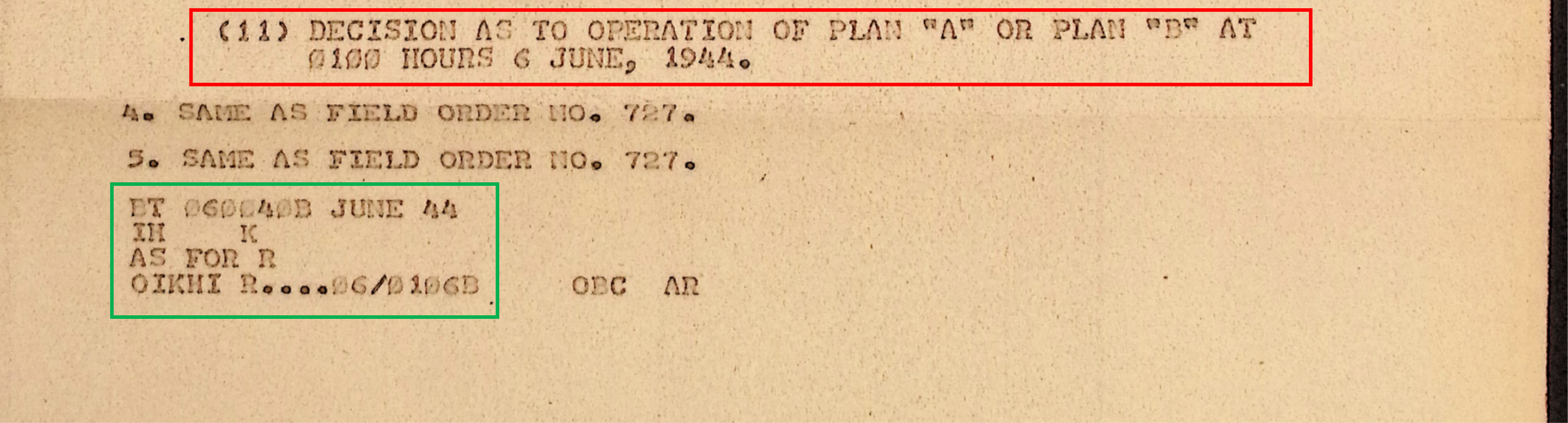
Figure 1. Drawn from the 2nd Bombardment Group’s files at NARA, this is an extract of the Eighth Air Force message D-60,763, sent at 0020 hours on 6 June. The red box highlights the instructions that the decision on implementing Plan “B” would not be made until 0100 hours. The green highlight shows that at 0040 hours, the Eighth Air Force teletype operator asked for confirmation of receipt of the messages (“AS for R”), and that the 2 Bombardment Division did not acknowledge it (“OIKHI R”) until 0106 hours on 6 June. (NARA, RG 18, Box 4971)
In the message footer, we see that 20 minutes later, at 0040 hours on 6 June, the Eighth Air Force teletype operator asked for acknowledgement of receipt of the message (“AS for R”). The 2nd Bombardment Division (message address “OIKHI”) did not acknowledge receipt (“R”) until 0106 hours, 6 June. This less that 45 minutes before the first aircraft would take off.
That last minute series of delayed communications was finally capped off by the apparent failure of Eighth Air Force to make the scheduled decision between the visual and bomb-through-overcast options. The files of the Eighth Air Force contain no records they made that decision or sent a message to that effect. Nor do the files of the 2nd Bombardment Division record receipt of such a decision. Perhaps the decision was transmitted by telephone, or perhaps that message has simple been lost in all the files. But the fact that there is no secondary reference to such a decision in any of the operational reports submitted on 6 June and the days following would argue otherwise.
Further, there is no record of the 2nd Bombardment Division retransmitting Plan “B” to its subordinate combat wings, and the Eighth Air Force’s message ‘header’ section did not list any message group address that would send the Plan “B” order directly to combat wings or bomb groups. So it seems clear the Plan “B” was not put into effect at any level within the 2nd Bombardment Division. Although we will continue to discuss the potential effects of Plan “B”—for the simple reason that it stands at the core of the air bombardment lore—it appears that plan is very much a red herring and had no role in the failure of the beach bombardment mission.
Bomb Lines and Aimpoints
In the lead-up to D-Day, GEN Doolittle (Commander, US Eighth Air Force) was determined to make the beach defense bombings work, despite the problems of using heavy bombers in the tactical role. Based on a limited number of actual attacks using H2X, he assured the Allied Expeditionary Air Force (AEAF) leaders that, under bomb-through-overcast conditions, his bombers could be accurate within an average range error of 400 yards. Taking deflection errors into account, too, the combined factors would achieve about a one-half mile accuracy.
Nevertheless, he established another safety measure, although in this case it addressed possible cratering of the landing beaches rather than potential destruction of approaching landing craft. The fear was that craters on the beach would become invisible water-filled holes that would trap men and vehicles, and that craters inland of the high-water line would choke the exits. (Ironically, many of the assaulting troops were briefed to expect to find craters which would provide cover as they made their way up the beach.)
Doolittle’s partial solution was to establish a bomb line, with the purpose of preventing bombs landing seaward of this line.[10] In theory this was a perfectly good idea, though it did not address cratering near the exits. It could not totally preclude gross aiming errors that resulted in short drops, but it gave targeting officers a solid point of reference when planning. Taking into account the normal bomb pattern, targeting officers could adjust their aimpoints so that the probable dispersion pattern on the ‘short’ end would fall on the correct side of the bomb line.
It was a sound idea, but in this case, not very practical. The bomb line he established followed the high tide line, which placed it impossibly close to the targets. Figure 2 shows the targets as specified in the Eighth Air Force Field Order 727. Plan “B” did not revise any of these. The red crosshair symbols reflect the specified target grid coordinates and the red circle represents the 1,000-foot radius within which the bombs ideally should land. The purple circle depicts the 2,000-foot radius. As you recall from the previous installment, the 2nd Bombardment Division had claimed it had put 34% of its bombs within the 1,000-foot circle in the month of May 1944. Even if we accept this number as accurate, that would still place 66% of the bombs in the outer ring . . . or beyond.
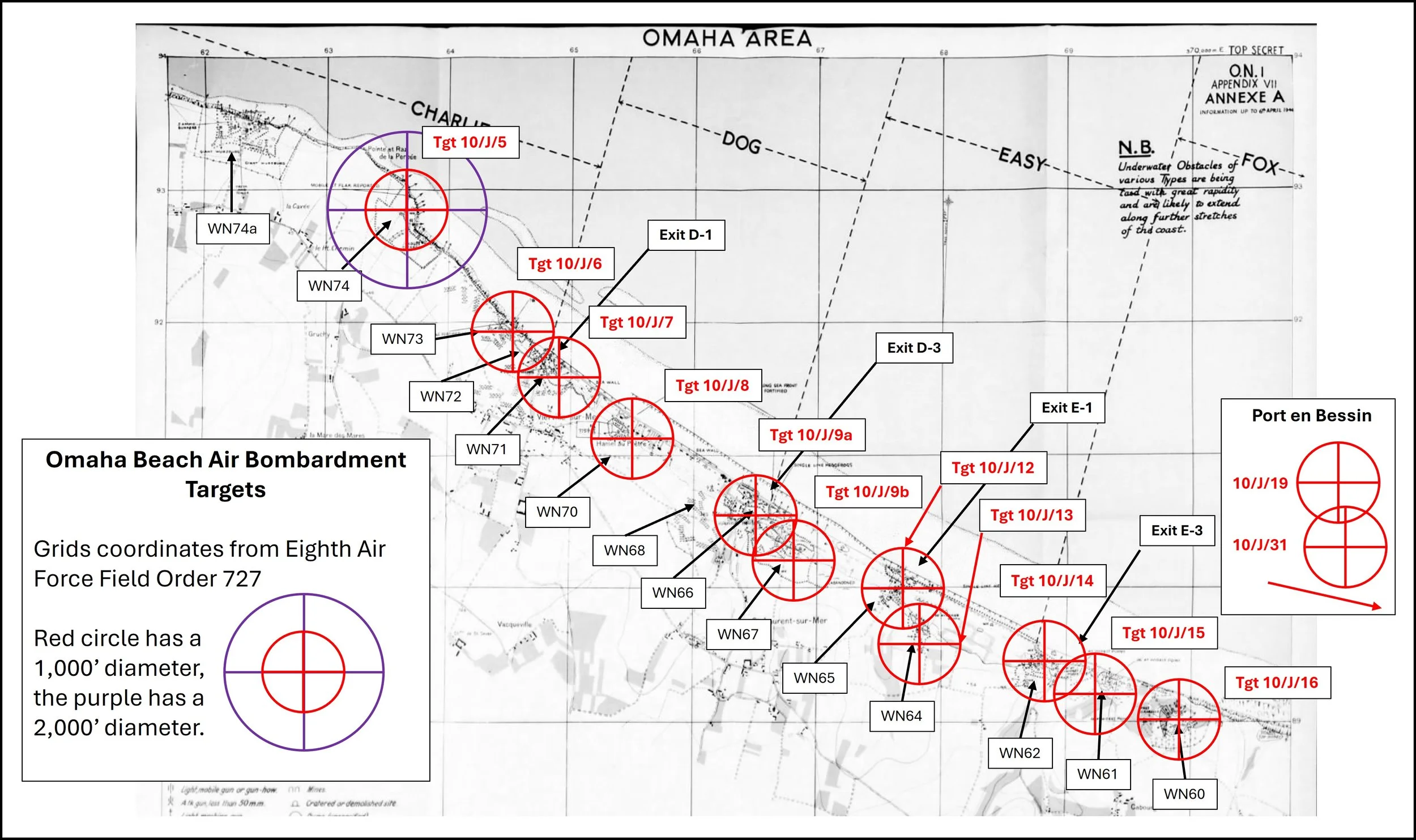
Figure 2. The Eighth Air Force targets in the Omaha Assault Area. These targets are placed using the target grid coordinates contained in the Eighth’s Field Order 727, and differ somewhat from the V Corps and TF-124 target lists. Note that gray shaded area representing the ocean reflects the low tide state. The actual high-water line falls within the 1000-foot radius circle for every target except 10/J/9b and 10/J/13.
The bombers may have been improving their accuracy to that level in May, but in the months prior to that, the figures were not comforting. (Figure 3) For the period starting in November 1943 to March 1944, the various bombardment groups could place only 20 to 63% of their bombs within 2000 feet of the aimpoint. That’s a very wide range and nearly impossible to use as a planning factor.
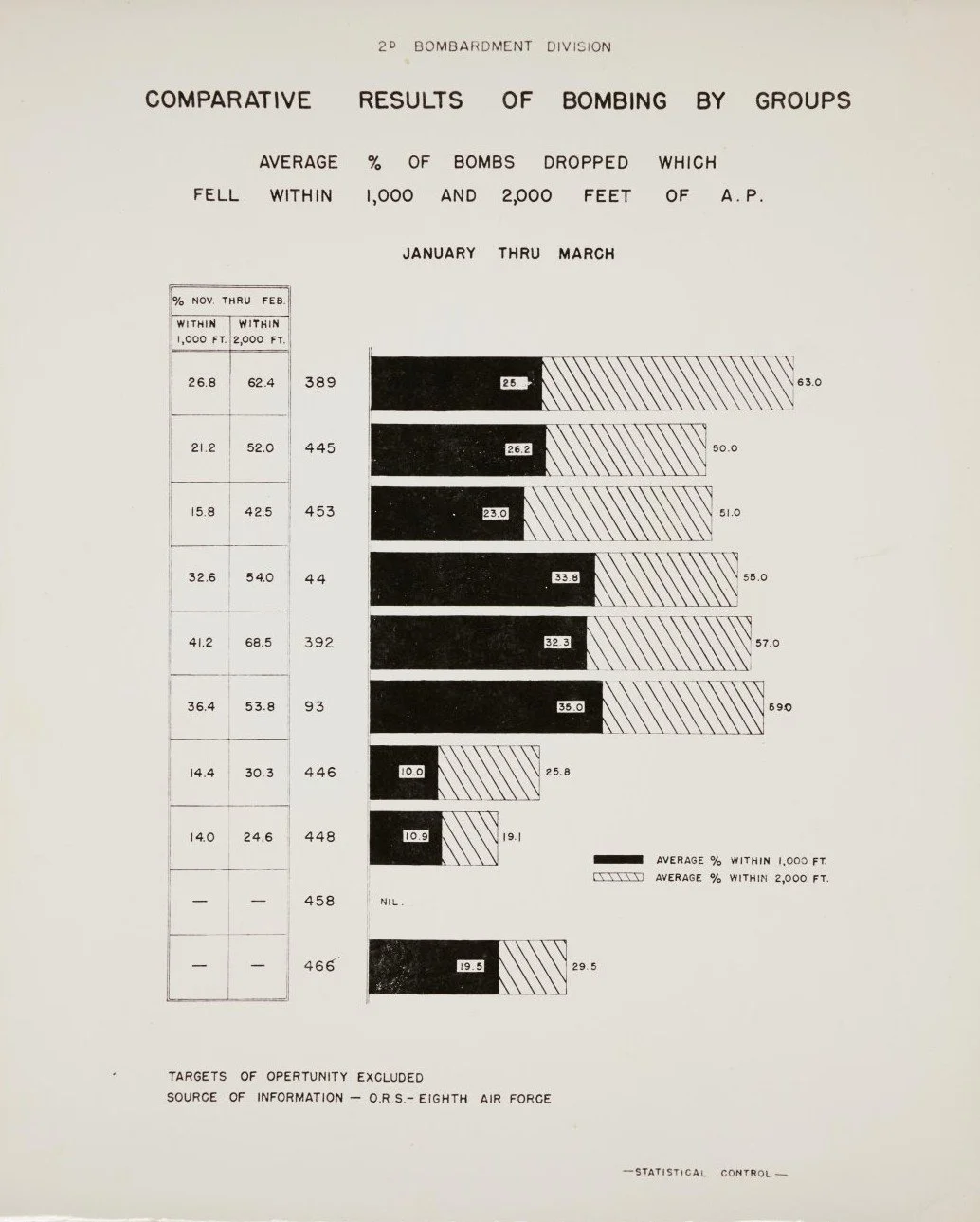
Figure 3. This chart from the 2nd Bombardment Division’s Statistical Summary shows the bombing accuracy figures for the groups under its commands. Data is presented for the period November 1943 through February 1944 (left) and January through March (right). Even the best groups saw roughly 40% of their bombs outside the 2,000-foot circle. While GEN Doolittle, the Eighth Air Force commander, was confident in the skill of his fliers to hit the beach defense targets, the data was not as convincing.
The example of the purple 2,000-foot radius ring in Figure 2 extends completely across the beach and into the boat lanes , even at low tide. Based on the data in Figure 3, roughly half the bombs would extend beyond 2,000 feet of the aimpoint, many of them on the ‘short’ end of the pattern, infringing into the safety zone. This was the 8% risk factor the air commanders predicted and the ground commanders accepted. While that risk to the landing craft was deemed acceptable, Doolittle’s insistence on no bombs landing on the beach should have had significant repercussions. Given the accuracy of the 2nd Bombardment Division, it would be physically impossible to effectively hit the targets without also bombing the beach.
As a result of this, one would expect the air planners on Doolittle’s staff to adjust the target coordinates farther south, or expect the subordinate commands to adjust the aimpoints farther south. But they did not do this. The Eighth Air Force did not alter the coordinates, and the subordinate units left no record of separate aimpoints, suggesting they planned to drop on the original target coordinates. Despite leaving the target coordinates unchanged, the bombing instructions contained in Field Order 727 still stated:
“No bombs will be dropped north of the bomb lines laid down in special overlay dated 2 June, 1944.”[11]
So, it is clear this was a control measure Doolittle intended to go to war with. But it was also one that was impossible for the bombers to comply with, not if they hoped to place most of their bombs on the targets. Doolittle was both aggressive and driven by a can-do attitude, but not to such an extent that he could have been blinded to the obvious contradictions the bomb line created. Since there was no effort to change the target coordinates, I suspect Doolittle’s bomb line was not intended to be an inviolate graphic control measure, rather as it was a symbolic tool he used to stress the importance of accuracy and safety to his aircrews. He had great faith in his crews; they just needed the right motivation to reach the standards he felt they were capable of.
Commander’s Intent
The preceding discussion paints a clear picture of the concern the Eighth Air Force had regarding short bomb drops. The time cutoff, the bomb release delays (discussed below) and the bomb lines all contributed to the pressure to drop farther and farther from the beach defenses. Yet there was some command pressure that attempted to strike a balance between safety and lethality.
As discussed above, the bomb windows for Omaha were either 25 or 15 minutes long. The emphasis on avoiding fratricide, however, led to the potential problem that the bombers would try to arrive as early in those windows as possible, thereby increasing the safety distance even farther. Although well-intentioned, it would also give the defenders more time to recover from the effects of the bombing. To counter this, the following guidance was contained in the General Instructions section of the Eighth Air Force Field Order 727:
“It is desirable that all targets be attacked as near the latter limit of the indicated time bracket as possible, still ensuring that bombing is complete within the time limits.”[12]
This was balanced—or undercut, depending on how you interpret the text—in the next paragraph which admonished crews not to drop bombs north of the bomb lines.
The 2nd Bombardment Division’s Field Order 328, issued 95 minutes later, stressed only the safety concern, and failed to place any emphasis on hitting the targets:
“Greatest possible care will be taken to prevent accidental releases and to ensure that all bombing range errors are overages, due to the danger of shortages causing loss of Allied lives and damage to landing points. Troops will be 400 yds to one mile offshore during attack. At Zero Hour troops and materiel will be moved ashore.”[13]
When Field Order 727 was issued, it served as an alert order as it did not specify the time of H-Hour. The actual execution order that specifie H-Hour was issued in the form of Annex 1 to Field Order 727, and it did not hit the teletype until 1850 hours, five hours after the base order. Paragraph 3.X. of the annex also stressed only the safety concerns, and not the required effects on target.
“In the briefing of crews stress will be made that short bombs are likely to fall on landing craft of friendly troops. Emphasis will be made on the position of surface boats and that such necessary precautions be taken in bombing runs to insure that forces afloat will not be subjected to bombing. If necessary the releasing of bombs will be delayed the minimum length of time to insure that surface forces will not be subjected to excessive losses.”[14]
Then at 2150 hours, 2nd Bombardment Group issued a message containing an address from the division commander.
“Read at briefing after General Doolittle’s message.
“I know that all of you realize the importance of this great undertaking. Success means acceleration of the march to victory. Failure means a long bitter and costly struggle that may last for years. Great emphasis has been placed upon the disastrous consequences to our troops of premature releases. Every one of you must be conscious of and guard against this danger to the boats below. At the same time our bombing must be highly effective if our own troops are to be spared the rakeing [sic] fire of strongpoints along and near the beach. So I remind you to be careful of the boats. But I emphasize that our bombs must be placed on the assigned targets. With all the skill of the veterans that you are. Good luck. I know I can depend on you. – Hodges” [15]
If this series of instructions confuses you, image how the aircrews felt. While it illustrates that both commands made some attempts to strike a balance in their guidance, I think it is fair to say that the preponderance of emphasis was on the side of safety. The average crew listening to these mixed messages might very well conclude they were in a ‘damned if you do, and damned if you don’t’ situation. And in that bind, I suspect most would choose to avoid directly risking the troops through the possibility of shorts drops, and instead choose the possible indirect risks resulting from long drops that did not hit the defenses.
Angles of Attack
Underlying these discussions is the matter of the bombers’ approach to the beach. If the concern over short bomb releases was based on the range dispersion along the flight path, why would you choose an approach that flew over the boat lanes, thereby putting the assault craft directly in the line of the inevitable range dispersion? Why not fly along the coast, passing down the line of targets? That approach would see any short or long releases merely hitting another target along the shoreline.
The Eighth Air Force presented three reasons for this decision.[16]
The most commonly cited reason rested on the ‘bomb-through-overcast’ scenario. Most of the discussion in the preceding installment and all of the data from the USSAF Accuracy study[17] were based on conditions permitting visual bombing. But weather conditions varied greatly throughout the year, with visual bombing possible in only 20% of the missions over Europe during some months. As D-Day neared, the specter of late Spring storms could not be ignored, and Doolittle had to consider how best to conduct this mission with the equipment he had at hand. Fortunately, the Eighth had considerable experience with non-visual navigation; the question was, how much of it would be useful for tactical targeting?
The Air Force had a couple systems for blind navigation, which could get the bombers to the vicinity of the target. It did not have any systems that enabled the bombardiers to see through the clouds for accurate aimpoint identification. And that could be a problem as clear identification of aimpoints would be essential for tactical bombing in conjunction with approaching assault waves. So, the challenge facing the Eighth Air Force was to somehow use the navigational systems to enable aimpoint identification. After some study of the matter, they selected the new H2X navigational radar system as the best bomb-release aid for the missions, having decided the Gee-H system had too large of a range error, though it would be used on the mission to minimize the deflection error in navigation.
Being a navigational radar, the H2X by itself was not particularly useful for determining when to release the bombs. At that time, the H2X had not been directly, electronically linked to the Norden bombsight, as it eventually would be. An ad hoc solution was developed that required the H2X radar and the Norden bombsight to be manually co-aligned before flight. Then, as the aircraft flew over selected checkpoints, the navigator (operating the H2X) had to pass corrections to the bombardier, who applied that data to the Norden bombsight and reset it. Hopefully, this series of data corrections would result in the H2X radar and Norden bombsight being correctly aligned during the bombing run. The H2X radar’s ranging data permitted the bombsight to create a faux aimpoint angle which determined bomb release. It was a workaround which depended on an imprecise radar and manual data transfer, and was made all the less reliable as the H2X operators were newly trained and had little experience. The first training on the H2X was in March 1944. Having selected H2X, enough planes were equipped with the device and enough crews trained on it such that one H2X-equipped pathfinder aircraft would lead each formation of 18 aircraft (three squadrons). Aircraft that could not link up with a pathfinder were ordered to fly on and bomb the secondary targets farther inland.
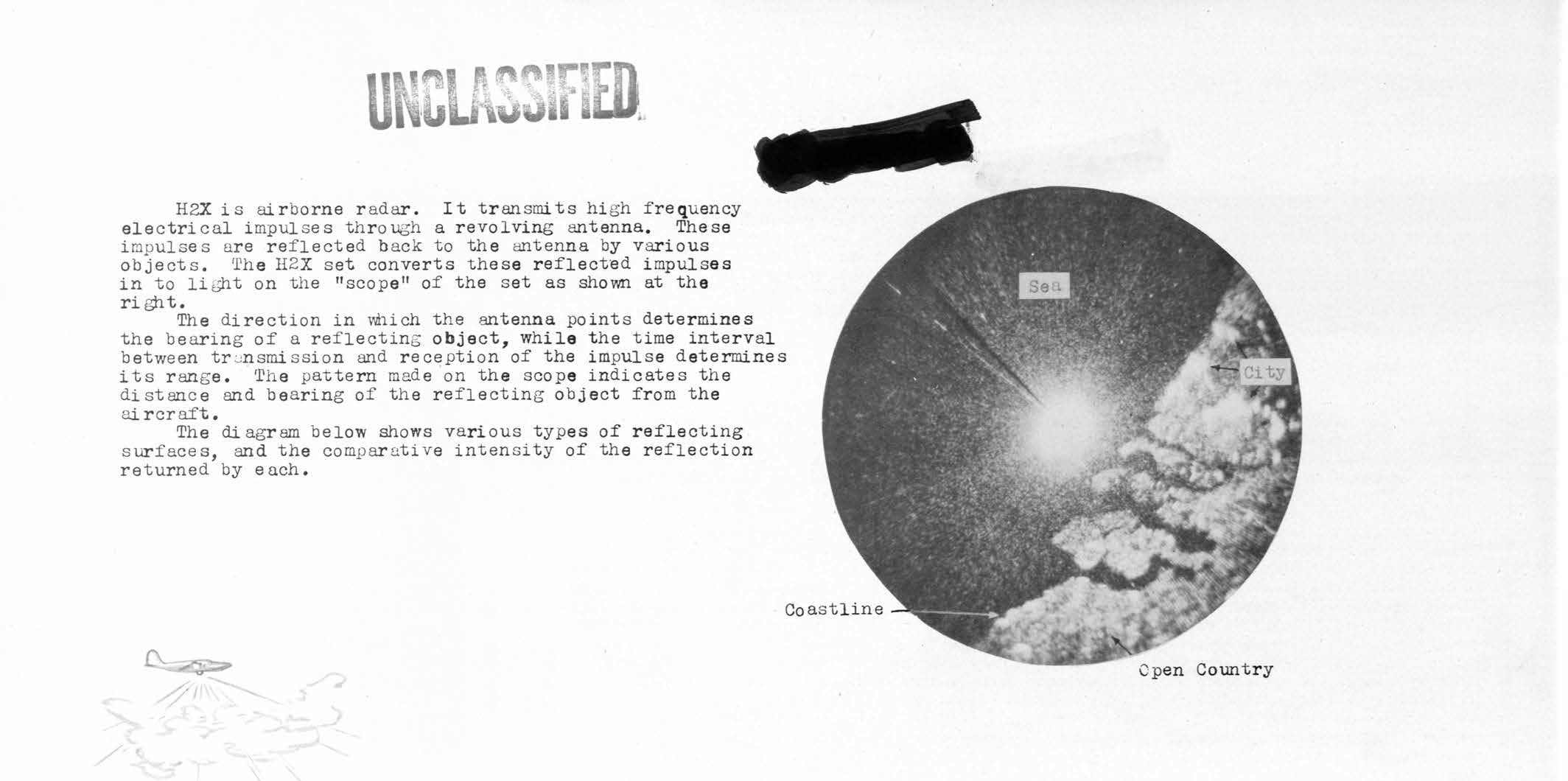
Figure 4. Taken from the Eighth Air Force Tactical Developments report (July 1945), this page outlines the capabilities of the H2X radar set.
The H2X radar screen was not particularly sharp, but it was determined that it produced the clearest returns when the line of flight crossed perpendicular to a clearly delineated terrain feature, such as the boundary of sea and shore. This contributed to the decision to choose bombing runs that approached targets from directly offshore, rather than parallel to the shore.
The 8AF Tactical Operations report claimed:
“ . . . two plans of operation had been prepared, one for the use of visual bombing methods, and the other for the use of through the overcast bombing technique.”[18]
That may well be true, but only one approach was chosen for both weather conditions. Both the Eighth Air Force’s Field Order 727 and the so-called Plan “B” message dictated the perpendicular approach.
Why would the Eighth Air Force plan to fly in perpendicular to the shore even if the weather permitted visual bombing? The answer to that lies in the second reason they gave for choosing the perpendicular approach: deconfliction with naval anti-aircraft defenses and with fighter patrols. The 5-inch, 38 caliber gun was the heaviest antiaircraft weapon on Navy ships and its shells could reach as high as 37,000 feet, more than twice the altitude the B-24s would fly on this mission. After the fratricidal engagement with the paratroopers’ jump aircraft during Operation Husky, no one wanted to see another such error. So, the decision was to create a protected air corridor; aircraft flying south from the UK, over the convoys and across the targets, would be assumed to be friendly, thus simplifying aircraft identification for the fleet gunners and fighter cover.
The Ninth Air Force, on the other hand, conducted beach bombardment at Utah using a bombing run parallel to the beach under visible conditions, without resulting in any fratricide from either fighters or naval ships. So, couldn’t the Eighth Air Force also plan for a parallel approach had the weather been good? Perhaps, but having two different approach options at Omaha would have led to confusion among the fleet when a late choice between two options could not be communicated to convoys on radio silence.
The final reason given by the Eighth Air Force was that an approach perpendicular to the beach would avoid passing over the entire length of the antiaircraft positions located in the various beach resistance nests. This point is debatable as the majority of the AA guns defending the beach were light weapons and barely able to reach the altitude of the lowest flying squadrons. And those squadrons could have been diverted a thousand feet higher with no complications. And while it was true a perpendicular approach might avoid the 88mm AA guns in the vicinity of Grandcamp-Maisy, it ironically would route the formations over an undiscovered cluster of 88mm AA guns in the vicinity of Trévières.
Those are the three reasons the Eighth Air Force gave for selecting a perpendicular approach to the beach. It’s fair to question the logic behind a couple of those reasons, while the H2X explanation offers solid grounds for a bomb-though-overcast scenario. But I suspect there was a far more practical reason at play as well. With the bomb runs coming in perpendicular to the beach, there would be 13 parallel air columns, each on average consisting of six squadrons. Control of the squadrons in this configuration would be fairly easy, and each column should drop its bombs within 5-6 minutes and be clear of the target area shortly after that.
By comparison, if the 2nd Bombardment Division approached lengthwise along the beach, it would require a single extended taxi queue consisting of all 75 squadrons flying in single column. Assembling that formation in the dark over England would have been a nightmare, if it were even possible. Worse, the bombing itself potentially might have been prohibitively long. Even with just 30 seconds between squadrons, and assuming every squadron was on time, it could take more time than the 25-minute bomb window allowed.
While the decision to bomb perpendicular to the beach is traditionally portrayed as a result of using H2X—which did indeed argue for a perpendicular bombing run—there was never any serious consideration given to a lengthwise approach to the beach.
Alert, Execute Orders and Preparation
The initial field orders issued by the Eighth Air Force (1350 hours) and 2nd Bombardment Division (1525 hours) included the full instructions for the subordinate units, but they did not designate H-Hour. As such these messages essentially served as alert or warning orders which set off a flurry of activity. A few hours later the ‘execute’ orders were issued, finally specifying H-Hour. These were published in the form of annexes and hit the teletype at 1830 hours for the Eighth Air Force and 2044 hours for the 2nd Bombardment Division. This set off another flurry of activity as the Eighth Air Force’s execute order included two pages of corrections, changes and new instructions. Interspersed during this period, a series of update messages was sent out from the meteorological office; the outlook for visible bombing was not good. As expected.
Nevertheless, the well-practiced routine to prepare for a mission shifted into high gear. Crews were alerted in the normal manner, and pilots, bombardiers and navigators received their routine briefings. Ground crews readied the planes and ordnance teams brought bombs from the bunkers. Depending on the group’s planned takeoff times, the briefings began as early as 2000 hours while the later groups started their briefings at 2230 hours. When the mission was announced, it brought standing cheers.
Unfortunately, during this period changes continued to come across the teletype machines. Between 1745 hours and 2335 hours, the 2nd Bombardment Division issued no fewer than six annexes (including the execute order). Some contained minor details, others were more extensive.
One of these, transmitted at 2204 hours, was the first sign that the planners were getting nervous. This message was Annex 5 to the 2nd Bombardment Division’s Field Order 328 (as discussed earlier), and it directed that squadrons carrying 500-pound bombs were not to drop on primary targets if they were obscured. Instead, they should proceed to bomb the secondary targets miles behind the coast.[19] This single message would eliminate one quarter of the squadrons (19 of the 75) intended for the beach air bombardment. Targets affected were Point de la Percée (4 of the 6 squadrons), Hamel au Prêtre (4 of 6 squadrons), WN60 (4 of 6 squadrons) and Port en Bessin (7 of 9 squadrons). If the intent was to avoid cratering beaches where troops would land, as stated in the order, this did not entirely make sense; eleven of those squadrons were scheduled to bomb targets where troops would not land and four more at Hamel au Prêtre would not have clogged an exit. This order has been ignored by almost accounts of the air bombardment, despite eliminating a quarter of the force targeting the beach defenses.
A few of the changes to the 2nd Bombardment Divisions orders were a result of changes coming from Eighth Air Force, which had issued three annexes of its own (including the execute order) between 1850 hours and 2350 hours. The real problem came just 30 minutes after the last annex was transmitted. At 0020 hours on 6 June, Eighth Air Force sent out a message with the subject ‘Plan “B”’ to their Field Order 727.[20]
Plan “B” – Literally
As discussed earlier, Plan “B” has been portrayed as contingency plan that had been previously prepared in case of bad weather. The plan was just two pages long, including the header and footer, and primarily dealt with the 1st and 3rd Bombardment divisions. It did contain three items that would impact the 2nd Bombardment Division, and they all betrayed a growing sense of confusion and nervousness at Eighth Air Force. The fact that it was issued just two hours before the first bombers were scheduled to take off reinforces that impression.
Plan “B” began in paragraph 2 by directing that the bomb-through-overcast technique would be used for the mission. Multiple weather forecasts over the past 20 hours had indicated visible bombing would not be possible, so Plan “B” was very late to the party, if it really had been written and approved in advance.
That paragraph also strongly addressed the safety vs lethality question, this time coming down squarely on the side of lethality.
“The Eighth Air Force will attack enemy beach batteries and strongpoints and other coastal objectives designated below by through the overcast bombing technique to cause maximum destruction and neutralization of these objectives in support of assault troops landing in the target area.”
The emphasis on “maximum destruction and neutralization” of the coastal targets would stand in stark contrast to post-operation claims they were merely aiming to disrupt the enemy’s rear areas. Unfortunately, the aggressive tone struck in paragraph 2 would be largely negated later in the message.
Paragraph 3.A. addressed the 19 squadrons of the 2nd Bombardment Division that had been loaded with 500-pound bombs which, just two hours earlier, that division had diverted to the secondary objectives. Eighth Air Force now directed those aircraft have their bomb fuzes changed from delay to instantaneous (as discussed earlier). With just an hour and a half before the first aircraft actually took off (a half hour early), it’s doubtful there was enough time to disseminate this order and change the fuzes. When 2nd Bombardment Division issued the order to divert those squadrons, Eighth Air Force was the first addressee on the distribution list, so it isn’t clear why the latter ordered the fuze change when they should have been aware it was no longer relevant for that division. Further, the change of fuzes would only make sense if these squadrons had been rerouted back to their original targets. But Plan “B” did not change the targets; the last standing order from the 2nd Bombardment Division still had them bombing the secondary targets. Intentionally or not, Plan “B” tacitly endorsed the diversion of 25% of the division’s bombers. Given the confusion surrounding this series of orders, it would remain to be seen what would actually happen in the air.
Another key part of the message came in Paragraph 3.A.X(6), which addressed the need for a greater safety margin for the bomb-through-overcast technique. As you will recall, there supposedly had been a decision during the planning to change the bomb cutoff time to H-10 if the bomb-though-overcast technique was used. You’ll see this claim in every official USAAF or USAF history of this campaign. But the fact is, this provision never actually made it into any of the plans. Not a single one, to include Plan “B”. Instead, Plan “B” changed the mechanism that would create the safety margin. The original cutoff-time approach had kept the aimpoints firmly on the targets, and created the safety margin by regulating the latest time for bomb release. The new approach contained in Plan B, however, made the bomb release locations variable based on a schedule of time delays for when the aircraft arrived over the coast.

Figure 5. An extract from the Eighth Air Force Plan “B” showing the details of the bomb release delay schedule. Usually portrayed as the schedule that caused the bombing to fall too far inland, it actually had little effect on the delayed releases.
In most histories, the details of this change are glossed over, merely stating that times had been delayed by anywhere from 5 to 30 seconds, with the intent to ensure a 1,000-yard safety margin for the approaching landing craft. This delay schedule has been used as the explanation for the bomb patterns falling too far to the rear of the beach defenses. But as we will discover, that explanation is incorrect.
What was generally omitted in those official histories was the actual mechanics of the system. The prescribed delays were graduated based on the time the bombers arrived over target. The later a squadron arrived, the longer the delay. For instance, a squadron arriving at 0617 hours (H-13) would reach the point the pathfinder aircraft determined to be the drop point, then wait 10 more seconds before releasing its bombs. Conversely, the sooner they arrived, the shorter—or even nonexistent—the delay should have been. Aircraft arriving in the first third of the bomb window (0610 hours or earlier) would incur no delay. (As we’ll see when we consider the actual times the squadrons released their bombs, this makes the delayed drops very difficult to explain.)
The stated intent of this delay schedule was to ensure:
“ . . . that the M.P.I. will be no less than 1000 yards from the forward wave of the assault forces.”
That statement appears to make no sense. The 1,000-yard safety zone was based on visible aiming. But the H2X bombing-through-overcast case called for an increased safety zone to account for the reduced accuracy of that technique. So why the callback to the 1,000-yard zone? That isn’t clear, but it turned out that, hidden in that schedule, there actually were increased safety margins, and they were perhaps excessive. Based on the directed bombing speed of 160 knots (indicated airspeed),[21] and the specified speed for the LCTs approaching the beach, the resulting safety margins would actually range from almost two and a half to four times the desired 1,000-yard margin. And any flight arriving after 0610 hours would place its bombs too far inland to hit its target.
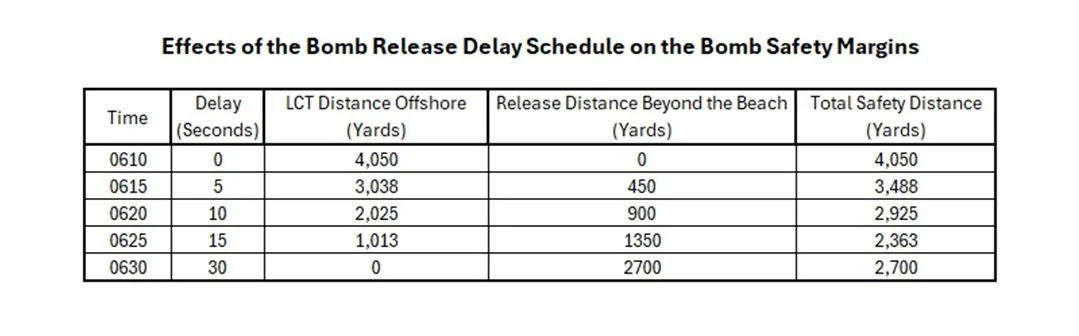
Figure 6. This chart translates the bomb release delays into the sizes of the combined safety margins for the landing craft heading to the beach.
The irony is that if they had simply implemented the H-10 cutoff time—the cutoff time that had supposedly been decided on in advance—without imposing a release delay, they would have still ended up with a safety zone double the original size (2,025 yards) and still have been able to drop on the targets. Instead they came up with the needlessly complicated delay schedule that potentially would shift almost all the strikes off the defenses and too far to the rear to be of much use.
So this new plan seems pointless. Worse than that, it was doubly harmful to the mission objectives. It would ensure bombs dropped close to H-Hour would be too far away to be of use, and it would ensure bombs dropped on the targets would land so early that potential neutralization effect would be mostly useless.
It’s worth noting that this order, and its significant consequences, was issued without Doolittle’s knowledge or approval.
Plan “B” was later presented in official histories as the prepared, pre-approved modification of the basic Field Order 727 intended to govern an attack in overcast conditions. Even a casual examination of the document argues against that. The entire plan is just two pages long, including header and footers. In addition to the portions mentioned above, the order contained little more, merely correcting errors in the base order and its annexes, and diverting some squadrons of the 1st and 3rd Bombardment Division.
In my opinion, Plan “B” clearly wasn’t a pre-approved contingency plan. It is best described as a hastily cobbled-together series of changes to address errors and oversights, issued far too late to be of much use. The sole new provisions relating to the bad weather contingency were the bomb release delay schedule and the change of fuzes, neither of which were well thought out and smacked of last-minute reactions. And there are reasons to believe neither of those was actually implemented down to squadron level. That does not at all resemble the pre-planned and pre-approved separate contingency plan the Air Force histories have so long touted. Furthermore, had it been a well-considered, pre-planned and pre-approved contingency, then Doolittle would have been aware of the critical changes to the bomb release times. But he was not.
The Staff Slips the Leash
So just how did Plan “B” come about? The best account of this comes from Stephen Borque’s book, D-Day 1944; The Deadly Failure of Allied Heavy Bombing on June 6 June. The following paragraphs summarize Borque’s findings.
The key players in this saga include: Brigadier General Orville Anderson (the Eighth Air Force chief of the air operations section); his deputy, Colonel Walter E. Todd; and Brigadier John Samford, the Eighth Air Force Chief of Staff. Plan “B” simply could not have been written, approved and dispatched without the involvement of these principals.
What little we know of the events of the night 5-6 June comes from a document called the Parker Memorandum. Major Thomas R. Parker was the command historian for the Eighth Air Force and he penned a summary of the developments. Quoting from Bourque’s book:
”The so-called ‘Parker Memorandum’ described how the planners became unhappy with their calculations on the evening before the invasion and worried about hitting friendly troops: ‘These officers were of the opinion that the overall results from attacks made by heavy bombardment aircraft in the assault area would be more beneficial if the number of bombs dropped along the shore line were reduced, and if a majority of them should be dropped in the communications and reserve areas behind the beaches proper.’
“These planners did not consult any of the commanders, who were already at sea. Essentially, Anderson and Todd, not named in the memo, overruled the decisions of Doolittle and the specific target requests by Bradley and Dempsey. Parker concluded his report: ‘Further studies are in progress at this headquarters and it is hoped that in the near future more specific information will be available.’ Unfortunately, there was no additional information, and no one in the US Air Force ever accepted responsibility for making this decision. No paper trail exists that can shed light on the decision-making process. Therefore, Parker’s interpretation of events, certainly written with the help of the operations staff, entered the official narrative and became part of the US Air Force’s official history of the conflict.”[22]
Note the irony that the very instructions that shifted the bombs from the beach defenses to the rear area were part of the same Plan “B” message that began with the exhortation to achieve ‘maximum destruction and neutralization’ of beach defenses.
Another paragraph in the memorandum asserted that the change in bombing focus and objectives had been “taken up with” GEN Eisenhower and Air Marshal Leigh-Mallory (commanding the Allied Expeditionary Air Forces) and was approved by them. Borque proceeded to demolish this claim, laying out a definitive case that no such coordination or approval ever occurred. In fact, none of the key officers or commands outside the Eighth Air Force were aware this change had occurred, including the supported naval and ground forces involved.
Borque concluded:
“The assertion that the staff contacted Eisenhower and the AEAF commander is a brazen lie.”[23]
It was also a gross exaggeration of the original source document. The 8AF Tactical Operations report was more moderate in its claim.
“Accordingly, in conjunction with Headquarters A.E.A.F., it was decided that if cloud cover should prevent visual synchronization, bombs would be dropped on Pathfinder indications in the normal manner except that the release would be delayed so that the Mean Point of Impact would be no less than 1000 yards, from the forward wave of the water borne assault forces.”[24]
That report was written by COL Todd, the deputy chief of operations and one of the key players. And Todd did not claim Eisenhower or SHAEF had ever been informed. However, even his more modest claim that the decision had been made “in conjunction with” the AEAF staff does not pass scrutiny, as they would have informed their commander (Leigh-Mallory) of such a change, and he was not informed. In fact, Todd did not even send a copy of the Plan “B” message to AEAF. He sent a copy to the Headquarters, Air Defense, Great Britain (HQADGB), requesting they retransmit the message to the intelligence—not operations—section at AEAF.
As a result of these machinations, the staff of the Eighth Air Force had instigated (or thought they had) a major change to the fundamental nature and purpose of the beach bombings, and had issued it in the form of Plan “B” at 20 minutes after midnight, just just an hour and a half before the 2nd Bombardment Division would begin taking off. And they had done it in isolation and without approval of any of the commanders. And even then, they had not actually issued the ‘execute’ order to implement that plan!
It was a very remarkable development, to say the least.
At that point the bombardiers, navigators, pilots and pathfinders had all been briefed and had headed out on their various duties or were manning their dispersed aircraft. It’s an open question whether the new bomb release instructions ever reached the crews. It’s equally doubtful the new fuzing instructions were disseminated and completed.
Borque’s comment that no one in the Air Force accepted responsibility for that decision is true, and I would add no one was held accountable, either. But this should not be a surprise, as the sole documentation of those events came in the form of the 8AF Tactical Operations report, and COL Todd, one of the principal suspects in the affair, wrote that report. Under those circumstances, you wouldn’t expect a full, unbiased report of the events. The other unanswered question is, what specifically worried the planners so much, at so late an hour so spur them to take such unprecedented action? There had to have been a significant, specific event or realization to spark that reaction. This point, too, was buried in the official account.
But despite the flurry of messages containing new annexes (i.e., changes) and the late arrival of Plan “B”, the preparations for takeoff largely followed the well-oiled machinery the Eighth Air Force had developed for staging and launching missions. Underlying the excitement over D-Day and the confusion over last-minute changes, the process of getting the mission off the ground maintained a degree of normalcy derived from frequent repetition.
At the appointed takeoff times, on dozens of airfields, 450 B-24s of the 2nd Bombardment Division anxiously sat, ready to taxi onto the runways.
The analysis of the actual bombing, however, will have to wait until the next installment . . .
If you would like to be notified by email when new installments of these series are posted, you may leave a comment below requesting notification, or contact me directly at cherrickbooks@gmail.com
Footnotes:
[1] These include Sunday Punch at Normandy, the second booklet in the immediate post-war Wings of War series; Air Force Historical Study No. 70, Tactical Operations of the Eighth Air Force, 6 June 1944 – 8 May 1945; and Chapter 7, Normandy, of Volume III of the Army Air Forces in World War Two series.
[2] In his book My Three Years with Eisenhower, 1942-1945, (Simon & Schuster, NY, 1946, pg. 530), Eisenhower’s naval aide Harry Butcher place the demonstration on 28 April as part of Exercise Tiger, and the margin as 1,500 yards. However, all other sources, such as the US Air Force Historical Division Study No. 70, Tactical Operations of the Eighth Air Force, 6 June 1944 – 8 May 1945 (pg 17) place the margin at 1,000 yards, as do the operation plans and reports.
[3] AFHS70, pg. 18.
[4] US Army Air Force Center for Air Force History, Sunday Punch in Normandy. The Tactical Use of Heavy Bombardment in the Normandy Invasion, (Number 2 in The Wings at War series), Wash, DC., 1992 reprint of the 1945 original. Pp. 9-10
[5] OIPMT [Eighth Air Force] message D-6O/775, dtg: 051350B June 1944, Subj: Field Order No. 727. Para 3.A. NARA, RG 18, Box 5743, Entry 7, and Box 4791, Entry 7.
[6] OIKHI [2nd Bombardment Division] message U-95-E, dtg: 051525B June 1944, subj: 2BD Field Order No. 328. See Paragraph 3.c. NARA, RG 18, Box 5743, Entry 7, and Box 5057, Entry 7.
[7] Eighth Air Force special report, Tactical Operations in Support of Allied Landings in Normandy, 2 June – 17 June 1944, dtd 6 November 1944. Combined Arms Research Library, Ft. Leavenworth, KS, Call # N4947. [https://cgsc.contentdm.oclc.org/digital/collection/p4013coll8/id/4859/rec/1] Pg. 56 of the .pdf. See also AFHS70, pg. 18.
[8] OIKHI [2nd Bombardment Division] message U-106-E, dtg: 052204B June 1944, subj: Annex No. 4 to Field Order 328. NARA, RG 18, Box 5057, Entry 7
[9] OIPNT [Eighth Air Force] message BT D-60/785, dtg: 06020B June 1944, subj: Field Order No. 727, “B” (Plan B). NARA, RG18, Box 4971, Entry 7
[10] Although I have not been able to locate any document actually citing Doolittle’s decision, his Field Order 727 did state that no bombs will be dropped north of the bomb line (the line itself contained on an overlay not filed with the field order). This cannot refer to the bomb line put into effect later on 6 June, as that bomb line followed the Aure River, and would have precluded any bombing within almost 5 miles of the beach. Further, Field Order 727 applied only to the early morning beach bombardments.
[11] OIPMT [Eighth Air Force] message D-GO/773, dtg 051350B June 1944, Subj: Field Order No. 727. Para 3.A. NARA, RG 18, Box 5693, Entry 7
[12] Ibid. Para. 3.X.(3). Note that in US military orders at that time, a sub-paragraph ‘X’ indicated that the following provisions applied to all units. This is why a series of pub-paragraphs, A through D, for instance, might see the next sub-paragraph seemingly labelled X out of sequence.
[13] OIHKI [2nd Bombardment Division] message U-95-E, dtg: 051525B June 1944, subj: 2BD Field Order No. 328. Para 3.C.(5). NARA RG 18, Box 5057, Entry 7
[14] OIPMT [Eighth Air Force] message D-GO/780, dtg 051850B June 1944, Subj: Annex No. 1 to Field Order No. 727. Para 3.A. NARA, RG 18, Box 5743, Entry 7
[15] OIKHI [2nd Bombardment Force] messaged U-105-E, dtg: 152150B June 1944, subj: [none]. NARA RG 18, Box 5057, Entry 7
[16] 8AF Tactical Operations. See Para 3.g. of the section for Operation No. 394, 6 June, First Mission. Pg 56 of the .pdf.
[17] USAAF, Office of Management Control, Statistical Control Division, Study ST-C-83, AAF Bombing accuracy: Continental – Overseas, April 1945, as discussed in the previous installment.
[18] 8AF Tactical Operations report, pp. 55-56 of the .pdf file.
[19] OIHKI [2nd Bombardment Division] message U-106E, DTG 052204B June 1944, Subj, Annex No.4 to Field Order 328. NARA, RG18, Box4871, Entry7
[20] OIPNT [Eighth Air Force] message BT D-60,786, DTG 060020B June 1944, Subj: Field Order No. 727 “B” (plan B). NARA, RG18, Box4871, Entry7
[21] As stated in the various navigator reports.
[22] Bourque, Stephen. D-Day 1944: The deadly failure of Allied heavy bombing on June 6 (Air Campaign Book 28) (pp. 101-102). Bloomsbury Publishing. Kindle Edition.
[23] Ibid. pg. 104.
[23] 8AF Tactical Operations report, pg. 56 of the .pdf document.