Charles Herrick Charles Herrick

Omaha Bombardment. Part IIIa: After Action Summaries

Having established that the Omaha Bombardment Groups as a whole fired only a bit more than half of the projectiles it was supposed to have used on the beach defenses, it is now time to examine the performances of the individual ships. This installment summarizes to the pre-H-Hour bombardment activities of every ship in the Omaha Bombardment Group, identifying its fire support position, targets and expenditure of ammunition against it assigned targets.
Introduction

Part III of this series analyzed the effectiveness of the pre-H-Hour bombardment at the Omaha Assault area, and generally summarized key details as they applied to the topic. Space precluded including a more complete accounting of the activities of the ships of the bombardment group. While that was necessary, it also omitted many smaller details which complete the picture of a bombardment that was indifferently prosecuted.

In the following paragraphs I have summarized the the various reports submitted by the ships of the bombardment group, highlighting the relevant portions as they pertain to the pre-H-Hour bombardment. If you have the time and interest in the bombardment, I recommend these paragraphs for your review.

As I mentioned, these paragraph, as with this entire Bombardment Series, focus only on the pre-H-Hour bombardment and it effectiveness in neutralizing the beach defenses. There is much more to the story of the ships of the bombardment group on D-Day and the following weeks. But that has been more than adequately covered by historians, whereas the initial bombardment had been virtually ignored.


Western Fire Support Group‍ ‍

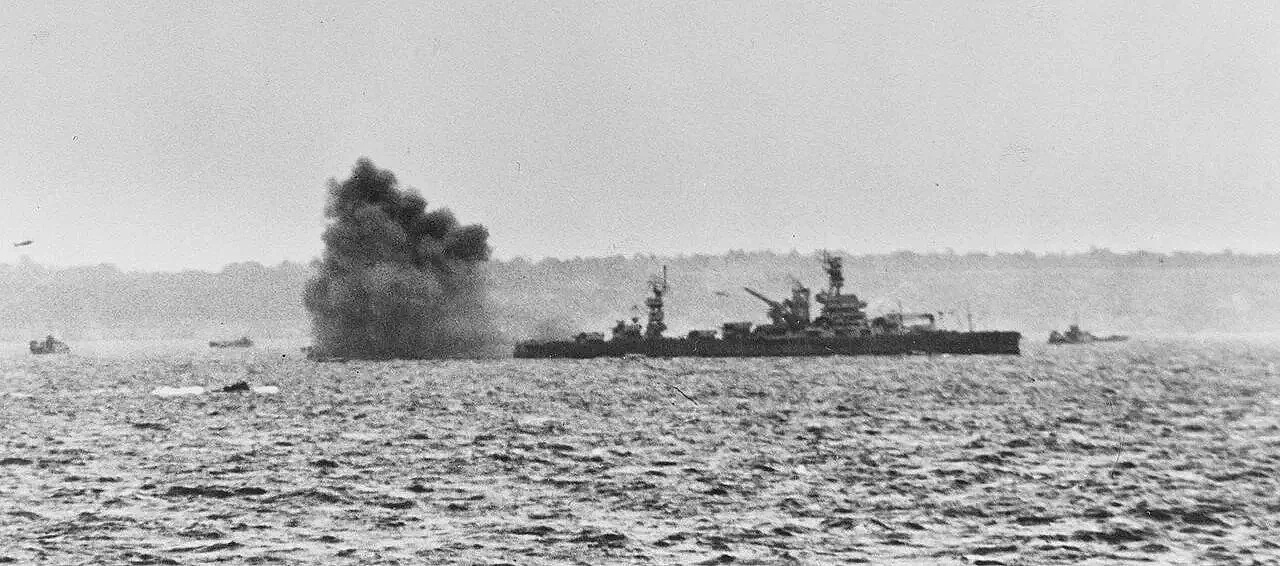
USS Texas, BB34

USS Texas, battleship, Omaha Beach, D-Day, bombardment

USS Texas, March 1943

Sources: 

-          Commanding Officer, USS Texas, Action Report for Period 3-17 June, 1944, Operation Neptune, dtd 28 June 1944

-          Commanding Officer, USS Texas, Chronological Narrative of Operations of U.S.S Texas for Period 3 June 1944 to 17 June 1944, inclusive, Operation Neptune, dtd 23 June 1944

-          USS Texas, War Diary, June 1944

Position:  Bearing about 030° from Pointe du Hoc, range about 13,000 yards.

The Texas was first tasked to neutralize the guns at Pointe du Hoc (WN75) with “up to 250 rounds” of 14-inch gunfire and ended up actually firing 255 rounds. 

Unfortunately, though the Texas wasn’t aware of it, the guns had been removed, and those 255 rounds did little more than “bounce the rubble,” as Steven Zaloga so aptly phrased it in The Devils Garden.  In reality, that massive shelling should also have stunned the garrison to the point the Rangers would have had an easy job.  But synchronization had fallen apart.  The Ranger boats were mistakenly led towards Pointe et Raz de la Percée, and by the time they had cleared up the confusion and reached their landing beach, they had lost a third of their LC(A)s and 40 minutes.  Any neutralization effects were largely overcome by the time the Rangers stepped off their craft and grabbed the ropes.

Despite the desperate fight the Rangers encountered as they scaled the cliffs, Texas’ action report claimed:

“Any personnel in the area must certainly have been killed.”[1]‍ ‍

It was a very unfortunate comment, but a perfect example of gunners being overly impressed by the big explosions they cause.  And once again we see clear evidence of a total lack of control over the bombardment force.  Some of the destroyers in the area were aware of the mix-up and the delay, and helped suppress German positions as the delayed Ranger flotilla passed too close inshore as they sought Point du Hoc.  Yet these were individual actions of initiative, and no one on the Texas had the situational awareness to restart neutralization fires on Pointe du Hoc itself as the Rangers belatedly approached their beach.  As a result the defenders would have 45 minutes to pull themselves together before the Rangers landed.

In his after action report, Hall tried to put the best face on the episode, stating:

“It later developed that four of the guns had been moved and emplaced in a hedge lane about a mile south.  This new position was bombarded and knocked out by Texas using airspot during the morning of D-Day.”[2]‍ ‍

Unfortunately, the only fire mission he could have been referring to (at 1033 hours) was too far south for the Pointe du Hoc’s relocated guns, but may have produced the very useful effect of silencing one of the 352d Division’s 155mm field artillery batteries (the Texas’ spotting aircraft did report it as a mobile field battery).

We’ll leave off the action at Pointe du Hoc and move to the Texas’ other missions.  At H-04, the Texas was to shift fires from the Pointe and place 12 rounds of 14-inch on two adjacent targets, T88 and T89, about a kilometer west of the point. That had also been Satterlee’s target for the previous half hour, and I’ll defer further comment on that objective until I get to that ship.

Texas’ final Pre-H-Hour mission was target T72 (WN73), which it was supposed to hit with 250 rounds from its 5-inch battery, from 0550 to 0623 hours.  It reported it fired for the full period, but expended only 190 rounds (91 HC and 99 Common).  This began a trend in which all ships firing at this key position failed to fire the full planned bombardment. At 13,500 yards to target T72, this was at the higher end of the 5-inch gun’s range, and it’s accuracy may have been less than desired, especially firing from casemate mounts with spotting from the foretop (rather than air spot).  In addition, at that range the projectiles would have lost about 60% of their velocity.  The secondary battery ceased fire at the planned time (0623 hours) rather than synchronized with the leading wave, probably because at that range it was impossible to observe the position of the leading waves.

Position of the ships of the Omaha Bombardment Group during the pre-H-Hour bombardment on D-Day

Figure 1. Bombardment Group ship positions during the pre-H-Hour bombardment. [Yellow pins: position located by range and bearing from a specified point. Green Pins: positions generally located by range from a specified point, but no bearing. Red pins: no firm data on position.]

‍ ‍

HMS Glasgow, C21

HMS Glasgow, Omaha Beach, D-Day, bombardment

HMS Glasgow

Source:  Commanding Officer, HMSGlasgow (C21), Operation Neptune – Chronological Narrative Report, dtd 22 June 1944. 

Position:  Laid own dan buoy in bombardment position: 49° 27’ 02” N, 00° 52’ 00” W.

Glasgow, along with the Arkansas, was slated to bombard the defenses of the D-3 exit.  Glasgow was tasked with neutralizing targets T59 and T61, which were up on the bluffs on the east side of the draw (WN67).  These defenses were generally west-facing to cover the draw, which meant Glasgow, firing from the western fire support lane, would have a good angle relative to the orientation of the key gun positions within its targets.

Unfortunately, Glasgow seems to have been infected with the same miserly attitude toward expending ammunition as had so many other ships.  It was allotted 400 rounds but fired only 219.  It started its bombardment at 0554 hours, but did not report when it ceased fire, so we can’t tell how well it synchronized its cease fire with the approach of the first waves.  It did state that at 0630 hours, it shifted fire to a ‘strongpoint’, giving a coordinate that placed it in the center of Vierville sur Mer. That engagement was not part of the bombardment plan, but might have been as a result of something the airspot observed.  

Glasgow’s report stated it opened fire on its assigned pre-H-Hour target (singular), when it was actually assigned two targets.  Fortunately, its Summary of Engagements (Enclosure 2 to its report) shows it did fire at two targets during this mission, and included grids coordinates correctly which matched coordinates for both T59 and T61.  So although only 55% of its planned projectiles, it seems to have hit both of its targets, though we have no indication how evenly the projectiles were distributed between the two.

‍ ‍

USS Satterlee, DD626

Sources:

USS Satterlee, Omaha Beach, D-Day, bombardment

USS Satterlee, September 1943

-          Commanding Officer, USS Satterlee, Report of Action, 6 June 1944, dtd 21 June 1944

-          USS Satterlee, War Diary, June 1944

Position:  About 3,000 yards bearing 185°T to Pointe du Hoc at a range of 3,000 yards. 

Satterlee was tasked to fire 300 rounds at targets T88 and T89 (also known as WN76).  In the previous post I pointed out that this was a curious target set as intelligence had only indicated there was a squad-sized element there, and it was difficult to see how it was significant enough to interfere with the landings or merit 300 rounds of scarce ammunition.   In fact, the position’s main ‘weapon’ was a 150cm searchlight, which posed no threat at all for a daylight assault.[3]  The position was also defended by two machine guns, but at a range of 1000 meters from Pointe du Hoc, they could not seriously interfere with the landing there.  In short, there was no reason to waste the firepower of an entire destroyer on this position, and certainly not during the critical pre-H-Hour bombardment.

Nevertheless, the Satterlee faithfully fired on the position from 0548 to 0645 hours (the mission was intended to extend past H-Hour by 15 minutes).  This mission was interrupted by the need to shoot a defensive counterbattery mission between 0618 and 0627 hours against light guns in the vicinity of the point.  Presumably these were to the east of the Pointe as the only ‘guns’ nearby to the west were wooden dummies, mounted in a fake battery position designed to draw fire away from the position on the point. 

Satterlee did not report  how many of the allotted 300 rounds it expended, but as it was one of only two fire support ships to fully expend its allotted 70% of rounds on D-Day, it’s not a stretch to assume it fired all 300.  One incident needs to be mentioned, although it did not take place during the pre-H-Hour bombardment. Satterlee recognized the need to suppress the Pointe du Hoc defenses as the delayed Ranger assault went in, and took the initiative to shell the area.  She was prompted to this action after observing enemy troops assembling on the cliff to repel the assault—presumably the same enemy troops the Texas thought “must certainly have been killed.”  Satterlee closed to within 1500 yards of the Pointe and fired with both its 5-inch guns and “heavy machine guns” (40mm and/or 20mm auto cannons?).

But this brings up another problem.  Aboard Satterlee was the deputy squadron commander for Destroyer Squadron 18, and since the squadron commander had been detailed off to set up the offshore screen, his deputy was in temporary command of the destroyers.  While Satterlee correctly took the initiative to shell Pointe du Hoc as the Ranger’s belatedly arrived, it took no steps to coordinate support for the Rangers with other destroyers.  Most of the ships had responded to one degree or another (suppressing German positions firing on the Ranger convoy as passed too close to the shore) but it was not coordinated and there was no effort to contact Texas to see if the 14-inch guns could fire a few more salvos.  At that phase of the morning (0630-0715 hours) DESRON18 was more of a collection of independently operating ships than a coordinated tactical squadron.

‍ ‍

HMS Talybont, L18

HMS Talybont, Omaha Beach, D-Day, bombardment

HMS Talybont

Source:  Commanding Officer, HMS Talybont, Report on Assault Bombardment, HMS Talybont, dtd 24 June 1944.

Position:  Bearing 038° from Pointe du Hoc at a range of 2.7 miles.

At 0550, Talybont opened fire on targets T82 and T83, from a range of 4,000 yards.  The targets covered an unnamed intermediate German position on the cliffs north of Hameau Lefevre.  It was defended only by small arms and was 1 ½-2 kilometers from Pointe Du Hoc.  At 0615, Talybont shifted fire to its second set of targets, T77 and T76.  This covered a radar installation jointly operated by the Luftwaffe and Kriegsmarine, and was designated WN74a (some sources refer to it as WN75).  The site had been heavily bombed in the predawn hours by the RAF, and by the time the pre-landing naval bombardment commenced, the presence of the fleet had mooted the usefulness of the radars, if they survived to that point.  Defended by small arms and a single mortar, it posed no immediate threat to the landings.

The 400 rounds the Talybont expended on these four targets accomplished absolutely nothing as far as the two objectives of the pre-Hour bombardment were concerned.  Talybont’s first concrete contribution to the invasion came after H-Hour when it helped suppress German small arms positions on the cliffs that had engaged the Ranger craft which had come too close to shore after becoming lost.

Talybont did not record its ammunition expenditure for this phase, although I suspect it was far below the specified amount, for no other reason that the ship had to re-engage all four of its targets after H-Hour to suppress further fire. 

‍ ‍

USS Thompson, DD627

USS Thompson, Omaha Beach, D-Day, bombardment

USS Thompson, May 1943

Sources:  Commanding Officer, USS Thompson, Chronological Narrative of Operations, Report Of, dtd 26 June 1944.

Position:  Bearing 180°T to Pointe et Raz de la Percée at a range of 2,200 yards.

From 0550 until 0715 hours, Thompson was ordered to fire 450 rounds at targets T74 and T75, which were the south and north portions of WN74 at Pointe et Raz de la Percée.  The high number of rounds allotted reflected the fact that these targets were to be shelled for an hour and twenty minutes.  But once again, only one of those two targets addressed a pre-H-Hour bombardment task.  T74 included two 80mm field cannons (identified as 75mm in some sources) enfilading the Charlie and Dog beach sectors and did require neutralization.  But T75 consisted of the site’s general defensive positions that should have been fired on at least an hour later, when the Rangers of Company C, 2nd Battalion might have been in position to assault the defenses.

At 0550 hours, Thompson elected to fire first at T74 (the gun positions) expending 107 rounds (55 common and 52 AA) and declared the position “apparently destroyed” at 0620 hours.  It then shifted fire to T75, firing just 56 rounds (26 common and 30 AA) over the next 50 minutes.  In total, it expended just 163 rounds (36%) of the allotted 450 against these two.  By ceasing fire on the two guns 10 minutes before H-Hour, Thompson gave the crews time to recover, man their guns and open fire on the leading wave, or shortly thereafter.  Thompson’s continued firing at T75 had resulted in a cloud of obscuring dust, which forced a cease fire between 0646 and 0700 hours.  It isn’t known how long the two 80mm guns had been back in action (perhaps hidden by the dust from target T75)  but at 0716 hours Thompson observed a field gun firing on the beachhead, and gave coordinates that matched T74—the target the ship had already declared “destroyed.”  Thompson re-engaged T74, firing another 106 rounds over the next 40 minutes (60 common, 46 AA).   It was a false economy to conserve the 267 rounds left unfired, just to have to fire them afterwards to silence the position that should have been neutralized before it had a chance to shell the troops ashore. 

‍ ‍

USS McCook, DD496

Sources:

USS McCook, Omaha Beach, D-Day, bombardment

USS McCook, 1943

-          Commanding Officer, USS McCook, Shore Bombardment off the Coast of Normandy – Report of, dtd 13 July 1994

-          USS McCook, War Diary, Month of June 1944

Position:  3200 yards off of beach at Vierville sur Mer (no bearing stated).

This ship was allotted 300 rounds to shell target T71 from 0550 to 0625 hours.  The coordinates for T71 would place the mean point of impact almost exactly on the newly built casemate that housed the 88m gun in WN72, with part of the pattern of impacts spilling over into the edges of WN73 and WN 71.  McCook’s action report indicated it was assigned three targets, though none of the three orders governing the bombardment reflect this.[4]  The captain decided shell the first two targets (unidentified) and reported they had been neutralized in 10 minutes, but it isn’t clear how he judged the defender’s status.  

He shifted fire to his third target at 0600 hours and at this point the reports become unclear and contradictory.  According to the war diary, 0603 hours the ship took two near misses from a shore battery (105mm or 155mm) followed by another one minute later.  Apparently, McCook ceased fire with its 5-inch battery about this time to maneuver to avoid the shelling, though it does not mention maneuvering at this point.  At 0606 hours both sources recap its ammunition expenditure to that point (220 rounds in rapid continuous fire, seemingly indicating it had ceased fire.  This cease fire seems to be confirmed as neither report goes on to mention the 5-inch battery ceasing fire later.  At 0615 hours McCook tried to engage an unidentified target with its automatic weapons (40mm and 20mm?) but ceased their fire one minute later due to excessive range. 

Although McCook did fire 220 rounds in ‘rapid continuous fire’ as neutralization required (and as so few of the other ships managed to do) there are serious questions about its bombardment.  What were the two additional targets it fired on during the pre-H-Hour bombardment and did they contribute to the beach neutralization mission?  Did the rounds fired at the other two targets spare the 88mm gun’s casemate much needed pounding?  And when exactly did it cease firing with its 5-inch battery?  Was it at 0606 hours?  Or 0616 hours?  In either case it would have been premature as far as synchronization was concerned, but 0606 would have had much worse consequences. 

After ceasing fire with its automatic weapons at 0616 hours (and possibly with its 5-inch battery as well?), McCook shifted fire to an unidentified target of opportunity on which it expended 100 more rounds by 0642 hours.  McCook reported the first troops (as distinct from tanks) hit the beach in that sector late, at 0638 hours, meaning the defenders had 22 to 32 minutes to recover from the effects of the shelling depending on when the ship ceased fire.  (However, the leading wave of tanks was landed at 0630 hours, so the breakdown in synchronization was a combination of McCook’s premature cease fire and the landing craft arriving late.) 

In addition to failing to fire at least 80 of its allotted 300 rounds at T71 (that number may actually be far higher depending on where its other two ‘assigned’ targets actually were), it markedly failed to pace its final high rate of firing to the progress of the leaning landing craft.

To recap the bombardment here at the defenses of the D-1 exit, recall the Texas fired only 200 of its allotted 250 5-inch rounds, and the Thompson fired only 220.  Where there should have been 550 rounds impacting, there were only 420, and that assumes all of Thompson’s extra ‘assigned targets’ were anywhere near T71.  This situation would be compounded when two of the LCG(L)s slated to fire there failed to arrive, and the third fired only about half its rounds.  Instead of 910 rounds, only 486 rounds were fired.

‍ ‍

USS Carmick, DD493

USS Carmick, Omaha Beach, D-Day, bombardment

USS Carmick, December 1942

Source:  Commanding Officer USS Carmick, Action Report, Forwarding of, dtd 1 July 1944

Position:  Bearing 19°T from Pointe et Raz de la Percée, range 3,500 yards

The Carmick was assigned three targets, T66, T67 and T68 (WN70, at Hamel-au-Pretet) and 250 rounds for the job, to be fired in the familiar 0550-0625 timeframe.  All three targets lay within an area of 300 by 200 yards and could be covered with minimal shifting of aimpoints A destroyer’s standard bombardment pattern was 200 by 200 yards).  Its action report stated it began firing on time at targets T67 and T68.  While firing, it was fired on by a gun in that area, which Carmick, with the aid of another destroyer,[5] silenced, at least temporarily.  When it was time to shift to the third target, dust was so thick it could not be seen, so it continued firing at T67 and T68 until end of ammunition and mission time.

Carmick probably made the most concrete contribution of all the fire support ships covered so far by knocking out the 80mm field gun sited in WN70.  That gun was in a field emplacement (its concrete casemate was still under construction) and facing generally west along the beach to cover the D-1 exit.  This was one of the few cases during the bombardment when the ship and the field gun were generally facing one another, giving the ship a favorable gun-target line, and resulted in that gun being put out of action (at least temporarily).  As the gun was not in a concrete casement, this is not a perfect example of the previous discussion of needing to engaging a hardened from the correct angle, but it serves to illustrate the advantage of proper ship positioning, even against field works. 

‍ ‍

Eastern Fire Support Group

USS Arkansas, BB33

USS Arkansas, battleship, Omaha Beach, D-Day, bombardment

USS Arkansas, April 1944

Sources:

-          Commanding Officer, USS Arkansas (BB33),  Report of Operations, June 3-18 June 1944, dtd 26 June 1944. 

-          USS Arkansas, War Diary for June 1944, dtd 21 July 1944.

Position:  About 3 miles off Port-en-Bessin, grid coordinates:  738943.

There were high hopes for the twelve big guns of the Arkansas.  They would fire on targets T60, T63 and T65 with 350 rounds of 12-inch projectiles.  These targets included all three resistances nests defending the D-3 exit (WN66, -67 and -68), with excellent angles against the large guns in WN68.  The chances of quickly opening the exit were pinned on those big guns . . . as long as the large shells didn’t crater the roadway too badly.

Having been briefly distracted by the necessary counterbattery fire against Port-en-Bessin, Arkansas’ main battery opened fire on its assigned targets at 0552 hours.  It ceased fire at 0623 hours, noting that the airspot had observed smoke and fires (but did not state that this smoke prevented firing).  After 30 minutes of firing its main battery, Arkansas’ expenditure of 12-inch ammunition was just 70 rounds (56 HC and 14 AP).  That was roughly only 18% of the expected support the ground troops had been counting on.  It isn’t at all clear why this happened.  The ship was anchored, had good firing data and was in a stable position.  And there were orders from both Admiral Ramsay and Rear Admiral Bryant to keep firing using the best data on hand in case of obstructed view.  Nor does it seem firing was interrupted or halted due to smoke.  That would seem to point to problems with fire control or the proficiency of the gun crews, but there was no mention of problems with either of those.  Regardless, 70 rounds would account for only five salvos—not counting rounds needed for ranging—which would take just five minutes of firing at a slow rate and just two-three minutes at a high rate of fire.

Something is missing here; the Arkansas seems to have been hardly used its main battery.  The only explanation I can think of is the ship kept the majority of its turrets free and aimed at Port-en-Bessin just in case those batteries came back to life.  

Another question is:  which target the ship fired on?  It was assigned three, and with two gun directors for the guns of its main battery, could theoretically have engaged two targets at a time.  But its reports fail to mention which target(s) it actually engaged, merely stating it opened fire on prearranged targets.  The ship fired such a small percentage of its allotted rounds that it is fair to ask, did Arkansas fire all 70 rounds at one target? Or attempt to spread the projectiles across all three targets (only about 30 projectiles per target)? Either way, it is almost certain the bombardment at the D-3 exit was ineffective.

All in all, it was a sorry showing at the D-3 draw.  Not only did Arkansas fire a mere 70 rounds of 12-inch projectiles out of a planned 385, but as we saw earlier in this piece, Glasgow fired only 219 6-inch projectiles of a planned 400 at the same exit.  The failure these two big ships to fire those 496 shells must sure have contributed to the defenses of the D-3 Draw being the last to fall on D-Day.

The Arkansas’ secondary (5-inch) battery was due to fire at the E-3 draw during the pre-H-Hour bombardment, but the ship instead left it engaging in counterbattery fire against Port-en-Bessin, so its 5-inch guns contributed nothing to the beach neutralization mission.  The Arkansas’ contribution to the pre-H-Hour bombardment was largely wasted.  Even when it engaged its tertiary battery’s 3-inch guns (which were not specifically addressed in the bombardment plan), it chose to direct them at Ste. Honorine (vicinity of WN59) instead of any of the beach defenses. 

‍ ‍

HMS Tanatside, L69

HMS Tanatside, Omaha Beach, D-Day, bombardment

HMS Tanatside

Source:  Commanding Officer, HMS Tanatside, Operation “Neptune” – Report on Bombardment – A.M. 6th June, 1944 (D_Day), dtd 26 June 1944. 

Position: At 0545 Hours, bearing 355° from Port-en-Bessin, range 4.1 miles, and a range of 10,000 yards to the targets.  Ship continued to close on targets until approximately 0621 hours when its range to target was 6,000 yards.

Tanatside was perhaps the only ship on the eastern side of Omaha that did not join the free-for-all against the Port-en-Bessin batteries before the bombardment period commenced.  I suspect this was because the ship had not yet reached its intended firing position as its report shows it was more than twice as far offshore as the other destroyers when the bombardment began, and it continued closing another 4000 yards while firing. 

Its orders were to fire on targets T54 and T128, which were about 100 yards apart on the west side of the E-1 exit (WN65).  It was allotted 400 rounds for the mission (with 200 more allotted for a post-H-Hour shoot at Port-en-Bessin).  It had a somewhat favorable angle on the WN65 positions.  It opened fire at 0545 hours, and although  the target was obscured at 0521 hours, it (correctly) continued blind firing until 0629 hours when it reported the DD tanks had been enveloped by the smoke.  As with so many of the other fire support ships that day, it was rather parsimonious in expending rounds on its beach bombardment task, firing just 238 rounds of the 400 allotted (60%).  It then fired 480 rounds at Port-en-Bessin during its post-H-Hour mission.  It seems the priority placed the beach bombardment came in a poor second place to preemptive counterbattery missions.  

‍ ‍

FS Georges Leygues

FS Georges Leygues, Light Cruiser, Omaha Beach, D-Day, bombardment

FS Georges Leygues

Source:  Pending.

Position:  Pending.

Unfortunately, I don’t have the action report for the Leygues.  According to the plan, it was to place 250 6-inch projectiles on target T53 (WN64, near the crest of the bluffs).  Given the results of most of the other fire support ships, the Leygues probably shorted its firing schedule, too, but we can’t say that for certain.

It does seem safe to say, however, that the E-1 draw defenses did not receive a substantial percentage of its planned neutralizing fire. 

‍ ‍

FS Montcalm

FS Montcalm, Light Cruiser, Omaha Beach, D-Day, bombardment

FS Montcalm

Source:  Pending.

Position:  Pending.

As with Leygues, we don’t have an action report for Montcalm.  It was scheduled to fire on seven targets in the vicinity of Port-en-Bessin for 70 minutes, from 0550 to 0700 hours, and had 300 rounds for the job.  Given the enthusiasm the rest of the fire support ships had for counterbattery fire, I think it’s safe to say Montcalm likely expended all 300 rounds, if not more. 

‍ ‍

USS Emmons, DD457

Sources:

USS Emmons, Omaha Beach, D-Day, bombardment

USS Emmons, November 1943

       -    Commanding Officer, USS Emmons, Report and Narrative of Operations of USS Emmons (DD457) during Operation Neptune from 5 June 1944 to 17 June 1944, dtd 22 June 1944. 

-    USS Emmons, War Diary, June 1944

Position:  Bearing 240° from targets (target coordinates 66808950 & 687088943) at a range of about 5,500 yards, placing ship about 2,000 yards off the nearest shore.

Emmons was one of five bombardment ships assigned to pummel the defenses of the E-3 draw.[6]  Earlier we covered the disappointing actions of the secondary battery of the Arkansas, which  failed to place any rounds on target T43 in WN61.  After briefly joining the dogpile on Port-en-Bessin, Emmons moved west towards its fire station, experiencing some difficulty finding a spot that did not foul the guns of Arkansas, Leygues and Montcalm.  If finally took position (as stated above) to shell its targets, T47 and T50, which were to receive 300 rounds.  Those targets encompassed WN62.  The Emmons position made it virtually impossible to engage the two west-firing casemated 75mm guns which enfiladed Easy Red.  The range and bearing the Emmons’ report listed are not compatible with the 2,000 yards it claimed it was offshore, so its exact position isn’t certain.  But its general location was very good to take on the 50mm cannon and 75mm PAK 40 antitank gun, both of which faced eastward and covered the anti-tank ditch that blocked the E-3 exit.  The 50 mm cannon was in an open-pit emplacement, and the PAK 40 was in a log bunker, both of which should have been highly vulnerable to the Emmons 5-inch shells.

As with so many other bombardment ships, Emmons did not fire its full allotment of shells, but fell short only a modest 42 shells.  It fired exactly twice as many of the less capable Common projectiles as it did AA projectiles, which may partially account for its failure to do any damage to the two vulnerable emplacements.  During the last part of the bombardment, the targets were clouded with dust, and the ship tried to maintain a firing solution while trying to keep position against the current, using an SG radar fix on the Port-en-Bessin breakwater; it had not dropped a dan buoy.  Despite the obscuration, the ship continued to fire blindly, ceasing fire at 0625 hours, about the time it claimed the first boat wave landed. 

‍ ‍

USS Baldwin, DD624

USS Baldwin, Omaha Beach, D-Day, bombardment

USS Baldwin, March 1944

Source:  Commanding Officer, USS Baldwin (DD624), Action Report for June 6-8, 1944, dtd 16 June 1944.

Position:  At 0556 hours, on a bearing of 227° to target T43 (coordinates 69308940), range not stated.  Between 0619-0637 hours, it closed to 1,830 yards from the beach.

There is some confusion regarding the Baldwin’s location relative to the Emmons.  Figure 1 shows where each ship reported its own location, but Baldwin’s report placed Emmons to the west of it.  In either case, Baldwin had poor angles on most of the emplacements within its assigned targets, T43, T47 and T50.  T43 was in WN61 (with the 88mm gun) while T47 and T50 were the same targets in WN62 that Emmons also targeted.  As was fairly standard, it was allotted 300 rounds for the period 0550 to 0625 hours.

Baldwin initially opened fire on T43 (WN61), which the Arkansas was also supposed to hit with 250 rounds (but did not).  It ceased fire after expending 56 rounds.  It then shifted fire to T47 (WN62), and though the target was partially obscured, enemy guns returned fire “sporadically.”  Baldwin fired just 24 rounds before it ceased fire on T47.  Next in line was T50 (Also in WN62) which came in for only 16 rounds.  At this point T43 became active again, and Baldwin directed 12 rounds at it, supposedly ‘silencing’ the position. From 0619 to 0638 hours, Baldwin closed the beach ahead of the boat wave, as far in as 1830 yards off the beach, firing an additional 42 rounds before breaking away.

In total, Baldwin fired only 150 of its allotted 300 rounds during the pre-H-Hour bombardment.  Despite that failure, it did two things well:  it closed the beach to closely support the leading boat waves, something few other destroyers did during this phase; and it synchronized its firing with the actual progress of that boat wave rather than ceasing fire according to the schedule.  Still, it failed to fire fully half its prescribed ammunition. 

‍ ‍

USS Harding, DD625

USS Harding, Omaha Beach, D-Day, bombardment

USS Harding, October 1943

Sources:

-          Commanding Officer, USS Harding (DD625), Action Report, USS Harding, Operation Neptune covering period from sortie from Weymouth, England 5 June to 0800 9 June (Departure this ship from bombardment area for Plymouth , England for repairs, ammunition and fuel replacement), dtd 20 June 1944. 

-          Commanding Officer, USS Harding, Brief Chronological Narrative Report of Operations – Operation Neptune – From time of departure for assault to and including 17 June in accordance with NCXTF 181220B of June, dtd 21 June.

Position:  No bearing given, but gave a range of about 3,000 yards from target T41 (coordinates 69558930).  [Harding’s report also placed Emmons west of Baldwin, reinforcing the possibility that one of them gave an incorrect position.]

Harding was tasked with a single target, T41, which was on the beach in the eastern end of WN61, and therefore could cover both the D-3 and F-1 exits.  As with other ships of the eastern group, Harding took part in the response to the shelling by the enemy batteries near Port-en-Bessin, while experiencing several near misses. 

Harding opened fire at 0547 hours on three pillboxes in the vicinity of T41, which it soon claimed it had destroyed.  It then continued to fire on “the area around the pillboxes including the draw to Colleville.”  Either Harding has mistaken the F-1 draw for the D-3 draw, or it had begun to fire 4-500 yards west of its target.  At any rate, it had fired 100 rounds in 18 minutes.  There is some difference between the ship’s two reports as the why it ceased fire, but it did so at about 0605 hours, either because all the positions were destroyed, or because smoke covered the area.  It then shifted fire to target T33, which was Melbreak’s primary target.  After 20 rounds fired in 5 minutes, Harding declared this target destroyed as well.  At 0610 hours it shifted fire to a fortified house in a draw west of Port-en-Bessin, which it declared destroyed after 40 rounds and five minutes.  At 0615 hours, having closed to about 1,700 yards from the beach, it shifted fire to a field gun it had spotted on the beach, and fired six salvos (24 rounds) to cover the area.  Harding claimed it scattered the crew and forced the gun to withdraw, but doubted it was destroyed.  Needless to say, no gun covering the beach was in a position that permitted it to withdraw. 

“At about this time a series of underwater explosions occurred along the beach and somewhat to the northward of our position, extending out into the water for almost 1000 yards.  This appeared to have been shore controlled mines.  Several minutes later the rocket craft opened up.”  That initial set of explosions were either ranging shots from the nearest LCT(R) or the German’s defensive rockets firing from near St. Laurent, as there were no command detonated sea mine fields.  

Harding then shifted fire to a gun emplacement on the breakwater at Port-en-Bessin, though its two reports differ as to the time this happened (0625 vs 0652 hours).  It believed it destroyed the position after firing 30 rounds.  The ship ceased fire at 0656 hours, when it said the troops landed.  The leading waves of the 3rd Battalion, 16th Regimental Combat Team did land about a half hour late, and far to the east, which would be consistent with Harding’s observations.

In its report, Harding figured as a hard-hitting, fast- and accurate-shooting, and quick-reacting ship, rapidly laying waste to a good section of the enemy defenses.  Yet the resistance encountered when the troops landed indicates the ship’s damage claims were overstated, to say the least.  Harding was clearly operating in a manner inconsistent with its orders.  Its mission was to drench one single target with 300 rounds to neutralize it, synchronized with the landing of the leading wave.  Instead, it engaged in a series of small scale sniping escapades with doubtful effects, all but one of which had nothing to do with its objective of neutralizing beach defenses.  It fired only 100 of its allotted rounds at its assigned target area and ceased fire there at least 25 minutes before H-Hour.  Harding totally failed in its beach neutralization mission.

‍ ‍

USS Doyle, DD494

USS Doyle, Omaha Beach, D-Day, bombardment

USS Doyle, January 1943

Source:  Commanding Officer, USS Doyle (DD494), Action Report for Period 6-8 June, 1944, Allied Invasion of the French Coast, undated. 

Position:  Not Stated.

As with  several others, Doyle began the day by piling on the Port-en-Bessin batteries, briefly engaging one between 0545 and 0550 hours.   Unlike the other ships, Doyle fired on a battery west of Port-en-Bessin.  It then shifted its fire to its assigned target, T40 (WN60) at 0550 hours and ”fired intermittently with half salvos until 0625.”  Its gun line was fouled twice by other destroyers and had the typical problem with dust and smoke.  The Doyle’s narrative report did not specify how many rounds it fired for this mission, but it included an overlay that showed its fire missions and rounds expended for each mission.  It listed 167 rounds fired for T40—out of an allotted 300 rounds—between 0550 and 0625 hours.

Obviously, a bombardment of half salvos (two rounds) fired intermittently has no resemblance to a neutralizing barrage fried rapidly and continuously, timed to coincide with the landing of the first wave. 

Interestingly, Doyle fired 562 AA projectiles and only 156 Common projectiles through D+1, indicating the assumed shortage of AA projectiles my not have been a fleet-wide issue.   

‍ ‍

HMS Melbreak, L73

HMS Melbreak, Omaha Beach, D-Day, bombardment

HMS Melbreak

Source:  Commanding Officer, HMS Melbreak (L73), [No title or subject], dtd 15 June 1944.

Position:  Not stated.

Unfortunately, Melbreak’s report was extremely brief and contained absolutely no details on its bombardment mission.  It was scheduled to shell target T33 (WN59 near Sainte-Honorine-des-Pertes) and was allotted 300 rounds for the task.   This was one of the targets that served neither the counterbattery mission nor beach neutralization mission.  As with the other Hunt class escort destroyers, it did not provide a detailed report of actual expenditure of ammunition.  It merely stated it left the area that evening with only 30% of its ammunition remaining.  The large majority of this would have been fired at one of Melbreak’s eight post-H-Hour assigned targets in and around Port-en-Bessin, which it was to shell from H+80 to H+240.   

‍ ‍

USS Augusta, CA31

USS Augusta, Heavy Cruiser, Omaha Beach, D-Day, bombardment

USS Augusta, August 1945

Source:  USS Augusta (CL31),  War Diary for the Month of June 1944, dtd 5 July 1944. 

Position:  Bearing 228°T to Pointe du Hoc at 8 miles range.

Although not included in any of the bombardment plans, the Augusta’s War Diary did include mention of firing one mission during the pre-H-Hour bombardment, and one more after H-Hour. The ship anchored in Fire Support Area 3 at 0617 hours and fired on an unspecified target between 0618 and 0623 hours.  It expended just 21 rounds. 

By 0805 hours, the ship had withdrawn and anchored in the Transport Area.

‍ ‍
‍ ‍

FOOTNOTES:
‍ ‍

[1]TexasAction report, pg. 7

[2] CTF 124 AAR, pg 102.

[3] Chazette, Alain, et al, Atlantikwall, Omaha Beach,  Editions Histoire et Fortifications, Vertou, Fance, 2014, pg 91.

[4] Hall’s CTF-124 order, Bryant’s CTG-124.9 order, or CAPT Sander’s COMDESRON 18 order No. 7-44.

[5]Carmick’s log stated they thought it was Thompson assisting them, but it more likely the McCook when it was firing on its target of opportunity.

[6]Arkansas, Emmons, Baldwin Harding and DoyleHarding’s target, T41, was on the east side of WN61.  Doyle’s target was WN60, and while that directly overlooked the F1 draw, its 75mm guns also dominated the D-3 exit.

‍ ‍

Read More

Omaha Bombardment. Part I: Setting the Stage

Perhaps the single greatest failure at Omaha Beach was the bombardment plan. Despite the efforts of 16 bombardment ships and dozens of supplemental bombardment craft, German defenses emerged sufficiently undamaged to virtually stop the invasion at the shoreline for the first hours. Many reasons have been advanced for this failure, to included a shortage of bombardment ships, too short of a bombardment window and the failure of the heavy bombers to hit the beach defenses.

This three-part series examines the facts behind the bombardment controversy and attempts to separate the valid criticisms from the popular misconceptions. This installment, Part I, explores the operational environment and how it shaped the basic concept of the landings, as well as how that constrained bombardment operations. Part II will examine in detail the bombardment plan developed for Omaha Beach, and Part III will analyze how effectively that plan was executed.

Join me to see what really lies behind the popular versions of the Omaha bombardment failure.

American Battleship USS Texas (BB-35) off Norfolk, Virginia in March 1944. The Texas was one of two WWI-era battleships assigned to Assault Force O at Omaha. She mounted ten 14-inch guns in five double turrets, and six 5-inch guns in casemate mounts. (NARA 80-G-63542)

The Failed Bombardment


One of the most infamous failures during the Omaha landings was the bombardment plan, a failure that saw infantry land in the teeth of strong defenses which had not been neutralized.  There has been no shortage of critics or shortage of criticisms of this plan.  There were not enough bombardment ships.  There was too little time for bombardment.  The bombardment relied too heavily on air power.  The bombardment counted too heavily on makeshift fire support assets.  And the list goes on. 

And honestly, there is more than a grain of truth to each of those accusations.  But what these critics—who, for the most part argued from their own single, narrow perspective—failed to consider were the constraints under which Neptune operated.  Were there too few bombardment ships?  Perhaps, but Eisenhower used all that he could wrangle from the Combined Chiefs of Staff.  Was the bombardment window too short?  Perhaps, but it was all the time that could be spared.  Was there too much reliance on airstrikes and on ‘gimmick’ fire support craft?  Perhaps, but these were necessary stopgaps to compensate for the paucity of bombardment ships.  The fact is that the Neptune planners did not accept those limitations because they mistakenly thought they were the best solutions.  No, they were accepted as the best options available in the face of limited resources, and within a unique and disadvantageous operational environment.

The stark fact is that the final bombardment concept was the product of numerous constraints and unavoidable tradeoffs with which the Neptune planners had to contend.  Many painful compromises had to be made between equally important, yet conflicting considerations.  As this series will illustrate, the bombardment would fall short at Omaha on 6 June due to several underappreciated factors which combined to produce a flawed plan and prevented effective execution of that plan.

HMS Glasgow (C21), a British Town class light cruiser assigned to Assault Force O at Omaha. She mounted twelve 6-inch guns in four triple mounts.

The Concept of the Assault

As the SHEAF command structure coalesced in the last months of 1943 and the beginning of 1944, the various new commanders began to reassess the plans left to them by LTG Frederick Morgan, who, as the Chief of Staff, Supreme Allied Commander (COSSAC) had conducted the invasion planning before General Dwight Eisenhower had been selected as the Supreme Allied Commander.  Both General Eisenhower and General Bernard Montgomery (the 21st Army Group Commander-designate) had opportunities to briefly review these plans while still assigned to the Mediterranean theater, and had independently come to the conclusion that the invasion needed to be stronger and launched across a broader front.[1]  After taking command of 21st Army Group (initially the land component of SHEAF) Montgomery formally proposed an expansion of the invasion in January, resulting adoption of the five-division plan and extension of the invasion front to include a landing on the Cotentin Peninsula (at Utah Beach, on the west side of the Vire estuary).[2]

Meanwhile doubts had been growing about the fundamental nature of the assault.  The operational environment of the Mediterranean had influenced the evolution of amphibious doctrine over the course of several landings in that theater, resulting in a technique that Admiral Bertram Ramsay (the Allied Naval Commander-in-Chief for Operation Neptune) would term the Silent Assault.  To oversimplify, this technique called for the invasion fleet to silently approach the objective area and land infantry assault waves well before dawn with little or no preparatory bombardment.  By dawn, the initial infantry waves would secure a limited beachhead against light opposition, and larger craft carrying heavier weapons would land behind them as quickly as possible.  It was a system that functioned well in areas of minimal defenses, manned by enemies not inclined to fight to the death, and in areas either isolated from reinforcements or that were difficult to reinforce.  The technique stood at virtually the polar opposite extreme of the technique generally used in the Central Pacific campaigns.  The objectives in the Central Pacific[3] were normally completely isolated, heavily defended and fanatically manned, which combined to demand extremely heavy preparatory fires, often lasting days.

GEN Morgan’s Outline Overlord Plan did not address whether the landings should be in daylight or at night,[4] but most of the key Neptune leaders had previously participated in landings in North Africa or the Mediterranean, and so brought with them to Neptune the expectation that a similar silent assault technique would be employed in Normandy. 

But the Normandy coast was neither North Africa nor the Mediterranean.   In some key respects, it was the worst case operational environment.  The beaches were much more heavily fortified and heavily manned.  That fact would normally call for serious preparatory fires before landing troops, which in turn would argue for a daylight attack.  But this consideration collided with another operational characteristic.[5] 

The extensively developed European road, rail and water networks enabled the enemy’s local reserves to be quickly committed, and similarly facilitated rapid deployment of his operational and strategic reserves from greater distances.  Thus, every minute of delay between discovery of the invasion fleet and the first troops hitting the beach gave the enemy time to reinforce.  As Samuel Elliott Morrison acknowledged in his History of United States Naval Operation in World War Two,

“They had to have tactical surprise, which a long pre-landing bombing or bombardment would have lost . . . Even a complete pulverizing of the Atlantic Wall at Omaha would have availed us nothing, if the German command had been given 24 hours' notice to move up reserves for counterattack."[6] 

This consideration called for the absolutely shortest time possible between discovery of the fleet offshore and the first troops setting foot on the beach.    

The Montcalm, one of two French La Galissonnière class light cruisers assigned to Assault Force O at Omaha. She mounted nine 6-inch guns in three triple turrets. (NARA 19-N-48998)

Perhaps the first to realize the significance of the different conditions was Ramsay.  At least he gave the impression he was.  In his diary he recorded that on 10 February 1944, he met with Montgomery to discuss the nature of the proposed landing operations.[7]  He said he convinced Montgomery the silent assault technique was wrong for Neptune, although he did not specify exactly what he proposed in its stead.  Although Montgomery had only recently arrived to assume his role, he had already pushed through his demand to expand the size of the invasion, underscoring his familiarity with the planning.  And in that process, was undoubtedly influenced by one of his subordinate commanders.

Two months earlier, on 14 December 1943, Lieutenant General John T. Crocker (Commanding General, British I Corps) had conducted an analysis of the situation which had come to much the same conclusion as Ramsay’s.  Quoting from Harrison’s Cross Channel Attack:

“The first essential, he [Crocker] said, was the development of ‘overwhelming fire support from all sources, air, naval and support craft ... to cover the final stages of the approach and to enable us to close the beaches.  This requires daylight.’  Mediterranean experience, in his view, had shown that the effectiveness of naval fire depended on observation and that it had been much greater than was previously supposed.  At least forty-five minutes of daylight, he estimated, would be necessary for full use of fire support, and he concluded that H Hour should be within one hour of first light.”[8]

That thinking was generally accepted and was incorporated into the Neptune Initial Joint Plan (issued 9 days before Ramsay’s diary entry):

“H Hour

“It is defined as the time at which the first wave of landing craft should hit the beach; which will be

“a. About l 1/2 hours after nautical twilight, and

“b. About 3 hours before high water.”[9] 

This shows that at an early point the matter had been closely studied, that there was a recognition that the Mediterranean style assault was not applicable, and that a daylight assault shortly after dawn was called for.  Over the following months, many debates would rage over the exact details, and the specific timing of H-Hour would be batted back and forth almost endlessly.  One result was a later change to the above Initial Joint Plan paragraphs which added: “so as to allow a minimum period of thirty minutes daylight for observed bombardment before H Hour.”  Nevertheless, the basic nature of the assault had been decided by 1 February.   And both the senior naval commander (Ramsay) and senior ground commander (Montgomery) were in accord.  As Ramsay stated in his report on Operation Neptune:

“7.  The one fundamental question on which there had to be early agreements was whether to assault during darkness so as to obtain the greatest measure of surprise on the beaches, or whether to assault after daylight and to rely on the greatly increased accuracy of air and naval bombardment under these conditions.  The decision which was made, to make a daylight landing, was in accord with experience in the PACIFIC against strong defenses, when the assaulting force possessed decisive naval and air superiority, and I am convinced this is the correct answer under these conditions.”[10]

So, daylight was essential to bring accurate preparatory fires to bear, yet the time to employ that fire support had to be severely curtailed in order to minimize the enemy’s opportunity to reinforce.  Striking a blance between the two imperatives would not be easy.

Nevertheless, the azimuth had been set by the leaders, and the planners set about their tasks.  Yet even as the Neptune planners came to grips with devising a new assault technique suited to the Normandy conditions, they had to contend with the longstanding shortage of naval assets.  There had been few enough ships and craft to support the original three-division assault.  Now, the expansion of the invasion to a five-division assault merely made matters much, much worse.  The original intent was that the invasion would be primarily supported by British naval forces, but this expansion demanded greater commitments from the US Navy.  And the US Navy was not receptive to any diversion of ships that would distract from its Pacific Campaign (not to mention its many other critical missions).  We’ve previously discussed the resulting shortage in shipping and landing craft, so it is no surprise that bombardment ships were in short supply as well.

As Ramsay and Montgomery were grappling with these issues a new factor had come into play. German General Erwin Rommel assumed command of Army Group B on 15 January 1944 and immediately began to strengthen the defenses.  The first indications of his impact were just being noticed by Allied intelligence in January and February, and their full implications would not be appreciated for several weeks.  The scope and speed of Rommel’s activity would be an unwelcome surprise.  The Neptune planners were struggling to cope with the challenges of the enemy defenses as they understood them in January and Februrary1944, even as the enemy was rapidly increasing the physical defenses and reinforcing those defenses with additional units.  Rommel was moving the goalposts on the invaders, and the fact is that the Neptune commanders and their staffs would be involved in a game of catch-up for the next few months.  A belated response to the multiplying obstacle fields saw the creation of the obstacle clearance plan and formation of units to execute it.  And that plan would have to be executed in the initial act of the invasion as well.

American destroyer USS Satterlee (DD-625). The Satterlee was one of nine Gleaves class fleet destroyers assigned to Assault Force O at Omaha. The Gleaves class destroyers mounted either four or five 5-inch guns in single mounts. The Satterlee is picture here in Belfast Lough three weeks before D-Day. In the background are two more Gleaves class destroyers; all three ships were part of Destroyer Squadron 18 (DESRON18). (NARA 80-G-367828)


The First 120 Minutes

A full discussion of the many factors that influenced the selection of H-Hour at Omaha is beyond the scope of this installment, but I will touch on some of the more important aspects as they related to the bombardment plan.  Essentially, the Omaha Assault Force planners (Admiral Hall’s CTF 124, working in conjunction with the Army V Corps) had to carefully orchestrate a complex sequence of actions within a roughly two hour period.  Two factors would help define the beginning of the assault window.  The first was light; specifically, the earliest time naval bombardment ships would have enough light to conduct observed fire.  Sunrise on 6 June would be at 0558 hours, and they might be able to take advantage of the last few minutes of morning civil twilight as well, especially if spotting aircraft were available.  The second factor was the tide; the Navy needed a rising tide to enable them to retract after unloading their landing craft, and low tide would be at 0530 hours.  The end of the critical window would also be dictated by the tide, and that would be when it was so far up the beach that the obstacle clearance teams would have to cease work.  That would be approximately 0800 hours.  Ideally, the obstacle clearance teams needed to land as early as possible to have the most time to do their job, but the first wave of infantry had to go in before the obstacle teams, and the earlier they went in, the more open sand they would have to cross under fire.  Potentially this could be as much as 350 yards, which would be suicidal.  So, the first wave could not go in too early.  As a result of all these factors (and many more) a critical window of roughly two hours was established for the start of the landings: 0558 hours (sunrise) to 0800 hours (the tide amid the obstacles). And in the middle of everything that had to take place in those two hours, the planners needed to squeeze in 45 minutes for air and naval bombardment, a figure that carried forward from Crocker’s analysis.  As you can see, the final landing schedule entailed a series of cruel tradeoffs between equally vital but usually incompatible considerations.   

To no one’s complete satisfaction, H-Hour was set at 0630 hours.  However, it is important to keep this in context.  Each and every H-Hour decision is a matter of compromising between the needs of different elements of the attack force.  The more complex the operation is—and Neptune was about as complex as they come—the more tradeoffs are necessary.  Having said that, it was clear it would be a rough two hours at Omaha.

The bottom line, as far as the bombardment mission was concerned came down, to 32 minutes between sunrise (0558 hours) and H-Hour (0630 hours).  Hall’s planners moved the start of that window forward to 0550 hours, counting on the growing visibility at the end of civil twilight, and that was as close to Crocker’s 45 minutes as could be managed. 

[As difficult as the conditions were for 6 June, it should be noted that H-Hour on the original invasion date, 5 June, was 20 minutes earlier, at 0610 hours.  That would have meant most of the bombardment would have been conducted during insufficient light, likely resulting in less damage to the defenses and far higher casualties among the assault troops.]

The British escort destroyer HMS Tallybont, one of three Hunt Class (Type III) escort destroyers assigned to Assault Force O. These Hunt class escort destroyers mounted four 4-inch guns in two twin turrets.

Too Few Guns

Ideally, if you have less time to fire your preparatory bombardment (and Hall had not been happy with the 45 minutes he did have), you want to increase the number of guns firing in order to deliver the required metal on target.  But, as noted above, Neptune as a whole was being conducted on something of a naval shoestring, and this held true for bombarding assets as well.  Bombarding types of ships (destroyers, cruisers and battleships) were at a premium, especially with the US Navy, which was husbanding its fleets for Pacific campaigns.  The British were no less reluctant to take capital ships from the Home Fleet, which was standing guard in case of a sortie by the remaining German capital ships.[11]  To address this shortfall, in late December 1943, RADM Kirk (commanding the Western Naval Task Force - TF 122) sent Washington a list of requirements for bombardment ships; no action was taken.  After the expansion of the assault to the five-division plan the following month, the deficit widened and pressure mounted for a greater US Navy contribution.  The matter came to a head on 13 February at a dinner being held in conjunction with a conference to iron out landing craft allocations.  RADM Cooke (chief planner for the US Navy’s Commander in Chief, ADM King) was present when Hall exploded in frustration over the lack of bombardment ships.  Cooke reprimanded Hall for the outburst, but he also saw to it that three old US battleships and a squadron of nine US destroyers were provided.[12] 

Initially, bombardment ships for Omaha, as allocated in Ramsay’s naval orders for Operation Neptune (ON 8, issued 14 April 1944, dealt with bombardment) amounted to:  one heavy cruiser, five light cruisers and an unspecified portion of 22 destroyers and escort destroyers.  (See Figure 1).  It wasn’t much.  By comparison, the US pre-war amphibious doctrine called for a bombardment force of three battleships, four light cruisers and 8-16 destroyers for an assault the size of the Omaha landings.[13]  As measured by this doctrinal template, Omaha was under-supported when it came to naval bombardment.

A week later, RADM Kirk’s Western Naval Task Force (CTF 122) operation order was issued, and it reflected Cooke’s reinforcements, which were split between Omaha and Utah Assault Areas.[14]  For Omaha, two battleships had been substituted for one heavy and two light cruisers (the third battleship Cooke had secured went to Utah Beach).  The loss of three cruisers (nine 8-inch guns, sixteen 5.25-inch guns and eight 5-inch guns) for the gain of two old battleships (ten 14-inch guns, twelve 12-inch guns and twelve 5 inch guns) apparently suited Hall, an old battleship admiral.  He gained heavier guns in his primary batteries and increased his secondary batteries by 50%.  The punch these old WWI-era battleships offered was very welcome.

Figure 1. A comparison of the original bombardment ships allocated to the Omaha Assault Force under ON 8 and the final allocation as shown in the CTF 122 operation Plan.


What was perhaps less welcome in this new ship allocation was the assignment of the Royal Navy Hunt class escort destroyers.  The US fleet destroyers were of the Gleaves class, which mounted either four or five 5-inch guns.  The Hunt class escort destroyers mounted four 4-inch guns.[15]  The 4-inch gun was not a bad weapon, and in fact, at 102mm was comparable in caliber to the 105mm howitzer that was the standard US divisional artillery weapon.  But besides the smaller gun, the Hunts carried fewer rounds per gun than the Gleaves (250 vs 400).[16] 

Figure 2 details the gunpower these ships mounted for naval bombardment.


Figure 2. A summary of the type and number of bombardment guns available on the battleships, cruisers and destroyers allocated to the Omaha Assault Force.


One hundred and fifteen guns sound like an impressive number, but was it an adequate number to get the job done?  As we’ll see, that answer depended on how you define the job, and which part of the doctrinal template you chose to apply. 

Two other points factor into that question, as well.  First, not all of these guns would be available for softening up the beach.  A significant percentage of them would be dedicated to counter-battery fire against enemy coastal artillery batteries, such as those on Pointe du Hoc and at Port en Bessin.  Second, six of the 5” guns, mounted in the battleships‘ secondary batteries, would be on the unengaged sides of the ships, and not be able to bear on a target.  So, the total of 5” guns, as shown in Figure 2, would be reduced by 12% to 44 guns.

Hall’s Force O (Omaha) was fortunate in one small respect.  All of his US ships had arrived in the UK by 28 April, in sufficient time to prepare for D-Day, unlike at least one division destined for Utah that barely arrived in time.  Information is scarce about participation of the US destroyers and battleships in Exercise Fabius I, the final D-Day exercise.  It is known that USS Thompson did participate, and that tends to indicate the rest of Destroyer Squadron 18 (DESRON18), the formation these destroyers belonged to) did as well.  After that exercise, DESRON18 held about a week of additional gunnery exercises.  This training was no doubt valuable.  Although all the DESRON18 destroyers had been in commission for over a year, they had primarily been tasked with convoy support missions.  D-Day would be their first combat experience in shore bombardment.  Although unbloodied and new to the shore bombardment role, there was no reason to doubt their ability.

The situation with the battleships is not entirely clear.  In his Action Report on Operation Neptune, RADM Bryant (commanding Battleship Division 5, and within TF-124 framework he commanded CTF 124.9, which was the Bombardment Group) discussed bombardment training after arriving in the UK, but nothing in the area of the Fabius Exercise, likely due to the limited live fire ranges at the rehearsal area.  The Texas had already seen combat during WWII, starting with Operation Torch.  The Arkansas, which had spent the bulk of the war either as a training ship or on escort duty, had yet to fire a gun in anger in this war.  


Supplementary Efforts

Clearly, more gunfire support was needed.  To complement and reinforce the usual bombardment battleships, cruisers and destroyers, a number of other craft would provide supporting fires.  Some of these were ad hoc solutions, some were systems new to the theater and not well understood, and some were such wild ideas that RADM Hall would dismiss them as gimmicks. 

The first group in this category were the Duplex Drive (DD) tanks.  Although part of the Gunfire Support Group (as distinct for the Bombardments Group consisting of the ‘real’ bombarding battleships, cruisers and destroyers), they would play no role in the preparatory bombardment; their role was to support the leading assault waves after landing.  For that reason, and since I have discussed them thoroughly in an earlier blog series, I will skip over them here.

The second element consisted of thirty-two Sherman tanks (and 16 tank dozers) that would ride in on 16 LCTs to beach at H-hour.  At the front of these LCTs (either LCT(A)s or LCT(HE)s) wooden platforms had been installed which raised the two front Shermans high enough to fire over the ramps.  During the run into the beach, these tanks would provide “drenching fire” that hopefully would suppress the defenders as the first two waves landed (the first infantry wave and the gap clearance teams).  As such, their role in the bombardment plan was marginal, and I’ll only lightly touch on them in the rest of this series.

The next group consisted of the Landing Craft, Tanks (Rocket) (LCT(R)s), which were LCTs fitted out with approximately a thousand 5-inch rockets.  Following at a distance behind the first wave, these craft would loose their rockets so that they would impact when the first wave was 300 yards offshore.  The desired impact area was supposed to be 200 yards deep and 400-700 yards wide (for an impressive theoretical density of one rocket for every 80 to 140 square yards).  There were nine of these craft for Omaha.

There would also be five Landing Craft, Gun (Large) (LCG(L)), each equipped with two 4.7” guns (120mm). These craft were to operate close inshore and were assigned to engage specific targets on the beach during the last 10 minutes before H-Hour.

The next fire support category is perhaps a measure of how desperate they were to scrape up additional fire support.  The 58th and 62nd Armored Artillery Battalions were equipped with M7 Priest self-propelled artillery vehicles, each mounting a 105mm howitzer.  The 36 howitzers of these battalions would be mounted in 10 LCTs, and fire from those craft over the heads of the first waves.  The LCTs were not stable gunnery platforms, and they would have to maintain about a 4-6 knot speed to minimize rolling and plunging.  Gunnery under those conditions would be challenging to say the least, with changes in range requiring constantly updated firing data.  Still . . . thirty-six 105mm howitzers were the theoretical equivalent firepower of nine additional Hunt class escort destroyers, and that was potentially a significant addition for a task force that considered itself starved for gunnery ships.  At least it would be if there was some way to ensure their rounds landed somewhere close to the intended targets.  In reality, they were expected to provide nothing more than what one would charitably describe as general area suppressive fire, if one wasn’t too particular about which area would actually be hit.

Also used were class 461 patrol craft (174 feet long, 280 tons and a crew of 65) which served as the primary control craft for various beach sectors.  There were 6 of these, each mounting a single 3-inch gun, and each was assigned a specific target.[17] 

One other category of craft would provide suppressive fire, though these were so small they were not even assigned targets in the bombardment plan.  These were 21 Landing Craft, Support (Small), or (LCS(S)).  Equipped with machine guns and 48 rockets, they would accompany the leading waves to beach and provide the last second suppressive fire for their accompanying landing craft.

It would appear everything that could be reasonably done to supplement the bombardment mission (and some that may not have been quite so reasonable) had been thrown into the mix.  Hall, the old battleship sailor, quite naturally bemoaned having to employ such a ragtag force, but given his shortage of ‘real’ bombarding ships he had no choice.

B-24 heavy bombers, such as this one, were incorporated into the bombardment plan for Omaha Beach.


Air Bombardment

Various air operations were mounted in support of Operation Neptune involving all manner of aircraft. For the purpose of this discussion, we’ll focus on the heavy bombers, whose primary mission had been strategic bombing, but had been incorporated into the tactical bombardment of the assault areas on D-Day. These bombers had two roles.  During the hours of darkness, early on D-Day, night bombers would attack the German coastal artillery batteries flanking the beach, in the vicinity of Pointe du Hoc to the west and Port en Bessin to the east.  The second role, commencing shortly after sunrise, was to strike the beach defenses.  Approximately 329 B-24 bombers of the Eighth Air Forces’ 2nd Bombardment Division would strike the beach defenses in the Omaha Assault Area at the same time as the naval bombardment. [18]  As impressive as that number is, the amount of their bombs that could reasonably be expected to actually hit the beach defenses—even had the weather been perfect—was far less than is generally realized.  In the next installment we’ll examine this point in more detail.  For now, suffice it to say that even had the air bombardment gone as planned, its actual potential effect on the beach defenses has been greatly overstated.


The Purpose of Bombardment – Destruction or Neutralization?

Even as Ramsay, Hall and the other naval leaders were trying to obtain additional bombardment assets, they were embroiled in another debate involving the basic question of what exactly was the purpose of the bombardment.  To be more precise, what effect was the bombardment expected to achieve?  The general statement of ‘pave the way for the assaulting troops’ meant nothing in a tactical sense.

The two camps in this debate were those who believed the bombardment must achieve destruction of the enemy defenses (or at least a substantial portion of them), and those who felt that goal was not possible, and believed neutralization of the enemy defenses was all that was practical. To quote the US Navy’s Landing Operations Doctrine (F.T.P. 167):

    1. Neutralization.--Neutralization fire is area fire delivered for the purpose of causing severe losses, hampering or interrupting movement or action and, in general, to destroy the combat efficiency of enemy personnel. In the usual case, neutralization is only temporary and the target becomes active soon after fire ceases. Neutralization is accomplished by short bursts of fire of great density to secure the advantage and effect of shock and surprise. Most targets engaged by naval gunfire will be of the type for which neutralization is appropriate.

    2. Destruction--The term is applied to fire delivered for the express purpose of destruction and when it is reasonable to expect that relatively complete destruction can be attained. Destruction should be attempted only under favorable conditions of target designation and observation.[19]

A good example of the proponents for the destruction school of thought was MG Charles Corlett.  Corlett had served in the Pacific, commanding first the Kiska Task Force, and then the 77th Division during the assault on Kwajalein.  He was then brought to the European Theater and given command of the XIXth Corps, which was scheduled to land on Omaha Beach shortly after D-Day.  After the mistakes at Tarawa, much greater emphasis was given to preparatory bombardment for the Kwajalein landings, and Corlett believed the lessons he’d learned in that operation were ignored in the run-up to the Normandy landings.  But those lessons were largely not applicable.  At Kwajalein, Corlett had been able to secure a number of small islets close to the main objective and landed forty-eight 105mm howitzers and twelve 155 howitzers—his entire division artillery—on one of them. All while four battleships, two cruisers and 4 destroyers bombarded Kwajalein throughout the day of D-1.  Harassing fires were maintained through the night by both the Army and the Navy (battleships Idaho, New Mexico, cruiser San Francisco and their destroyer screen).  A large scale bombardment incorporating all arms was conducted the next day in support of the main landings on Kwajalein itself.

There are few, if any, relevant lessons here for the Normandy landings.  Corlett didn’t have to worry about the possibility of Japanese reinforcing divisions—to include perhaps a panzer division or two—rolling up while he took a day for preliminary operations.  He didn’t have to worry about nearby E-Boat or U-Boat bases or Japanese air formations stationed within range.  He was able to outflank the Japanese seaward defenses by landing from the less defended lagoon side.  And Kwajalein was only 2.5 miles long and 800 yards wide, flat, lacking beach obstacles and mostly lacking vegetation.  And it still took him longer to secure the island than it would take to secure the equivalent beach area at Omaha.

The comparison really falls apart when one considers the preparation.  The Kwajalein naval bombardment totaled something less than 7,000 rounds during D-Day, most of which were fired during the beach preparatory bombardment.  The Omaha Beach bombardment was scheduled to deliver 6,297 rounds for the preparatory bombardment alone.  So, despite having more and heavier naval gunfire for Kwajalein, the planned Omaha bombardment was effectively equivalent, if not perhaps even greater.  The real difference was not so much the naval bombardment, but the support provided from Corlett’s own Army guns.  The 60 howitzers that were landed the previous day consisted of the entire 77th Division Artillery.  And those 60 guns—whose accuracy had the advantage of solid ground, not rolling ships—fired 29,000 rounds during Kwajalein’s D-Day.[20]  At Omaha there was no convenient island to preposition Army firepower, and even if there had been, there was no time to emplace it or fire a prolonged barrage.  The Pacific model simply did not fit.

Corlett was an excellent general, and did a fine job commanding the XIXth Corps, so much so that he was later transferred back to the Pacific to command another corps for the planned invasion of Japan.  But in pressing for a Pacific-style bombardment, he’d brought the wrong experience to the Normandy operational environment.  He was bitter at the way he perceived his advice was ignored within SHAEF, but his advice was wrong.

Despite the inapplicability of the Kwajalein model, RADM Hall nevertheless embraced it to support his position:

“Using Kwajelein [sic] as a basis for a rough comparison, and disregarding other considerations, the landing of four times the number of troops against three time the defensive strength would call for an amount of naval gunfire support at Omaha many time greater than that employed at Kwajelein.  Yet the weight of metal delivered at Omaha defenses was one-third that used at Kwajelein . . . Though the amount of naval gunfire to be delivered in a given situation cannot be arrived at mathematically, and though naval gunfire alone will not necessarily insure a successful landing . . . the foregoing rough comparative figures will serve to substantiate the conclusion that Omaha Beaches during the pre-landing phase, not enough naval gunfire was provided.”[21]

Probably the best proponent of the neutralization school of thought was Ramsay himself.  He was influenced in this matter by a report titled "Fire Support of Sea-Borne Landings Against a Heavily Defended Coast” (the so-called Graham Report).[22]  Although Graham was a Royal Air Force officer and his report focused primarily on the air contribution, it provided two insights that would largely govern the naval bombardment plan as well. 

“a. Casemated batteries probably could not be destroyed by bombardment, but could be sufficiently neutralized to render them acceptably ineffective until the army could capture them. The report also calculated in detail the weight of fire required to do this.
“b. Beach defenses could best be neutralized by "beach drenching," which would force the defender underground and numb his mind and nerves. Aimed fire in the dust and smoke of battle would be less likely to accomplish this.”
[23]

In other words, direct hits on individual bunkers, weapons positions and concrete troop shelters were highly unlikely with any reasonably sized naval bombarding force, so the emphasis should be on the more achievable goal of neutralization.  (Graham’s final sentence in that quote would prove prophetic.)

This thinking was translated into Ramsay’s ANCEX orders. 

“2.  The object of the naval bombardment is to assist in ensuring the safe and timely arrival of our forces by the engagement of hostile coast defenses, and to support the assault and subsequent operations ashore.

“This will involve the following tasks:

“(a)  Neutralization of coast defence and inland batteries capable of bringing fire to bear on the assault beaches or sea approaches until each battery is captured or destroyed,

“(b)  Neutralization or destruction of beach defenses during the final approach and assault.”[24]

While the wording of this order included the term ‘destruction’, any such results would be incidental, and they were not to be counted on.

This focus was rooted in a firm grasp of reality.  Not only was there not time available for a more comprehensive bombardment, but a significant portion of the available firepower could not be dedicated to shelling the beach defenses.  As paragraph (a) of the above quote specified, the bombarding ships also had the defensive mission to neutralize any coastal artillery positions that might threaten the landing.  And that requirement would demand a large portion of the cruisers’ and battleships’ firepower.  At Omaha, for instance, the Texas fired not a single 14-inch projectile on the principal beach landing sectors during the preparatory bombardment; every single one of the 262 14-inch rounds allotted for its preparatory bombardment was targeted on or near the coastal artillery battery at Pointe du Hoc.  Similarly, the entire firepower of one of the three cruisers was dedicated to neutralizing German guns in the vicinity of Port en Bessins.[25]     

In fact, battleships were allocated specifically on the basis of the number of key coastal artillery batteries that threatened an assault area, and Omaha had just two: Pointe du Hoc, and Longues-sur-Mer - and the latter was within the Gold Assault Area and was to be targeted by a capital ship belonging to the Gold Assault Force.  So, this interpretation of the doctrinal template did not indicate Omaha was under-supported in battleships or cruisers

Ramsay’s objective of neutralization focused on what he thought was possible, and in this he was supported by the very same FTP-167 that Hall had selectively cited.   That publication specified that a four- or five-gunned 5-inch destroyer could neutralize a 200 yard by 200 yard area with 80 rounds of rapid fire.  Further, it could neutralize six such targets an hour.  As the bombardment period was scheduled for 40 minutes, each destroyer should have been able to neutralize four targets.  But no destroyer at Omaha was assigned four targets.  One destroyer was assigned to just a single target, most were assigned just two targets, and only one was assigned three targets.  The destroyers should have had ample time and ammunition to neutralize their assigned targets.  A similar analysis for the cruisers produces the same results.  Glasgow, for instance, was assigned two targets within 200 yards of each other (its area of coverage for a twelve-gun broadside was 300 yards by 300 yards), and the ship was allotted more than three times the doctrinal number of rounds necessary to neutralize those targets.  So, a persuasive argument can be made that there was not in fact a shortage of bombardment ships at Omaha.  The fact that none of these targets was actually neutralized by the D-Day preparatory bombardment suggests we need to examine whether there were shortfalls in how the bombardment was executed, as opposed to faulting the number of ships available.

In the next installment, I will examine the actual bombardment plan, illustrate how it was organized and show how the targets selected for the various supporting ships would combine to (hopefully) create a fully integrated neutralization of the defenses at key locations across the length of Omaha Beach.  In the third installment I will examine how well that plan was executed, and how it fell short.


Concluding Thoughts

One of the continuing themes of this Omaha Beach Series has been that Neptune was under-resourced, and that chronic lack of resources affected how the operation was executed and how well it succeeded.  In the matter of the bombardment mission, this theme is not as applicable as I initially thought.  Yes, one reading of the amphibious doctrinal template definitely called for more bombardment ships and greater time for the bombardment.  But the one true limiting criterion was the time allocated for the bombardment, and that was dictated by hard realities.  The debate of neutralization vs destruction was fruitless, as destruction simply could not be achieved within a timeframe suited to the operational environment. 

Further, even if RADM Hall had been allotted more bombardment ships, there is a real question as to whether he could have employed them profitably in the crowded fire support areas.  As we’ll see in a later installment, some of the ships he did have were not used to their full extent due to other bombardment ships masking their gun-target lines. 

Any commander with any common sense instinctively wants more combat power, especially fire support, but few ever get what they want.  Or even need.  The mark of a good commander is how well he employs the fire support he does have.  And that’s the question we will pursue in the following installments: was the bombardment plan for Omaha as efficient as it reasonably could have been, and did its execution on 6 June live up to its objectives.

Finally, I want to stress once again that simplistic analyses continue to grossly misrepresent how the plan developed.  An example is this quote from a 1998 US Naval Institute article:   

“It is more accurate to state that the Allied leaders and planners of the Normandy invasion did not display the level of professionalism expected this late in the war. For the Normandy invasion, the Allied commanders ignored tested doctrine and thus ignored the cumulative body of knowledge in amphibious operations gained through hard-fought battles in North Africa, Sicily, and Tarawa. Montgomery and Bradley used an unproved means to deliver the vast majority of the combat power needed to overcome the defense. They failed to trouble-shoot their primary plan—air power—and to fully a back-up plan [sic]—naval gunfire, and so, the Allied plan failed at the most heavily defended beach.“[26]

That passage is particularly objectionable as it placed the entire blame for the naval bombardment on two Army officers, completely ignoring the fact that naval bombardment was, obviously, a naval responsibility, and the bombardment plan was written by naval staffs and approved by naval commanders.  Indeed, the landings were commanded by naval officers, with Army commanders in subordinate positions. Given this, it’s hard to believe the author chose to completely ignore the role of Ramsay in the Neptune planning, or the US Navy’s role in allocating bombardment ships.  This is not to deny army involvement, for of course it was a joint operation, and ground commanders presented considerations that had to be factored into the many painful trade-off decisions.  But to place all the blame on Montgomery and Bradley is patently absurd.

So too was that the comment that Bradley and Montgomery “ignored the cumulative body of knowledge” gained in the course of Mediterranean operations.  They didn’t use many of the Mediterranean (or Pacific) techniques simply because: 1) they didn’t have the naval combat power necessary; or 2) the operational characteristics of the Normandy coast made those techniques either irrelevant or extremely dangerous to the chances of success.

The author is marginally more on point when he says they failed to trouble-shoot their primary plan and have some sort of backup plan in case the air support failed.  Ideally, that’s a very good point, and all good plans should have such contingencies.  But it is one thing to hurl that doctrinal accusation, and quite another to imagine what possible contingency plan was feasible.  Could they magically draw on three or four more battleships when, at H-15, the bombers hadn’t arrived?  Did they have the option to delay the Omaha landings – and only the Omaha landings - until better weather showed up?  No.  Of course not.  Such criticism is meaningless if there is no better alternative.

The weather for Neptune was a gamble.  A famous one.  A dangerous one.  And while it had tragic consequences for the landings at Omaha Beach and the airdrops of the 82nd and 101st Airborne Divisions, it also ensured priceless surprise across all the assault areas, from the tactical level through the strategic level.  The weather that foiled the air support at Omaha also permitted the vast invasion fleet, sailing from dozens of ports, to miraculously arrive off the beaches undetected.  And that surprise worked in the favor of the Omaha landings.

Rare is the commander who has the luxury of ample assets for an operation.  At Omaha, no more ships were to be had.  No more time was available.  And the weather was beyond anyone’s control.  ADM Hall had what he had to work with.  It’s as simple as that.  The question before us in the next installment is, how well did Hall use the assets he was provided?


[1] Pogue, Forest, United States Army in World War II, The European Theater of Operations: The Supreme Command (CMH Publication 5-6), Center of Military History, United States Army, Washington, D.C., 1989, pg. 108.

[2] An additional invasion area was also added in the Eastern Naval Task Force sector.

[3] As opposed to GEN MacArthur’s Southwest Pacific theater, where the geography generally enabled the selection of generally lightly held or undefended beaches.

[4] Harrison, Gordon, Cross Channel Attack, Center of Military History, U.S. Army, Washington, D.C. 1993, pg. 73.

[5] This is not to overlook several important advantages the theater offered, such as being within fighter range of the UK, the relatively short distances between staging bases in the UK and the invasion beach, and many others.

[6] Samuel Eliot Morison, History of United States Naval Operation in World War Two, Vol XI, The Invasion of France and Germany 1944-1945, Little, Brown, and Co., Boston, 1957. P. 152-3.

[7] Love, Robert and Major, John, editors, The Year of D-Day; The 1944 Diary of Admiral Sir Bertram Ramsay, The University of Hull Press, 1994, pg. 24.

[8] Harrison, pg. 189.

[9] Neptune, Initial Joint Plan, (NJC 1004), dtd 1 Feb 1944, see Section V, Assault Phase.

[10] Ramsay, Bertram, Report by the Allied Naval Commander-in-Chief Expeditionary Force on Operation Neptune, pg. 6 (covering letter).

[11] Morison, pp 55-56.

[12] Godson, Susan, Viking of Assault; Admiral John Lesslie Hall, Jr., and Amphibious Warfare,1982, University Press of America, pg. 124.

[13] Department of the Navy, F.T.P. 167, Landing Operations Doctrine, 1938, US Government Printing Office, pg. 122.

[14] CTF-122 Operation Plan No. 2-44, dtd 21 April 1944, Task Organization.

[15] As the primary mission of these escort destroyers was to protect convoys from submarines, their main battery did not require larger guns.  In a similar vein, many of the US destroyer escorts were armed with 3-inch guns.

[16] CTF-122 Operation Plan No. 2-44, dtd 21 April 1944, Appendix 1 to Annex D.  See also ANCX Naval Operation Orders for Operation Neptune, ON 8, Appendix III.

[17] The 3-inch gun is small by naval standards, but with a bore of 76mm, it compared favorably with the 75mm guns mounted on the Sherman tanks.  The 3-inch guns that made up the tertiary batteries of the battleships also would provide good service on D-Day. Although not incorporated into the bombardment plan.

[18] Hennessy, Juliette, US Air Force Historical Study No. 70; Tactical Operations of the Eighth Air Force, 6 June 1944 – 8 May 1945, USAF Historical Division, Air University, 1952, pg. 25. There are conflicting reports on this number, and the matter will be examined further in the next installment.

[19] Landing Operations Doctrine, United States Navy F.T.P. 167, 1938, Ch V.

[20] Crowl, P and Love, E, United States Army in World War II, The War in the Pacific: Seizure of the Gilberts and Marshalls (CMH Publication 5-6), Office of the Chief of Military History, Department of the Army, Washington, D.C., 1955.  Chapter XIV, pg. 231.

[21] COMINCH P-006, Amphibious Operations, Invasion of Northern France, Western Task Force, June 1944, pg. 2-27

 [22] See Ramsay’s Report by the Allied Naval Commander in Chief, Expeditionary Force on Operation ‘Neptune’, dtd October 1944.  Vol I, Annex 5, pg. 64

[23] United States Naval Administration in World War II. United States Naval Forces, Europe. Volume V, Operation NEPTUNE - The Invasion of Normandy, 1948, pg. 489

[24] Allied Naval Commander in Chief, “Expeditionary Force, Operation Neptune, Naval Operations Orders,” dtd 10 April 1944, pg. 124.

[25] And that was just what the plan anticipated.  In the event even more firepower was required for Port en Bessin.

[26] Lewis, Adrian, The Navy Falls Short at Normandy, US Naval Institute History, Dec 1998, Vol 12, Number 6.

Read More