Omaha Bombardment. Part I: Setting the Stage
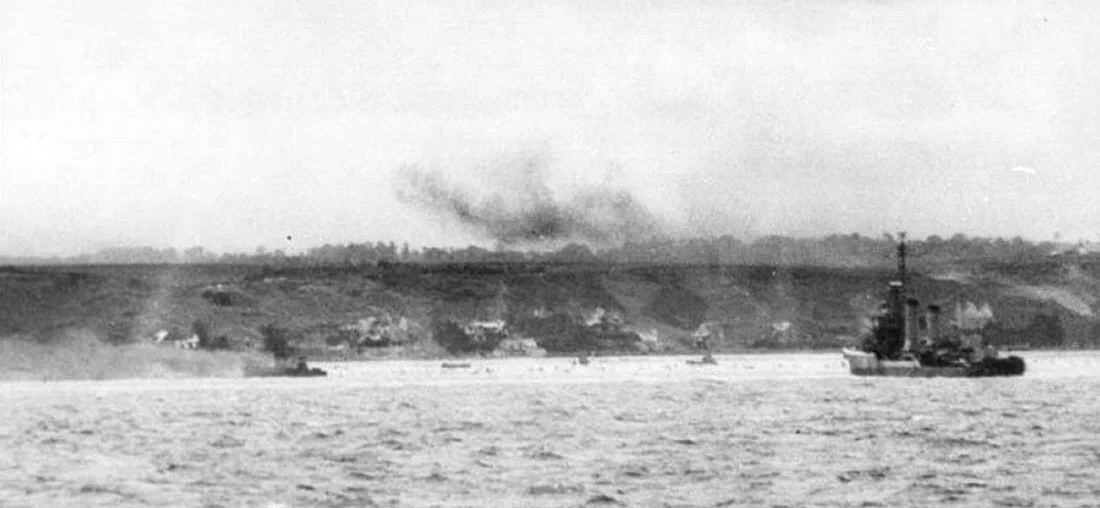
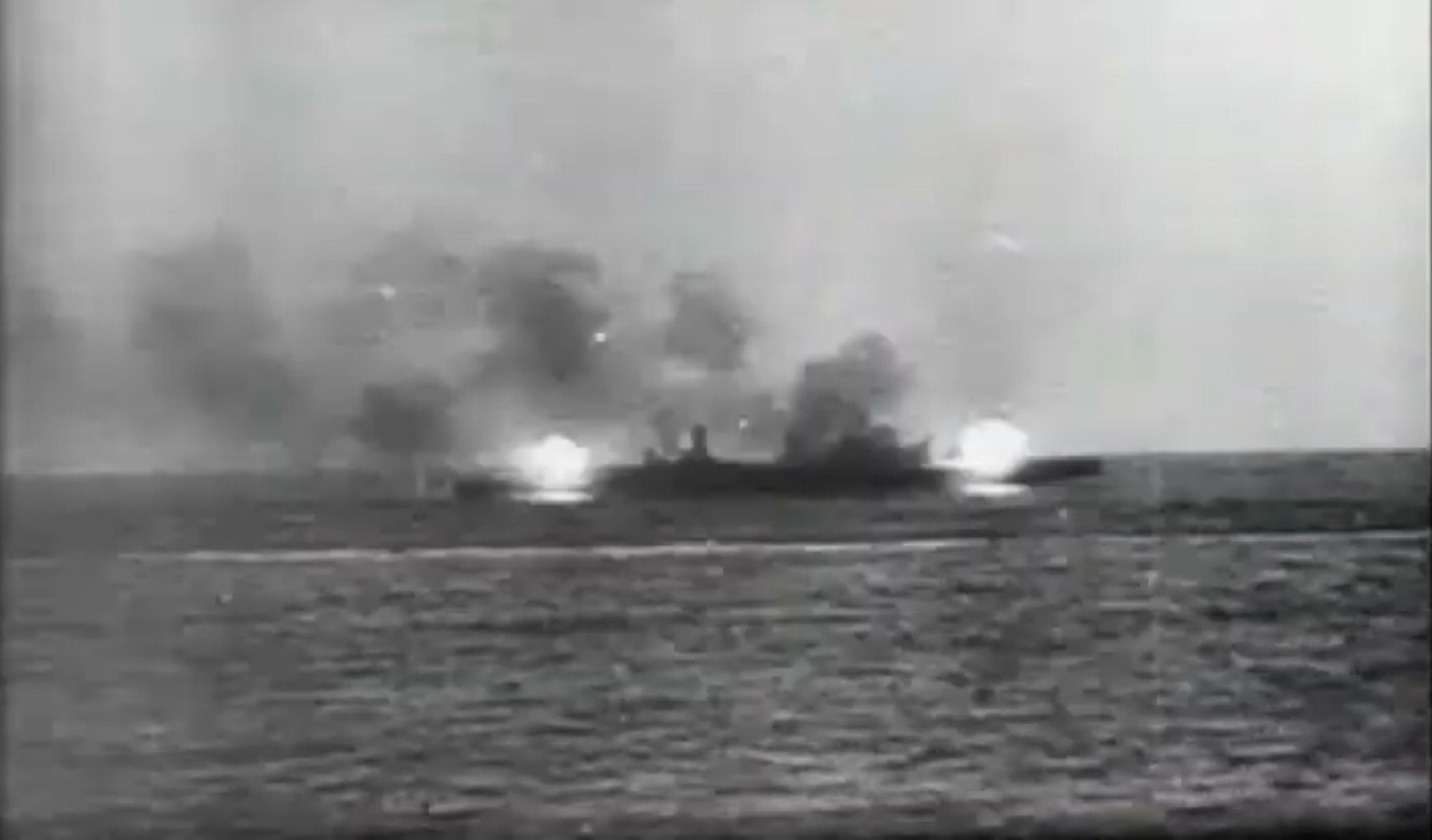
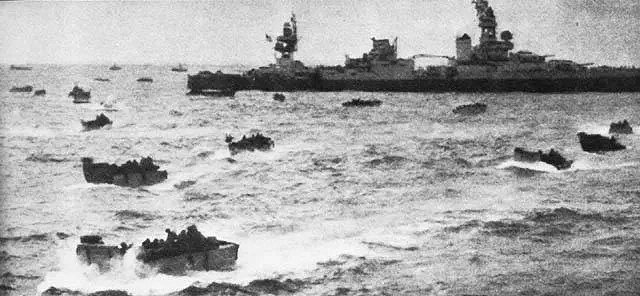
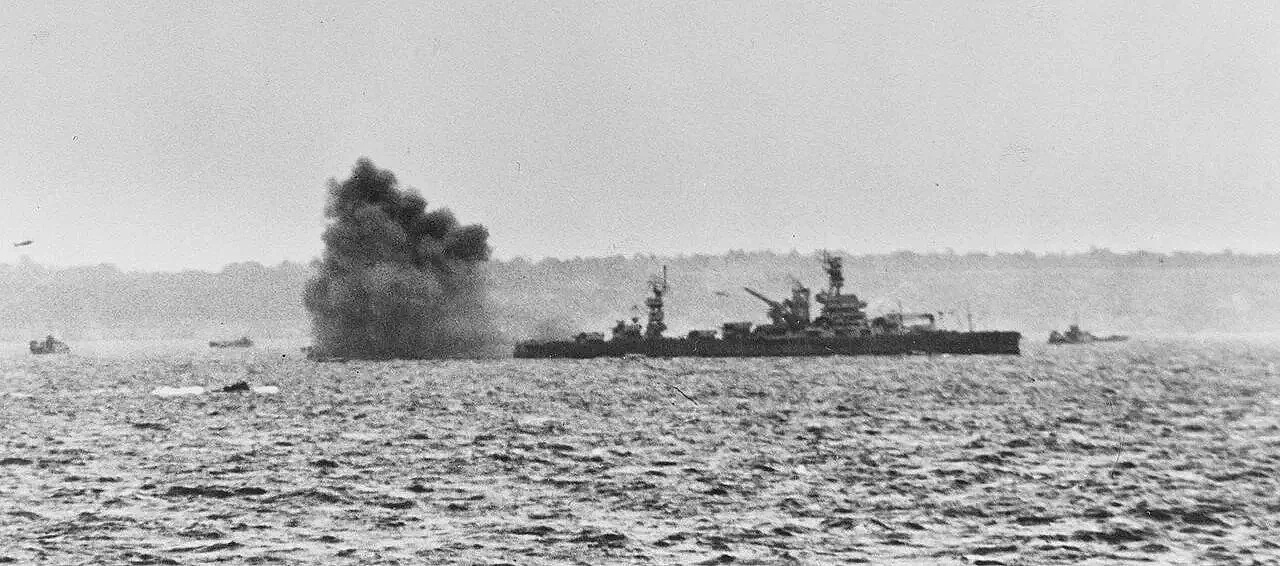
Perhaps the single greatest failure at Omaha Beach was the bombardment plan. Despite the efforts of 16 bombardment ships and dozens of supplemental bombardment craft, German defenses emerged sufficiently undamaged to virtually stop the invasion at the shoreline for the first hours. Many reasons have been advanced for this failure, to included a shortage of bombardment ships, too short of a bombardment window and the failure of the heavy bombers to hit the beach defenses.
This three-part series examines the facts behind the bombardment controversy and attempts to separate the valid criticisms from the popular misconceptions. This installment, Part I, explores the operational environment and how it shaped the basic concept of the landings, as well as how that constrained bombardment operations. Part II will examine in detail the bombardment plan developed for Omaha Beach, and Part III will analyze how effectively that plan was executed.
Join me to see what really lies behind the popular versions of the Omaha bombardment failure.
American Battleship USS Texas (BB-35) off Norfolk, Virginia in March 1944. The Texas was one of two WWI-era battleships assigned to Assault Force O at Omaha. She mounted ten 14-inch guns in five double turrets, and six 5-inch guns in casemate mounts. (NARA 80-G-63542)
The Failed Bombardment
One of the most infamous failures during the Omaha landings was the bombardment plan, a failure that saw infantry land in the teeth of strong defenses which had not been neutralized. There has been no shortage of critics or shortage of criticisms of this plan. There were not enough bombardment ships. There was too little time for bombardment. The bombardment relied too heavily on air power. The bombardment counted too heavily on makeshift fire support assets. And the list goes on.
And honestly, there is more than a grain of truth to each of those accusations. But what these critics—who, for the most part argued from their own single, narrow perspective—failed to consider were the constraints under which Neptune operated. Were there too few bombardment ships? Perhaps, but Eisenhower used all that he could wrangle from the Combined Chiefs of Staff. Was the bombardment window too short? Perhaps, but it was all the time that could be spared. Was there too much reliance on airstrikes and on ‘gimmick’ fire support craft? Perhaps, but these were necessary stopgaps to compensate for the paucity of bombardment ships. The fact is that the Neptune planners did not accept those limitations because they mistakenly thought they were the best solutions. No, they were accepted as the best options available in the face of limited resources, and within a unique and disadvantageous operational environment.
The stark fact is that the final bombardment concept was the product of numerous constraints and unavoidable tradeoffs with which the Neptune planners had to contend. Many painful compromises had to be made between equally important, yet conflicting considerations. As this series will illustrate, the bombardment would fall short at Omaha on 6 June due to several underappreciated factors which combined to produce a flawed plan and prevented effective execution of that plan.
HMS Glasgow (C21), a British Town class light cruiser assigned to Assault Force O at Omaha. She mounted twelve 6-inch guns in four triple mounts.
The Concept of the Assault
As the SHEAF command structure coalesced in the last months of 1943 and the beginning of 1944, the various new commanders began to reassess the plans left to them by LTG Frederick Morgan, who, as the Chief of Staff, Supreme Allied Commander (COSSAC) had conducted the invasion planning before General Dwight Eisenhower had been selected as the Supreme Allied Commander. Both General Eisenhower and General Bernard Montgomery (the 21st Army Group Commander-designate) had opportunities to briefly review these plans while still assigned to the Mediterranean theater, and had independently come to the conclusion that the invasion needed to be stronger and launched across a broader front.[1] After taking command of 21st Army Group (initially the land component of SHEAF) Montgomery formally proposed an expansion of the invasion in January, resulting adoption of the five-division plan and extension of the invasion front to include a landing on the Cotentin Peninsula (at Utah Beach, on the west side of the Vire estuary).[2]
Meanwhile doubts had been growing about the fundamental nature of the assault. The operational environment of the Mediterranean had influenced the evolution of amphibious doctrine over the course of several landings in that theater, resulting in a technique that Admiral Bertram Ramsay (the Allied Naval Commander-in-Chief for Operation Neptune) would term the Silent Assault. To oversimplify, this technique called for the invasion fleet to silently approach the objective area and land infantry assault waves well before dawn with little or no preparatory bombardment. By dawn, the initial infantry waves would secure a limited beachhead against light opposition, and larger craft carrying heavier weapons would land behind them as quickly as possible. It was a system that functioned well in areas of minimal defenses, manned by enemies not inclined to fight to the death, and in areas either isolated from reinforcements or that were difficult to reinforce. The technique stood at virtually the polar opposite extreme of the technique generally used in the Central Pacific campaigns. The objectives in the Central Pacific[3] were normally completely isolated, heavily defended and fanatically manned, which combined to demand extremely heavy preparatory fires, often lasting days.
GEN Morgan’s Outline Overlord Plan did not address whether the landings should be in daylight or at night,[4] but most of the key Neptune leaders had previously participated in landings in North Africa or the Mediterranean, and so brought with them to Neptune the expectation that a similar silent assault technique would be employed in Normandy.
But the Normandy coast was neither North Africa nor the Mediterranean. In some key respects, it was the worst case operational environment. The beaches were much more heavily fortified and heavily manned. That fact would normally call for serious preparatory fires before landing troops, which in turn would argue for a daylight attack. But this consideration collided with another operational characteristic.[5]
The extensively developed European road, rail and water networks enabled the enemy’s local reserves to be quickly committed, and similarly facilitated rapid deployment of his operational and strategic reserves from greater distances. Thus, every minute of delay between discovery of the invasion fleet and the first troops hitting the beach gave the enemy time to reinforce. As Samuel Elliott Morrison acknowledged in his History of United States Naval Operation in World War Two,
“They had to have tactical surprise, which a long pre-landing bombing or bombardment would have lost . . . Even a complete pulverizing of the Atlantic Wall at Omaha would have availed us nothing, if the German command had been given 24 hours' notice to move up reserves for counterattack."[6]
This consideration called for the absolutely shortest time possible between discovery of the fleet offshore and the first troops setting foot on the beach.
The Montcalm, one of two French La Galissonnière class light cruisers assigned to Assault Force O at Omaha. She mounted nine 6-inch guns in three triple turrets. (NARA 19-N-48998)
Perhaps the first to realize the significance of the different conditions was Ramsay. At least he gave the impression he was. In his diary he recorded that on 10 February 1944, he met with Montgomery to discuss the nature of the proposed landing operations.[7] He said he convinced Montgomery the silent assault technique was wrong for Neptune, although he did not specify exactly what he proposed in its stead. Although Montgomery had only recently arrived to assume his role, he had already pushed through his demand to expand the size of the invasion, underscoring his familiarity with the planning. And in that process, was undoubtedly influenced by one of his subordinate commanders.
Two months earlier, on 14 December 1943, Lieutenant General John T. Crocker (Commanding General, British I Corps) had conducted an analysis of the situation which had come to much the same conclusion as Ramsay’s. Quoting from Harrison’s Cross Channel Attack:
“The first essential, he [Crocker] said, was the development of ‘overwhelming fire support from all sources, air, naval and support craft ... to cover the final stages of the approach and to enable us to close the beaches. This requires daylight.’ Mediterranean experience, in his view, had shown that the effectiveness of naval fire depended on observation and that it had been much greater than was previously supposed. At least forty-five minutes of daylight, he estimated, would be necessary for full use of fire support, and he concluded that H Hour should be within one hour of first light.”[8]
That thinking was generally accepted and was incorporated into the Neptune Initial Joint Plan (issued 9 days before Ramsay’s diary entry):
“H Hour
“It is defined as the time at which the first wave of landing craft should hit the beach; which will be
“a. About l 1/2 hours after nautical twilight, and
“b. About 3 hours before high water.”[9]
This shows that at an early point the matter had been closely studied, that there was a recognition that the Mediterranean style assault was not applicable, and that a daylight assault shortly after dawn was called for. Over the following months, many debates would rage over the exact details, and the specific timing of H-Hour would be batted back and forth almost endlessly. One result was a later change to the above Initial Joint Plan paragraphs which added: “so as to allow a minimum period of thirty minutes daylight for observed bombardment before H Hour.” Nevertheless, the basic nature of the assault had been decided by 1 February. And both the senior naval commander (Ramsay) and senior ground commander (Montgomery) were in accord. As Ramsay stated in his report on Operation Neptune:
“7. The one fundamental question on which there had to be early agreements was whether to assault during darkness so as to obtain the greatest measure of surprise on the beaches, or whether to assault after daylight and to rely on the greatly increased accuracy of air and naval bombardment under these conditions. The decision which was made, to make a daylight landing, was in accord with experience in the PACIFIC against strong defenses, when the assaulting force possessed decisive naval and air superiority, and I am convinced this is the correct answer under these conditions.”[10]
So, daylight was essential to bring accurate preparatory fires to bear, yet the time to employ that fire support had to be severely curtailed in order to minimize the enemy’s opportunity to reinforce. Striking a blance between the two imperatives would not be easy.
Nevertheless, the azimuth had been set by the leaders, and the planners set about their tasks. Yet even as the Neptune planners came to grips with devising a new assault technique suited to the Normandy conditions, they had to contend with the longstanding shortage of naval assets. There had been few enough ships and craft to support the original three-division assault. Now, the expansion of the invasion to a five-division assault merely made matters much, much worse. The original intent was that the invasion would be primarily supported by British naval forces, but this expansion demanded greater commitments from the US Navy. And the US Navy was not receptive to any diversion of ships that would distract from its Pacific Campaign (not to mention its many other critical missions). We’ve previously discussed the resulting shortage in shipping and landing craft, so it is no surprise that bombardment ships were in short supply as well.
As Ramsay and Montgomery were grappling with these issues a new factor had come into play. German General Erwin Rommel assumed command of Army Group B on 15 January 1944 and immediately began to strengthen the defenses. The first indications of his impact were just being noticed by Allied intelligence in January and February, and their full implications would not be appreciated for several weeks. The scope and speed of Rommel’s activity would be an unwelcome surprise. The Neptune planners were struggling to cope with the challenges of the enemy defenses as they understood them in January and Februrary1944, even as the enemy was rapidly increasing the physical defenses and reinforcing those defenses with additional units. Rommel was moving the goalposts on the invaders, and the fact is that the Neptune commanders and their staffs would be involved in a game of catch-up for the next few months. A belated response to the multiplying obstacle fields saw the creation of the obstacle clearance plan and formation of units to execute it. And that plan would have to be executed in the initial act of the invasion as well.
American destroyer USS Satterlee (DD-625). The Satterlee was one of nine Gleaves class fleet destroyers assigned to Assault Force O at Omaha. The Gleaves class destroyers mounted either four or five 5-inch guns in single mounts. The Satterlee is picture here in Belfast Lough three weeks before D-Day. In the background are two more Gleaves class destroyers; all three ships were part of Destroyer Squadron 18 (DESRON18). (NARA 80-G-367828)
The First 120 Minutes
A full discussion of the many factors that influenced the selection of H-Hour at Omaha is beyond the scope of this installment, but I will touch on some of the more important aspects as they related to the bombardment plan. Essentially, the Omaha Assault Force planners (Admiral Hall’s CTF 124, working in conjunction with the Army V Corps) had to carefully orchestrate a complex sequence of actions within a roughly two hour period. Two factors would help define the beginning of the assault window. The first was light; specifically, the earliest time naval bombardment ships would have enough light to conduct observed fire. Sunrise on 6 June would be at 0558 hours, and they might be able to take advantage of the last few minutes of morning civil twilight as well, especially if spotting aircraft were available. The second factor was the tide; the Navy needed a rising tide to enable them to retract after unloading their landing craft, and low tide would be at 0530 hours. The end of the critical window would also be dictated by the tide, and that would be when it was so far up the beach that the obstacle clearance teams would have to cease work. That would be approximately 0800 hours. Ideally, the obstacle clearance teams needed to land as early as possible to have the most time to do their job, but the first wave of infantry had to go in before the obstacle teams, and the earlier they went in, the more open sand they would have to cross under fire. Potentially this could be as much as 350 yards, which would be suicidal. So, the first wave could not go in too early. As a result of all these factors (and many more) a critical window of roughly two hours was established for the start of the landings: 0558 hours (sunrise) to 0800 hours (the tide amid the obstacles). And in the middle of everything that had to take place in those two hours, the planners needed to squeeze in 45 minutes for air and naval bombardment, a figure that carried forward from Crocker’s analysis. As you can see, the final landing schedule entailed a series of cruel tradeoffs between equally vital but usually incompatible considerations.
To no one’s complete satisfaction, H-Hour was set at 0630 hours. However, it is important to keep this in context. Each and every H-Hour decision is a matter of compromising between the needs of different elements of the attack force. The more complex the operation is—and Neptune was about as complex as they come—the more tradeoffs are necessary. Having said that, it was clear it would be a rough two hours at Omaha.
The bottom line, as far as the bombardment mission was concerned came down, to 32 minutes between sunrise (0558 hours) and H-Hour (0630 hours). Hall’s planners moved the start of that window forward to 0550 hours, counting on the growing visibility at the end of civil twilight, and that was as close to Crocker’s 45 minutes as could be managed.
[As difficult as the conditions were for 6 June, it should be noted that H-Hour on the original invasion date, 5 June, was 20 minutes earlier, at 0610 hours. That would have meant most of the bombardment would have been conducted during insufficient light, likely resulting in less damage to the defenses and far higher casualties among the assault troops.]
The British escort destroyer HMS Tallybont, one of three Hunt Class (Type III) escort destroyers assigned to Assault Force O. These Hunt class escort destroyers mounted four 4-inch guns in two twin turrets.
Too Few Guns
Ideally, if you have less time to fire your preparatory bombardment (and Hall had not been happy with the 45 minutes he did have), you want to increase the number of guns firing in order to deliver the required metal on target. But, as noted above, Neptune as a whole was being conducted on something of a naval shoestring, and this held true for bombarding assets as well. Bombarding types of ships (destroyers, cruisers and battleships) were at a premium, especially with the US Navy, which was husbanding its fleets for Pacific campaigns. The British were no less reluctant to take capital ships from the Home Fleet, which was standing guard in case of a sortie by the remaining German capital ships.[11] To address this shortfall, in late December 1943, RADM Kirk (commanding the Western Naval Task Force - TF 122) sent Washington a list of requirements for bombardment ships; no action was taken. After the expansion of the assault to the five-division plan the following month, the deficit widened and pressure mounted for a greater US Navy contribution. The matter came to a head on 13 February at a dinner being held in conjunction with a conference to iron out landing craft allocations. RADM Cooke (chief planner for the US Navy’s Commander in Chief, ADM King) was present when Hall exploded in frustration over the lack of bombardment ships. Cooke reprimanded Hall for the outburst, but he also saw to it that three old US battleships and a squadron of nine US destroyers were provided.[12]
Initially, bombardment ships for Omaha, as allocated in Ramsay’s naval orders for Operation Neptune (ON 8, issued 14 April 1944, dealt with bombardment) amounted to: one heavy cruiser, five light cruisers and an unspecified portion of 22 destroyers and escort destroyers. (See Figure 1). It wasn’t much. By comparison, the US pre-war amphibious doctrine called for a bombardment force of three battleships, four light cruisers and 8-16 destroyers for an assault the size of the Omaha landings.[13] As measured by this doctrinal template, Omaha was under-supported when it came to naval bombardment.
A week later, RADM Kirk’s Western Naval Task Force (CTF 122) operation order was issued, and it reflected Cooke’s reinforcements, which were split between Omaha and Utah Assault Areas.[14] For Omaha, two battleships had been substituted for one heavy and two light cruisers (the third battleship Cooke had secured went to Utah Beach). The loss of three cruisers (nine 8-inch guns, sixteen 5.25-inch guns and eight 5-inch guns) for the gain of two old battleships (ten 14-inch guns, twelve 12-inch guns and twelve 5 inch guns) apparently suited Hall, an old battleship admiral. He gained heavier guns in his primary batteries and increased his secondary batteries by 50%. The punch these old WWI-era battleships offered was very welcome.
Figure 1. A comparison of the original bombardment ships allocated to the Omaha Assault Force under ON 8 and the final allocation as shown in the CTF 122 operation Plan.
What was perhaps less welcome in this new ship allocation was the assignment of the Royal Navy Hunt class escort destroyers. The US fleet destroyers were of the Gleaves class, which mounted either four or five 5-inch guns. The Hunt class escort destroyers mounted four 4-inch guns.[15] The 4-inch gun was not a bad weapon, and in fact, at 102mm was comparable in caliber to the 105mm howitzer that was the standard US divisional artillery weapon. But besides the smaller gun, the Hunts carried fewer rounds per gun than the Gleaves (250 vs 400).[16]
Figure 2 details the gunpower these ships mounted for naval bombardment.
Figure 2. A summary of the type and number of bombardment guns available on the battleships, cruisers and destroyers allocated to the Omaha Assault Force.
One hundred and fifteen guns sound like an impressive number, but was it an adequate number to get the job done? As we’ll see, that answer depended on how you define the job, and which part of the doctrinal template you chose to apply.
Two other points factor into that question, as well. First, not all of these guns would be available for softening up the beach. A significant percentage of them would be dedicated to counter-battery fire against enemy coastal artillery batteries, such as those on Pointe du Hoc and at Port en Bessin. Second, six of the 5” guns, mounted in the battleships‘ secondary batteries, would be on the unengaged sides of the ships, and not be able to bear on a target. So, the total of 5” guns, as shown in Figure 2, would be reduced by 12% to 44 guns.
Hall’s Force O (Omaha) was fortunate in one small respect. All of his US ships had arrived in the UK by 28 April, in sufficient time to prepare for D-Day, unlike at least one division destined for Utah that barely arrived in time. Information is scarce about participation of the US destroyers and battleships in Exercise Fabius I, the final D-Day exercise. It is known that USS Thompson did participate, and that tends to indicate the rest of Destroyer Squadron 18 (DESRON18), the formation these destroyers belonged to) did as well. After that exercise, DESRON18 held about a week of additional gunnery exercises. This training was no doubt valuable. Although all the DESRON18 destroyers had been in commission for over a year, they had primarily been tasked with convoy support missions. D-Day would be their first combat experience in shore bombardment. Although unbloodied and new to the shore bombardment role, there was no reason to doubt their ability.
The situation with the battleships is not entirely clear. In his Action Report on Operation Neptune, RADM Bryant (commanding Battleship Division 5, and within TF-124 framework he commanded CTF 124.9, which was the Bombardment Group) discussed bombardment training after arriving in the UK, but nothing in the area of the Fabius Exercise, likely due to the limited live fire ranges at the rehearsal area. The Texas had already seen combat during WWII, starting with Operation Torch. The Arkansas, which had spent the bulk of the war either as a training ship or on escort duty, had yet to fire a gun in anger in this war.
Supplementary Efforts
Clearly, more gunfire support was needed. To complement and reinforce the usual bombardment battleships, cruisers and destroyers, a number of other craft would provide supporting fires. Some of these were ad hoc solutions, some were systems new to the theater and not well understood, and some were such wild ideas that RADM Hall would dismiss them as gimmicks.
The first group in this category were the Duplex Drive (DD) tanks. Although part of the Gunfire Support Group (as distinct for the Bombardments Group consisting of the ‘real’ bombarding battleships, cruisers and destroyers), they would play no role in the preparatory bombardment; their role was to support the leading assault waves after landing. For that reason, and since I have discussed them thoroughly in an earlier blog series, I will skip over them here.
The second element consisted of thirty-two Sherman tanks (and 16 tank dozers) that would ride in on 16 LCTs to beach at H-hour. At the front of these LCTs (either LCT(A)s or LCT(HE)s) wooden platforms had been installed which raised the two front Shermans high enough to fire over the ramps. During the run into the beach, these tanks would provide “drenching fire” that hopefully would suppress the defenders as the first two waves landed (the first infantry wave and the gap clearance teams). As such, their role in the bombardment plan was marginal, and I’ll only lightly touch on them in the rest of this series.
The next group consisted of the Landing Craft, Tanks (Rocket) (LCT(R)s), which were LCTs fitted out with approximately a thousand 5-inch rockets. Following at a distance behind the first wave, these craft would loose their rockets so that they would impact when the first wave was 300 yards offshore. The desired impact area was supposed to be 200 yards deep and 400-700 yards wide (for an impressive theoretical density of one rocket for every 80 to 140 square yards). There were nine of these craft for Omaha.
There would also be five Landing Craft, Gun (Large) (LCG(L)), each equipped with two 4.7” guns (120mm). These craft were to operate close inshore and were assigned to engage specific targets on the beach during the last 10 minutes before H-Hour.
The next fire support category is perhaps a measure of how desperate they were to scrape up additional fire support. The 58th and 62nd Armored Artillery Battalions were equipped with M7 Priest self-propelled artillery vehicles, each mounting a 105mm howitzer. The 36 howitzers of these battalions would be mounted in 10 LCTs, and fire from those craft over the heads of the first waves. The LCTs were not stable gunnery platforms, and they would have to maintain about a 4-6 knot speed to minimize rolling and plunging. Gunnery under those conditions would be challenging to say the least, with changes in range requiring constantly updated firing data. Still . . . thirty-six 105mm howitzers were the theoretical equivalent firepower of nine additional Hunt class escort destroyers, and that was potentially a significant addition for a task force that considered itself starved for gunnery ships. At least it would be if there was some way to ensure their rounds landed somewhere close to the intended targets. In reality, they were expected to provide nothing more than what one would charitably describe as general area suppressive fire, if one wasn’t too particular about which area would actually be hit.
Also used were class 461 patrol craft (174 feet long, 280 tons and a crew of 65) which served as the primary control craft for various beach sectors. There were 6 of these, each mounting a single 3-inch gun, and each was assigned a specific target.[17]
One other category of craft would provide suppressive fire, though these were so small they were not even assigned targets in the bombardment plan. These were 21 Landing Craft, Support (Small), or (LCS(S)). Equipped with machine guns and 48 rockets, they would accompany the leading waves to beach and provide the last second suppressive fire for their accompanying landing craft.
It would appear everything that could be reasonably done to supplement the bombardment mission (and some that may not have been quite so reasonable) had been thrown into the mix. Hall, the old battleship sailor, quite naturally bemoaned having to employ such a ragtag force, but given his shortage of ‘real’ bombarding ships he had no choice.
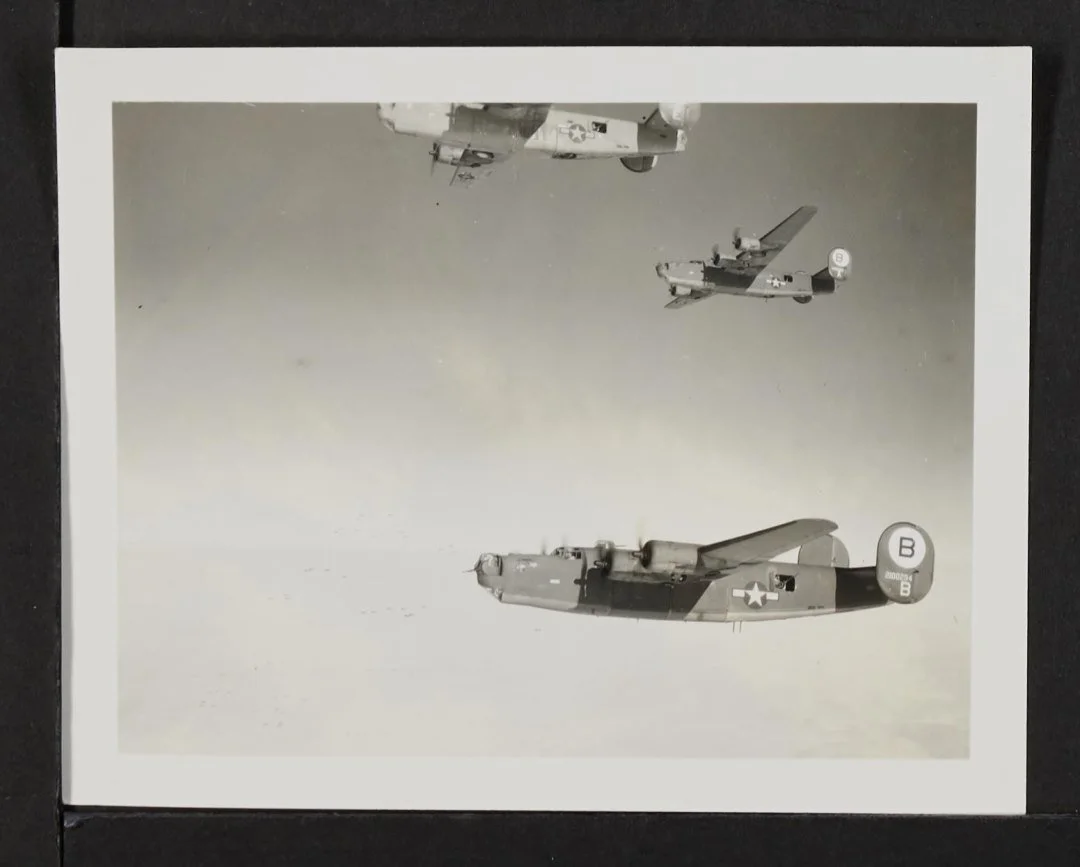
B-24 heavy bombers, such as this one, were incorporated into the bombardment plan for Omaha Beach.
Air Bombardment
Various air operations were mounted in support of Operation Neptune involving all manner of aircraft. For the purpose of this discussion, we’ll focus on the heavy bombers, whose primary mission had been strategic bombing, but had been incorporated into the tactical bombardment of the assault areas on D-Day. These bombers had two roles. During the hours of darkness, early on D-Day, night bombers would attack the German coastal artillery batteries flanking the beach, in the vicinity of Pointe du Hoc to the west and Port en Bessin to the east. The second role, commencing shortly after sunrise, was to strike the beach defenses. Approximately 329 B-24 bombers of the Eighth Air Forces’ 2nd Bombardment Division would strike the beach defenses in the Omaha Assault Area at the same time as the naval bombardment. [18] As impressive as that number is, the amount of their bombs that could reasonably be expected to actually hit the beach defenses—even had the weather been perfect—was far less than is generally realized. In the next installment we’ll examine this point in more detail. For now, suffice it to say that even had the air bombardment gone as planned, its actual potential effect on the beach defenses has been greatly overstated.
The Purpose of Bombardment – Destruction or Neutralization?
Even as Ramsay, Hall and the other naval leaders were trying to obtain additional bombardment assets, they were embroiled in another debate involving the basic question of what exactly was the purpose of the bombardment. To be more precise, what effect was the bombardment expected to achieve? The general statement of ‘pave the way for the assaulting troops’ meant nothing in a tactical sense.
The two camps in this debate were those who believed the bombardment must achieve destruction of the enemy defenses (or at least a substantial portion of them), and those who felt that goal was not possible, and believed neutralization of the enemy defenses was all that was practical. To quote the US Navy’s Landing Operations Doctrine (F.T.P. 167):
Neutralization.--Neutralization fire is area fire delivered for the purpose of causing severe losses, hampering or interrupting movement or action and, in general, to destroy the combat efficiency of enemy personnel. In the usual case, neutralization is only temporary and the target becomes active soon after fire ceases. Neutralization is accomplished by short bursts of fire of great density to secure the advantage and effect of shock and surprise. Most targets engaged by naval gunfire will be of the type for which neutralization is appropriate.
Destruction--The term is applied to fire delivered for the express purpose of destruction and when it is reasonable to expect that relatively complete destruction can be attained. Destruction should be attempted only under favorable conditions of target designation and observation.[19]
A good example of the proponents for the destruction school of thought was MG Charles Corlett. Corlett had served in the Pacific, commanding first the Kiska Task Force, and then the 77th Division during the assault on Kwajalein. He was then brought to the European Theater and given command of the XIXth Corps, which was scheduled to land on Omaha Beach shortly after D-Day. After the mistakes at Tarawa, much greater emphasis was given to preparatory bombardment for the Kwajalein landings, and Corlett believed the lessons he’d learned in that operation were ignored in the run-up to the Normandy landings. But those lessons were largely not applicable. At Kwajalein, Corlett had been able to secure a number of small islets close to the main objective and landed forty-eight 105mm howitzers and twelve 155 howitzers—his entire division artillery—on one of them. All while four battleships, two cruisers and 4 destroyers bombarded Kwajalein throughout the day of D-1. Harassing fires were maintained through the night by both the Army and the Navy (battleships Idaho, New Mexico, cruiser San Francisco and their destroyer screen). A large scale bombardment incorporating all arms was conducted the next day in support of the main landings on Kwajalein itself.
There are few, if any, relevant lessons here for the Normandy landings. Corlett didn’t have to worry about the possibility of Japanese reinforcing divisions—to include perhaps a panzer division or two—rolling up while he took a day for preliminary operations. He didn’t have to worry about nearby E-Boat or U-Boat bases or Japanese air formations stationed within range. He was able to outflank the Japanese seaward defenses by landing from the less defended lagoon side. And Kwajalein was only 2.5 miles long and 800 yards wide, flat, lacking beach obstacles and mostly lacking vegetation. And it still took him longer to secure the island than it would take to secure the equivalent beach area at Omaha.
The comparison really falls apart when one considers the preparation. The Kwajalein naval bombardment totaled something less than 7,000 rounds during D-Day, most of which were fired during the beach preparatory bombardment. The Omaha Beach bombardment was scheduled to deliver 6,297 rounds for the preparatory bombardment alone. So, despite having more and heavier naval gunfire for Kwajalein, the planned Omaha bombardment was effectively equivalent, if not perhaps even greater. The real difference was not so much the naval bombardment, but the support provided from Corlett’s own Army guns. The 60 howitzers that were landed the previous day consisted of the entire 77th Division Artillery. And those 60 guns—whose accuracy had the advantage of solid ground, not rolling ships—fired 29,000 rounds during Kwajalein’s D-Day.[20] At Omaha there was no convenient island to preposition Army firepower, and even if there had been, there was no time to emplace it or fire a prolonged barrage. The Pacific model simply did not fit.
Corlett was an excellent general, and did a fine job commanding the XIXth Corps, so much so that he was later transferred back to the Pacific to command another corps for the planned invasion of Japan. But in pressing for a Pacific-style bombardment, he’d brought the wrong experience to the Normandy operational environment. He was bitter at the way he perceived his advice was ignored within SHAEF, but his advice was wrong.
Despite the inapplicability of the Kwajalein model, RADM Hall nevertheless embraced it to support his position:
“Using Kwajelein [sic] as a basis for a rough comparison, and disregarding other considerations, the landing of four times the number of troops against three time the defensive strength would call for an amount of naval gunfire support at Omaha many time greater than that employed at Kwajelein. Yet the weight of metal delivered at Omaha defenses was one-third that used at Kwajelein . . . Though the amount of naval gunfire to be delivered in a given situation cannot be arrived at mathematically, and though naval gunfire alone will not necessarily insure a successful landing . . . the foregoing rough comparative figures will serve to substantiate the conclusion that Omaha Beaches during the pre-landing phase, not enough naval gunfire was provided.”[21]
Probably the best proponent of the neutralization school of thought was Ramsay himself. He was influenced in this matter by a report titled "Fire Support of Sea-Borne Landings Against a Heavily Defended Coast” (the so-called Graham Report).[22] Although Graham was a Royal Air Force officer and his report focused primarily on the air contribution, it provided two insights that would largely govern the naval bombardment plan as well.
“a. Casemated batteries probably could not be destroyed by bombardment, but could be sufficiently neutralized to render them acceptably ineffective until the army could capture them. The report also calculated in detail the weight of fire required to do this.
“b. Beach defenses could best be neutralized by "beach drenching," which would force the defender underground and numb his mind and nerves. Aimed fire in the dust and smoke of battle would be less likely to accomplish this.” [23]
In other words, direct hits on individual bunkers, weapons positions and concrete troop shelters were highly unlikely with any reasonably sized naval bombarding force, so the emphasis should be on the more achievable goal of neutralization. (Graham’s final sentence in that quote would prove prophetic.)
This thinking was translated into Ramsay’s ANCEX orders.
“2. The object of the naval bombardment is to assist in ensuring the safe and timely arrival of our forces by the engagement of hostile coast defenses, and to support the assault and subsequent operations ashore.
“This will involve the following tasks:
“(a) Neutralization of coast defence and inland batteries capable of bringing fire to bear on the assault beaches or sea approaches until each battery is captured or destroyed,
“(b) Neutralization or destruction of beach defenses during the final approach and assault.”[24]
While the wording of this order included the term ‘destruction’, any such results would be incidental, and they were not to be counted on.
This focus was rooted in a firm grasp of reality. Not only was there not time available for a more comprehensive bombardment, but a significant portion of the available firepower could not be dedicated to shelling the beach defenses. As paragraph (a) of the above quote specified, the bombarding ships also had the defensive mission to neutralize any coastal artillery positions that might threaten the landing. And that requirement would demand a large portion of the cruisers’ and battleships’ firepower. At Omaha, for instance, the Texas fired not a single 14-inch projectile on the principal beach landing sectors during the preparatory bombardment; every single one of the 262 14-inch rounds allotted for its preparatory bombardment was targeted on or near the coastal artillery battery at Pointe du Hoc. Similarly, the entire firepower of one of the three cruisers was dedicated to neutralizing German guns in the vicinity of Port en Bessins.[25]
In fact, battleships were allocated specifically on the basis of the number of key coastal artillery batteries that threatened an assault area, and Omaha had just two: Pointe du Hoc, and Longues-sur-Mer - and the latter was within the Gold Assault Area and was to be targeted by a capital ship belonging to the Gold Assault Force. So, this interpretation of the doctrinal template did not indicate Omaha was under-supported in battleships or cruisers
Ramsay’s objective of neutralization focused on what he thought was possible, and in this he was supported by the very same FTP-167 that Hall had selectively cited. That publication specified that a four- or five-gunned 5-inch destroyer could neutralize a 200 yard by 200 yard area with 80 rounds of rapid fire. Further, it could neutralize six such targets an hour. As the bombardment period was scheduled for 40 minutes, each destroyer should have been able to neutralize four targets. But no destroyer at Omaha was assigned four targets. One destroyer was assigned to just a single target, most were assigned just two targets, and only one was assigned three targets. The destroyers should have had ample time and ammunition to neutralize their assigned targets. A similar analysis for the cruisers produces the same results. Glasgow, for instance, was assigned two targets within 200 yards of each other (its area of coverage for a twelve-gun broadside was 300 yards by 300 yards), and the ship was allotted more than three times the doctrinal number of rounds necessary to neutralize those targets. So, a persuasive argument can be made that there was not in fact a shortage of bombardment ships at Omaha. The fact that none of these targets was actually neutralized by the D-Day preparatory bombardment suggests we need to examine whether there were shortfalls in how the bombardment was executed, as opposed to faulting the number of ships available.
In the next installment, I will examine the actual bombardment plan, illustrate how it was organized and show how the targets selected for the various supporting ships would combine to (hopefully) create a fully integrated neutralization of the defenses at key locations across the length of Omaha Beach. In the third installment I will examine how well that plan was executed, and how it fell short.
Concluding Thoughts
One of the continuing themes of this Omaha Beach Series has been that Neptune was under-resourced, and that chronic lack of resources affected how the operation was executed and how well it succeeded. In the matter of the bombardment mission, this theme is not as applicable as I initially thought. Yes, one reading of the amphibious doctrinal template definitely called for more bombardment ships and greater time for the bombardment. But the one true limiting criterion was the time allocated for the bombardment, and that was dictated by hard realities. The debate of neutralization vs destruction was fruitless, as destruction simply could not be achieved within a timeframe suited to the operational environment.
Further, even if RADM Hall had been allotted more bombardment ships, there is a real question as to whether he could have employed them profitably in the crowded fire support areas. As we’ll see in a later installment, some of the ships he did have were not used to their full extent due to other bombardment ships masking their gun-target lines.
Any commander with any common sense instinctively wants more combat power, especially fire support, but few ever get what they want. Or even need. The mark of a good commander is how well he employs the fire support he does have. And that’s the question we will pursue in the following installments: was the bombardment plan for Omaha as efficient as it reasonably could have been, and did its execution on 6 June live up to its objectives.
Finally, I want to stress once again that simplistic analyses continue to grossly misrepresent how the plan developed. An example is this quote from a 1998 US Naval Institute article:
“It is more accurate to state that the Allied leaders and planners of the Normandy invasion did not display the level of professionalism expected this late in the war. For the Normandy invasion, the Allied commanders ignored tested doctrine and thus ignored the cumulative body of knowledge in amphibious operations gained through hard-fought battles in North Africa, Sicily, and Tarawa. Montgomery and Bradley used an unproved means to deliver the vast majority of the combat power needed to overcome the defense. They failed to trouble-shoot their primary plan—air power—and to fully a back-up plan [sic]—naval gunfire, and so, the Allied plan failed at the most heavily defended beach.“[26]
That passage is particularly objectionable as it placed the entire blame for the naval bombardment on two Army officers, completely ignoring the fact that naval bombardment was, obviously, a naval responsibility, and the bombardment plan was written by naval staffs and approved by naval commanders. Indeed, the landings were commanded by naval officers, with Army commanders in subordinate positions. Given this, it’s hard to believe the author chose to completely ignore the role of Ramsay in the Neptune planning, or the US Navy’s role in allocating bombardment ships. This is not to deny army involvement, for of course it was a joint operation, and ground commanders presented considerations that had to be factored into the many painful trade-off decisions. But to place all the blame on Montgomery and Bradley is patently absurd.
So too was that the comment that Bradley and Montgomery “ignored the cumulative body of knowledge” gained in the course of Mediterranean operations. They didn’t use many of the Mediterranean (or Pacific) techniques simply because: 1) they didn’t have the naval combat power necessary; or 2) the operational characteristics of the Normandy coast made those techniques either irrelevant or extremely dangerous to the chances of success.
The author is marginally more on point when he says they failed to trouble-shoot their primary plan and have some sort of backup plan in case the air support failed. Ideally, that’s a very good point, and all good plans should have such contingencies. But it is one thing to hurl that doctrinal accusation, and quite another to imagine what possible contingency plan was feasible. Could they magically draw on three or four more battleships when, at H-15, the bombers hadn’t arrived? Did they have the option to delay the Omaha landings – and only the Omaha landings - until better weather showed up? No. Of course not. Such criticism is meaningless if there is no better alternative.
The weather for Neptune was a gamble. A famous one. A dangerous one. And while it had tragic consequences for the landings at Omaha Beach and the airdrops of the 82nd and 101st Airborne Divisions, it also ensured priceless surprise across all the assault areas, from the tactical level through the strategic level. The weather that foiled the air support at Omaha also permitted the vast invasion fleet, sailing from dozens of ports, to miraculously arrive off the beaches undetected. And that surprise worked in the favor of the Omaha landings.
Rare is the commander who has the luxury of ample assets for an operation. At Omaha, no more ships were to be had. No more time was available. And the weather was beyond anyone’s control. ADM Hall had what he had to work with. It’s as simple as that. The question before us in the next installment is, how well did Hall use the assets he was provided?
[1] Pogue, Forest, United States Army in World War II, The European Theater of Operations: The Supreme Command (CMH Publication 5-6), Center of Military History, United States Army, Washington, D.C., 1989, pg. 108.
[2] An additional invasion area was also added in the Eastern Naval Task Force sector.
[3] As opposed to GEN MacArthur’s Southwest Pacific theater, where the geography generally enabled the selection of generally lightly held or undefended beaches.
[4] Harrison, Gordon, Cross Channel Attack, Center of Military History, U.S. Army, Washington, D.C. 1993, pg. 73.
[5] This is not to overlook several important advantages the theater offered, such as being within fighter range of the UK, the relatively short distances between staging bases in the UK and the invasion beach, and many others.
[6] Samuel Eliot Morison, History of United States Naval Operation in World War Two, Vol XI, The Invasion of France and Germany 1944-1945, Little, Brown, and Co., Boston, 1957. P. 152-3.
[7] Love, Robert and Major, John, editors, The Year of D-Day; The 1944 Diary of Admiral Sir Bertram Ramsay, The University of Hull Press, 1994, pg. 24.
[8] Harrison, pg. 189.
[9] Neptune, Initial Joint Plan, (NJC 1004), dtd 1 Feb 1944, see Section V, Assault Phase.
[10] Ramsay, Bertram, Report by the Allied Naval Commander-in-Chief Expeditionary Force on Operation Neptune, pg. 6 (covering letter).
[11] Morison, pp 55-56.
[12] Godson, Susan, Viking of Assault; Admiral John Lesslie Hall, Jr., and Amphibious Warfare,1982, University Press of America, pg. 124.
[13] Department of the Navy, F.T.P. 167, Landing Operations Doctrine, 1938, US Government Printing Office, pg. 122.
[14] CTF-122 Operation Plan No. 2-44, dtd 21 April 1944, Task Organization.
[15] As the primary mission of these escort destroyers was to protect convoys from submarines, their main battery did not require larger guns. In a similar vein, many of the US destroyer escorts were armed with 3-inch guns.
[16] CTF-122 Operation Plan No. 2-44, dtd 21 April 1944, Appendix 1 to Annex D. See also ANCX Naval Operation Orders for Operation Neptune, ON 8, Appendix III.
[17] The 3-inch gun is small by naval standards, but with a bore of 76mm, it compared favorably with the 75mm guns mounted on the Sherman tanks. The 3-inch guns that made up the tertiary batteries of the battleships also would provide good service on D-Day. Although not incorporated into the bombardment plan.
[18] Hennessy, Juliette, US Air Force Historical Study No. 70; Tactical Operations of the Eighth Air Force, 6 June 1944 – 8 May 1945, USAF Historical Division, Air University, 1952, pg. 25. There are conflicting reports on this number, and the matter will be examined further in the next installment.
[19] Landing Operations Doctrine, United States Navy F.T.P. 167, 1938, Ch V.
[20] Crowl, P and Love, E, United States Army in World War II, The War in the Pacific: Seizure of the Gilberts and Marshalls (CMH Publication 5-6), Office of the Chief of Military History, Department of the Army, Washington, D.C., 1955. Chapter XIV, pg. 231.
[21] COMINCH P-006, Amphibious Operations, Invasion of Northern France, Western Task Force, June 1944, pg. 2-27
[22] See Ramsay’s Report by the Allied Naval Commander in Chief, Expeditionary Force on Operation ‘Neptune’, dtd October 1944. Vol I, Annex 5, pg. 64
[23] United States Naval Administration in World War II. United States Naval Forces, Europe. Volume V, Operation NEPTUNE - The Invasion of Normandy, 1948, pg. 489
[24] Allied Naval Commander in Chief, “Expeditionary Force, Operation Neptune, Naval Operations Orders,” dtd 10 April 1944, pg. 124.
[25] And that was just what the plan anticipated. In the event even more firepower was required for Port en Bessin.
[26] Lewis, Adrian, The Navy Falls Short at Normandy, US Naval Institute History, Dec 1998, Vol 12, Number 6.
The Duplex Drive Tanks of Omaha Beach, Part (b) Confusion of Command
Faced with an acute shortage of both naval ships and time for pre-landing bombardment, the U.S. Army sought other means to give the leading waves an advantage in firepower. One of these solutions was the Duplex Drive tank, which through the use of flotation screens and add-on propeller kit, could be launched from offshore and swim to the beach. For the Omaha landings, however, the concept was met with cool disdain by the amphibious commander. As a result, the planning for employment of these tanks was vague, sketchy and disjointed. This installment examines how the planning - or lack of planning - set the confused conditions which contributed to the loss of so many DD tanks at Omaha on D-Day.
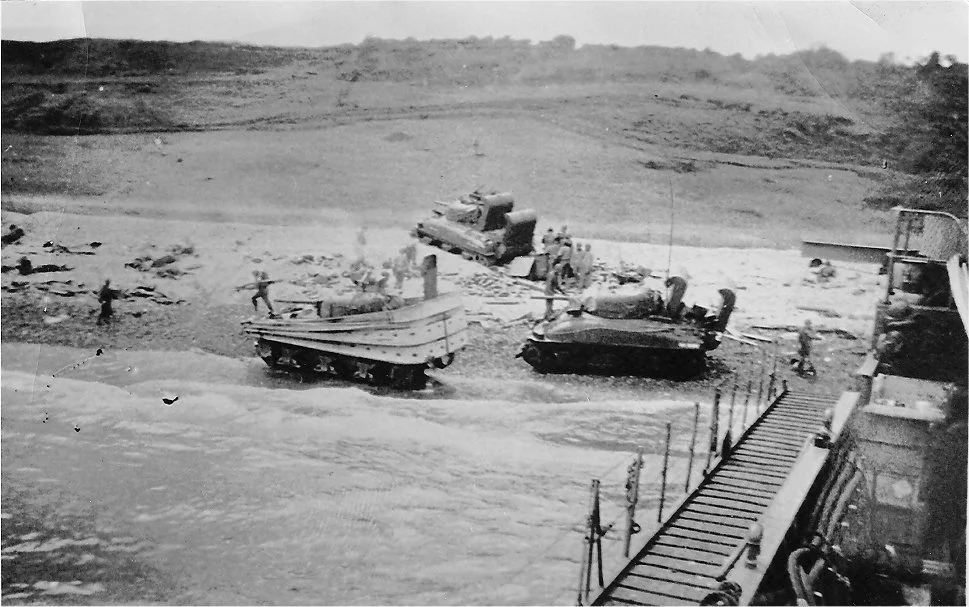
Rear Admiral John L. Hall, USN.
Commander, Assault Force “O”
(USN 80-G-302404, via NARA)
Revised and updated, 27 September 2025 - CRH
Historical discussions of the loss of the DD tanks generally have been framed as a comparison of the decisions made by two sets of very junior officers; one set chose badly, the other chose wisely. That’s very convenient framing for some parties as it distracts attention from the root causes of the debacle. You see, the decisions of those junior officers were merely the precipitants for what immediately followed. What has been excluded by that framing were the precedents. That is to say, the questionable decisions and actions of the chain of command in the preceding weeks which placed some of those junior officers in a difficult and ambiguous situation for which they were unprepared, and which set the stage for the loss of so many tanks. Let’s see if we can provide a more complete perspective.
Command at Omaha - A Small Matter of Attitude
Rear Admiral (RADM) John L. Hall, Jr., had spent most of his early career serving in battleships, cruisers and destroyers, eventually rising to command the battleship USS Arkansas (BB-33). The advent of war found Hall on the staff of the Commander, Battleships Atlantic, which duty was soon followed by a brief stint on the staff of the Chief of Naval Operations. In the summer of 1942, Hall had a crushing disappointment. He was to be sent out with the Operation TORCH naval forces (the North Africa landings, 9 November 1942), initially serving as chief of staff to then-RADM Hewitt, who commanded the Western Naval Task Force that would land Patton’s troops. Following the landings, Hall was slated to command the West African Sea Frontier and the Naval Operating Base at Casablanca. It was not the combat career for which he had spent a lifetime preparing.
From there, Hall’s career became wedded to the amphibious forces, and he soon became commander of the Amphibious Force Northwest Africa (later the Eighth Amphibious Force). As such he was responsible for all US naval amphibious forces in the Mediterranean Theater of Operations and their bases. It was principally an administrative and training command, whose mission was to prepare the amphibious elements for operations. When amphibious landings took place, Hall’s position made him the logical man to command an amphibious assault force, and during Operation HUSKY (the invasion of Sicily, 9 July 1943) Hall commanded the amphibious assault force that landed US troops at Gela (one of the two US amphibious assault forces in the invasion). He then commanded the amphibious task force that landed the American corps at Salerno (Operation AVALANCHE). By the time he was summoned to the UK in the fall of 1943, Hall had a solid foundation in amphibious landings. It was a somewhat deceptive foundation, however, as none of the three landings he had taken part in was opposed by strong German-manned defenses at the water’s edge, or extensive beach obstacles. As a result, he would perhaps underestimate some aspects of the Omaha Beach landings and be slow to appreciate the dangers.[1]
When Hall arrived in the UK, he was placed in command of the newly created Eleventh Amphibious Force, which was responsible for all US naval amphibious forces and bases operating from the UK. It was a lateral transfer, and not to his liking. His immediate superior was RADM Allan Kirk (Commander of NEPTUNE’s Western Naval Task Force), whose amphibious experience had been limited to a single landing (Operation HUSKY), where he had been Hall’s peer, commanding the second US amphibious assault force for that invasion. Hall thought Kirk was “too much flash, not enough substance”, and believed he was more experienced than Kirk and therefore should have had his job. But Kirk was not the only man Hall held in low esteem. He similarly thought little of Admiral Bertram Ramsay (the Allied Naval Commander-in-Chief) and General Eisenhower, the Supreme Allied Commander. In short, he thought little of all three men above him in the operational chain of command, which was less than an ideal situation. Hall’s attitude must have been further soured when the size of NEPTUNE was increased to five beaches and RADM Donald Moon was chosen to command the amphibious task force for the newly added Utah Beach landings. Not only did Hall’s D-Day force get reduced by that decision, but Moon had absolutely no previous amphibious experience, which further irritated Hall.[2]
The organizational structure of Rear Admiral Hall’s Assault Force “O” for the Omaha Beach landings. The LCTs carrying the Duplex Drive tanks were divided between CTG 124.3 (Assault Group O-1) and CTG 124.4 (Assault Group O-2).
This slightly sour attitude arguably would combine with three other factors to influence Hall’s decisions during the leadup to NEPTUNE. First, as touched on above, in his previous amphibious experiences, the beaches had not been nearly as heavily defended as they would be in Normandy, which led him to underestimate the difficulties the initial infantry waves would face. This was evidenced in his opinion that landing tanks in the early waves of an assault was unnecessary, a rather poor piece of judgement to which he clung even in the wake of the Omaha landings. [See three paragraphs below.]
Second, Omaha Beach would be Hall’s third outing as an amphibious assault force commander, a role which doctrinally placed him in command of the Army forces for the first days of the landings until the Army was “firmly established ashore.” It was a very temporary arrangement which, nevertheless, could lead some amphibious commanders to believe they understood ground combat better than the soldiers. In Hall’s case, this tendency was influenced by recent experience. As Hall approached his third landing, he could look back on the lack of amphibious experience of some of his Army landing force commanders, both past and present. Only Patton (who Hall landed in HUSKY) had previous experience commanding an amphibious landing (TORCH). The Salerno landings saw the inexperienced Lieutenant General Mark Clark as the commander of the Army landing force, and Clark’s conduct of that operation was far from satisfactory. For the Omaha landings, Hall would have the veteran 1st Division (which had been in the amphibious assaults for TORCH and was landed by Hall in HUSKY), but neither the division’s new commander nor the new V Corps commander for NEPTUNE (under whom the 1st Division would operate) had any previous amphibious experience. As a result, there was an undertone in Hall’s planning that indicated he thought he knew better than the Army when it came to the soldiering side of the business. And in some amphibious respects he probably did, but it would turn out that his greater experience would lead him somewhat astray in the unique operating environment of Normandy.
And third, although very aware of the inadequate bombardment assets available, he took a very dim view of the makeshift—yet vital—efforts to compensate for that shortage, and perhaps failed to do all he could have to help those efforts succeed. Which brings us back to the Duplex Drive tanks.
In February 1944, Hall and Lieutenant General (LTG) Omar Bradley (commander of the First US Army) had observed a demonstration of the DD concept using British Valentine tanks. Bradley was enthused. Recognizing the need for substantial tank support in the initial waves to compensate for the lack of bombardment assets, Bradley was faced with the problem of how to get them ashore. The Navy was initially unprepared to support this, and the best they could do was obtain a limited number of British LCTs, to which some additional armor was added, in the hopes that they had a reasonable chance of surviving the task of landing tanks in the first wave (the so-called LCT(A)s). In an effort to bolster the bombardment firepower and provide last minute suppressive fire, wooden platforms were built at the front of these LCTs to permit the two lead tanks to fire over the ramp during the final approach to the beach. It was a limited and hurried effort, producing only enough LCT(A)s to bring in two tank companies on Omaha Beach (and one company on Utah). That was four companies fewer than Bradley needed for Omaha, and even then, these up-armored LCTs barely arrived in time for the operation. If the Navy was not willing to use unarmored LCTs to bring in the remaining four tank companies, the DD tank concept appeared to be the next best solution. Hall, by contrast, viewed them as impractical ‘gimmicks.’ He was at least partially correct; DD tanks did prove practical only under restricted conditions. His error was in not recognizing that bad circumstances sometimes require the least bad options—which, frankly, is what the DD tanks were. As Hall noted in his after action report:
“The Force Commander [Hall, talking of himself in the third person] acquiesced reluctantly in both the decision to employ tanks and artillery firing from landing craft, and to land tanks in the first wave. He ultimately agreed because he realized the necessity for more firepower at this stage of the assault than could be supplied by the Naval craft then available. He was then, and still is, doubtful of the efficacy of DD tanks and tanks firing from LCT(A)s landing in the first wave on strongly defended beaches.” [3]
His disdain for the concept almost certainly fathered the disjointed and vague planning for the employment of the DD tanks, and led to inadequate command supervision on D-Day.
Delegation or Dereliction?
At four of the five invasion beaches, the decision to launch the DD tanks was made by the amphibious force commander for that particular beach, or it was delegated to one of his senior subordinates. They used their judgement as to how far out to launch or whether to launch at all.[4] There was only one beach where the amphibious force commander refused both to make that decision or delegate it to a senior subordinate, and that was Omaha Beach. Hall, who viewed the DD tanks as impractical gimmicks, ended up fobbing the decision off on very junior officers with woefully unclear guidance.
The origin of what would become the heart of the problem lay in reports from then-Lieutenant (Junior Grade) Dean Rockwell[5] (US Navy) and Major William Duncan (US Army). Duncan was the Executive Officer of the 743rd Tank Battalion but had been temporarily detailed to be the school commandant for training the Army DD tank crews and for preparing the newly arrived DD tanks. Rockwell, commanding the newly created LCT Group 35 (part of LCT Flotilla 12), was charged with supporting the school’s training while also training LCT crews for their role in launching DD tanks. Their reports, both signed on 30 April 1944, were clearly written in concert and differed only in minor details. Both reports stated that the decision to launch the DD tanks should be the responsibility of a suitable Army officer. Neither report mentioned any role for the Navy in such a decision. To quote Duncan’s recommendation:
“(b) That an Army officer who has worked with DD’s and knows the sea conditions which are favorable to DD’s give the decision as to whether the DD’s will be launched or carried directly to the beach by the LCT.”[6]
Presumably, MAJ Duncan felt that those risking their lives in the DD tanks would be the men best equipped to decide what risk the sea posed. And that logic is attractive. But it is doubtful that an Army officer who has undergone just one or two weeks of training (which was all the tank company commanders had), half of which did not include open water launching, would be qualified as to what differentiated Force 3 from Force 4 conditions just by sight (Force 3 being the recommended upper limit for safe launches). Moreover, he would be completely unqualified to judge the nature and strength of crosscurrents off the beach, which consideration, as it turns out, was as important a factor in the loss of the DD tanks as were the waves and winds. Clearly these are factors the naval officers would be far more able to judge, and Duncan was in error suggesting the Navy be relieved of the responsibility. Duncan was also in error recommending the decision be solely left to a junior Army officer, as it would turn out, the most senior Army officer afloat with the DD tanks would be a captain.
Rockwell’s report included much the same recommendation, but it also revealed the Navy’s reluctance to shoulder any responsibility in the matter.
“Inasmuch as the Army is desirous of launching, if at all possible and feasible, the DD tanks on D-Day, an Army officer who is thoroughly cognizant of the limitations and peculiarities of said tanks should make the decision, in case of rough sea, whether or not that tanks shall be launched or taken directly to the beach.” [7]
To crudely paraphrase, ‘it’s the Army’s pet idea and I don’t want anything to do with that decision.’ As we’ll see, he later changed his tune in the wake of 6 June.
Colonel Severne MacLaughlin, U.S. Army, was the commander of the 3rd Armored Group, the headquarters the controlled both the 741st and 743rd Tank Battalions. Because the Armored Group was basically an administrative headquarters (the tank battalions would be attached to and controlled in battle by infantry divisions), COL MacLaughlin and part of his staff primarily functioned as the Armor staff element on the V Corps staff. In that position he was part of the coordination between the V Corps staff and Hall’s staff in developing the invasion plans. And these soon came into conflict over the matter of DD tanks. Perhaps inspired by Rockwell’s and Duncan’s idea that the launch-or-land decision be an Army responsibility, Hall’s position was that the decision should indeed be solely the Army’s, but that it should be made by V Corps commander (MG Gerow), himself, a clearly unacceptable position to the Army. Although MacLaughlin’s brief account of this planning process (contained in his command’s action report) did not go into detail, the disagreement between Hall and Gerow eventually was kicked upstairs on the Army side.
Bradley also disagreed with Hall’s position. Bradley recognized that the ultimate decision on delivering the DD tanks was fundamentally a Navy obligation, though necessarily with the advice of an Army counterpart. Although the DD tanks were something of a doctrinal odd duck, it was solely the Navy’s unchallenged responsibility to get the Army ashore, and by extension in the case of the DD tanks, to decide whether launching or landing was the more effective option given the sea conditions on D-Day. As a result, on 17 May Bradley sent a letter on the subject to his counterpart, RADM Kirk, Commander of the Western Naval Task Force. Kirk’s two subordinate task forces were responsible for the Omaha and Utah operations, thus he was RADM Hall’s immediate superior. Quoting from that letter:
“Although the control of DD tanks in the final analysis remains the responsibility of the Corps Commander concerned, it is appreciated that the decision to beach the LCTs is a responsibility of the Naval Task Force Commander and must be the result of close collaboration with the Corps Commander.”[8]
In other words, while the Army had a big stake in the decision and should have input, ultimately it was a Navy responsibility to make the ‘launch or land’ decision. To facilitate knowledgeable Army input to that decision, two days before Bradley sent his letter, V Corps (the Omaha Landing Force) had directed COL McLaughlin be assigned to the command ship USS Ancon “as he will be the specialist to advise CG Force O in regard to launching DD tanks.”[9] COL McLaughlin was not only the commander of the 3rd Armored Group, but Duncan’s DD tank school fell within MacLaughlin’s authority. Designated as the ‘knowledgeable officer’, MacLaughlin was therefore positioned to advise the V Corps Commander, who in turn would advise the amphibious task force commander in his decision—the latter man being RADM Hall for Omaha Beach.
Bradley’s letter went on to address an additional, related issue that seems to have arisen. His closing sentence to that letter read:
“It is believed that to delegate that authority for either of the above decisions to Commanders of craft would result in uncoordinated and piecemeal attacks.”
We don’t know exactly what sparked this concern or who might have wanted to delegate the ‘launch or land’ decision to craft commanders. A literal reading of both Rockwell’s and Duncan’s reports recommended the decision fall to an Army officer “who had worked with DDs” (Duncan’s words, though Rockwell used similar language) which would have precluded any Navy participation in this decision. Only one Navy order had been issued by the date of Bradley’s letter, and that was Kirk’s Operation Plan No. 2-44 (for the Western Naval Task Force (WNTF)), dated 21 April1944, and it made no mention of an option to land DD tanks directly on the beach, much less did it identify who would make that decision.[10] How this concern may have reached Bradley isn’t clear (I suspect it came from COL McLaughlin), but he clearly saw the folly in such an idea. Almost all of the designated LCT officers-in-charge (OICs) were of the lowest naval officer rank—ensign (officer grade O-1)—recently commissioned and with little leadership experience and even less sea experience. To entrust to these men a decision involving the fate of two thirds of the initial armor support would be irresponsible. But to be clear, Bradley was not just casting aspersions on junior naval officers. The phrase “uncoordinated and piecemeal” would have equally applied if the decision were to be entrusted to junior Army officers, as the senior tank commanders aboard on D-Day (company commanders of grade O-3) were just one grade higher than the two most senior LCT commanders. This was a decision that demanded older, wiser and more experienced officers than would be found aboard those LCTs on D-Day.
In summary, Bradley insisted on two points: 1) It was a naval responsibility, with due consideration given to Army advice; and 2) It should be made at the amphibious task force command level; delegating that decision to a junior naval officer in Wave 1 would be a mistake. Bradley would be proven absolutely correct.
SIDEBAR: COL Severne S. MacLaughlin, Commander, 3rd Armored Group.
The armored groups were established as headquarters for the independent tank battalions assigned to a corps. Unlike most headquarters, however, the armored groups did not normally exercise direct tactical control over their subordinate battalions. Instead, the battalions were attached to the infantry divisions under the corps for tactical operations. The responsibilities of the armored group headquarters were limited to a minimal degree of administrative supervision, and their small staffs were usually tasked with additional duties. In V Corps, COL MacLaughlin and the bulk of his staff served as the ‘Armored Section’ of the corps general staff. Although also charged with supervision of his group’s pre-invasion training, his presence at the DD Tank School was minimal, at least according to MAJ Duncan.
In fact, MacLaughlin’s reputation among the men of the DD tanks was not good, resulting from a fatal accident. According to MAJ Duncan, MacLaughlin visited the school one Sunday, wanting to see a demonstration of the the DD tanks. The weather was poor enough that it prevented swimming the tanks, and the Navy rescue craft had been released and were back at their base at Dartmouth. MAJ Duncan and COL MacLaughlin had a confrontation, with the former refusing to order men out in the water under the circumstances. MacLaughlin took responsibility and sent for two company commanders, who came up with two volunteer crews. At this point Duncan and MacLaughlin had another exchange of words, with MacLaughlin stating he only wanted to see them go out 50 yards, and Duncan holding that 10 yards was far enough under the circumstances. Have lost this exchange, too, Duncan returned to his office in a nearby building.
One of the volunteer tanks had made it into the water and gotten 50-75 yards out when its canvas skirts collapsed. A hurried, makeshift rescue effort was mounted. The lieutenant commanding the tank disappeared after directing rescuers to leave him and go after two of his men. Those two were eventually pulled ashore, but, suffering from sever hypothermia, died en route to a hospital.
A board of inquiry was held that night, and COL MacLaughlin was found responsible. The findings of the board were forwarded to higher headquarters, where the findings were overturned and the incident was written off as a training accident - at least according to Duncan. Duncan’s 30 April 1944 report on DD tank training did mention the loss of three men, so the incident did happen. Whether the details are accurate as Duncan reported them is another question, as he clearly did not respect MacLaughlin—and perhaps with good cause.
The question then is, was MacLaughlin a wise choice as the officer best suited to offer the Army input for launching the DD tanks in questionable weather? In a counterintuitive manner, he may have been exactly the man to make the judgement. Having been responsible for the loss of a DD tank and three men just a stone’s throw from the beach at Torcross, he would have known better than most how fragile the tanks were in the face of marginal seas. And, already suffering from the guilt for his role in the loss of the men, he would have been predisposed to err on the side of caution. In this sense, COL MacLaughlin might well have been the best possible man to offer advice.
Or . . . it could be that he was the kind of man who refused to learn from his mistakes (and the deaths of others), and on D-Day he might have doubled down in his poor judgement. After all, GEN Eisenhower was launching the entire invasion in the face of marginal weather. Might not Severne MacLaughlin be considered just as bold and decisive for expecting his tankers to succeed in the face of waves?
The fact is that we have no idea whether MacLaughlin would have rendered sound advice on D-Day. All we can say for certain is that the first decision point that might have averted disaster was eliminated when RADM Hall decided to cut himself and the Corps commander (and MacLaughlin) out of the decision loop.
The Best Laid Plans . . .
There is no record of RADM Kirk’s reply to Bradley’s letter, but we can make an inference from what Kirk did next. On 22 May—five days after Bradley’s letter—Kirk’s headquarters issued “Change Number Three 3 to Naval Commander, Western Task Force Operation Plan No. 2-44.” It stated in part:
“Assault Force Commanders may break radio silence after H minus 120 [0430 hours] for communication in connection with launching DD tanks.”
To be clear, the senior Army officer was termed the ‘Landing Force Commander’; the term ‘Assault Force Commanders’ referred to the senior Navy officers—Hall (Omaha) and Moon (Utah). So, in that change, Kirk was clearly authorizing Hall and Moon to use radios to contact the LCTs (or the LCT flotilla commanders) to inform them of the results of the ‘launch or land’ decisions. And they could make this decision as early as 0430 hours. It would seem Bradley’s wisdom was endorsed by Kirk.
In the wake of Bradley’s letter, a major change took place on the matter. With the ball back in Hall’s lap, he decided to hand it off to someone else. There is no pre-invasion document from Hall stating the new policy; his only reference to it was contained in his 19 September 1944 endorsement to Rockwell’s action report on the landings. In the endorsement, Hall laid out the revised policy he claimed he issued and tried to justify it in this manner:
“2. The question as to who should decide whether to launch DD tanks was discussed at length by the Assault Force Commander with the Commanding General, Fifth Corps, U.S. Army and the Commanding General, First Infantry Division, U.S. Army. For the following reasons it was agreed that the decision should be left to the Senior Army Officer and the Senior Naval Officer of each of the two LCT units carrying DD Tanks:
“(a) They had more experience than any other officers in the Assault Force in swimming off DD Tanks from LCTs.
“(b) The decision should be made by someone actually on the spot where the launching was to take place and embarked on an LCT rather than on a large vessel. A decision under such conditions should be sounder than one made on a large vessel miles away where the sea conditions might have been much different.
“(c) If a decision were to be made elsewhere and action had to await an order, confusion and delay might result in the absence of such an order, and it was anticipated that communications might be disrupted by the enemy action so that it would be impossible to transmits orders by radio.
“NOTE: The two unit commanders were to inform each other by radio of the decision reached.”
In military vernacular, ‘discussed at length’ is usually a euphemism for ‘there were strong disagreements.’ Similarly, in that context, the phrase ‘it was agreed’ generally means the commander made a decision over objections of those he was consulting with, who, by virtue of subordinate stations, ultimately had to go along with that decision. So, despite the gloss of unanimity, that paragraph seems to indicate it remained a contentious issue.
Nevertheless, the justifications Hall laid out had the virtue of having some merit, at least insofar as excusing himself from making the decision. But there are serious grounds to doubt Hall believed what he wrote here based on his original position on this matter. Hall had had no problem with the decision not being made by ‘a man on the spot’ when he was forcing that decision on MG Gerow (who would be aboard the command ship USS Ancon with Hall for the landing). It was only when the decision was placed back in the Navy’s lap that Hall suddenly realized the decision could not possibly be made aboard the Ancon and simply had to be passed on to someone else. It’s all too evident that he wanted nothing to do with a concept he believed was merely a ‘gimmick’ and was grasping for reasons to delegate responsibility for it. And while we might sympathize with wanting to distance himself from the DD tanks, by virtue of his command responsibilities he was legally and morally obligated to exert every effort to to ensure their success. And in this he failed.
In the 3rd Armored Force action report, MacLaughlin provided a slightly, but significantly different version of the ‘agreed upon’ decision:
“ . . . the senior naval commander in each flotilla carrying DD tanks make the decision as to whether the DDs would be launched, or the LCTs beached and the tanks unloaded on the shore. The senior DD tank unit commander was to advise the flotilla commander in this matter.”
While mostly in line with Hall’s version, there was a major difference. Where Hall described a joint decision—with the Army’s role emphasized by being mentioned first—MacLaughlin’s version clearly indicated it was a Navy decision, with Army input. Thus from this initial decision, the Navy and Army were not on the same page regarding this key responsibility.
And apparently, not all the actors within the Navy were on the same page, either. And this failure was also a result of Hall’s faulty planning, for his ‘joint decision’ guidance was never reduced to writing, and was glaringly absent from his Operation Order No. BB-44 (dated 20 May 1944[11], two days before Kirk’s clarifying order on radio silence regarding DD tanks). Hall’s order contained these specific instructions to the commanders of Assault Groups O-1 and O-2 (paragraphs 3(c) and 3(d) of the base order):
“Weather permitting, launch DD tanks about six thousand yards offshore and land them at about H minus ten minutes. If state of sea is such as to prevent their being launched and proceeding to the beach under their own power, land them with the first wave.”
The Attack Landing Plan for the LCTs (Annex D to Hall’s operations order) contained similar language:
“LCT’s carrying DD tanks launch DD tanks about 6,000 yards from beach in time for them to land at H-10, if state of sea permits swimming. Otherwise LCTs land with LCT(A)s in first wave.”
There was at least some good news, as Hall’s order did address the possibility of needing to make a launch-or-land decision. His boss’ original order (RADM Kirk’s order for the WNTF) did not even do that. This represented a softening of the Navy’s position; they’d bring the DD tanks all the way into the beach in unarmored LCTs, but only if the sea state made it necessary. In the individual instructions to both the Assault Group O-1 and O-2 commanders (the only two assault groups that included the DD/LCTs), Hall’s order used language identical to the above passage, thereby effectively delegating the launch-or-land decision to those two men. However, the glaring fact is that he made absolutely no mention of such a decision being a joint Navy-Army matter, or that Army advice was even to be sought. Whatever the ‘agreement’ between Hall and Gerow might have actually been, Hall failed to articulate in his orders. Rather than the decision being placed with the Navy and Army LCT/DD senior officers, his order made the O-1 and O-2 Assault Group commanders responsible.
While this delegation to the Assault Group appears to be clear, an oddity of the naval command structure then came into play. The men designated as the commanders of those two assault groups were also commanders of their respective Transport Divisions. CAPT Fritzsche, as the commander of Transport Division 1 (including the USS Chase, USS Henrico and HMS Empire Anvil) also served as the Assault Group O-1 commander. Similarly, CAPT Bailey, commanding Transport Division 3 (including the USS Carroll, USS Jefferson and HMS Empire Javelin) also served as the Assault Group O-2. Not only would those two men also be located 23,000 off shore— nowhere near being ‘on the spot’—they had absolutely no experience with DD tanks. Furthermore, they were scheduled to be in the area for only about 12 hours before their transports sailed to the UK, at which time their deputies would take over command of the assault groups. Their stake in the goings-on among LCT skippers was as shallow as it was brief. So Hall delegated the responsibility to men just as remote from the scene as he was, and men who would not have the benefit of MacLaughlin’s presence and advice. Hall’s planning and guidance were seriously disjointed and ill-judged.
The common sense alternative would have been to delegate that authority to the two deputy Assault Group Commanders. These deputies were in command of the awkwardly named “Non-Transport Based Assault Ships and Craft” task element within their respective assault groups, and would be actively working out in the boat lanes during the landings, overseeing movement of craft to and from the beach. Critically, the DD/LCTs were in the task elements directly commanded by the Deputy Assault Group commanders. Between the craft directly under their commands (the LSTs, LCIs, LCTs and Rhino ferries) and the other craft whose movements they controlled during the landings, they were responsible for 98% of the craft in each assault group. In addition, as they would be located in the boat lanes and would operate far closer inshore than the Assault Group commanders (whose ships would be anchored 13 miles offshore), they would be in a much better position to judge sea conditions for launching. This alternative also would have largely paralleled the policy at the British beaches, where the decision was delegated to the Deputy/Senior Officer, Assault Group—with advice from his Army counterpart.
Perhaps Hall assumed that the two Assault Group commanders would naturally delegate this decision further down to their deputies? If so, he was wrong.
Further, Hall’s order was critically vague on the key point of what would be an unsafe sea state. While both Rockwell and Duncan had stated that Force 3 was the maximum sea state for launching, Hall’s order did not include this key decision criterion for his subordinate commanders. Duncan, as the executive officer of his battalion, would not be aboard the DD/LCTs on D-Day. In this planning vacuum, it appears the only man who would both be present on D-Day in a position to influence things and who had been part of establishing the Force 3 decision criterion would be Rockwell. Was it likely that this detail had been informally passed among LCT and tank company commanders? Yes, it probably was. But the failure to clearly state the Force 3 cutoff in the orders meant inexperienced junior officers would be left to their ‘best military judgement’ under the pressure of D-Day. It simply created yet another possible point of confusion and error.
So far, the planning process had eliminated one key decision point, kicked the decision down to the lowest levels, and introduced confusion by failing to state the most important decision criterion. And the planning process was just getting under way.
Hall’s order followed Bradley’s letter by just 3 days and was published before Kirk issued the change to his order. So Hall’s order could not be expected to reflect any agreement Bradley and Kirk had reached. Nevertheless, Hall’s original order did contain this provision (Annex H, Communications Plan):
“8. (a) Radio silence is to be maintained by all units of the assault force from the time of sailing up to H-Hour, except for:
“(1) Enemy reports providing the enemy has been clearly identified.
“(2) After “H” minus 120 minutes as ordered by the Force Commander for specific purposes.”
Those were the only two exceptions, and his order did not elaborate on what ‘specific purposes’ the Force Commander might have in mind. So clearly Hall did anticipate being granted authority to break radio silence at H-120 (advance knowledge perhaps coming through staff channels or discussions between Kirk and Hall), but his order did not link that exception to the DD tank decision, which was the specific exception cited in Kirk’s change to his WNTF order two days later. Although Kirk’s exception was not published before Hall’s order, when it finally was issued, Hall did nothing to implement it. On 30 May 1944, Hall issued 20 pages of changes to his original Force “O" order (BB-44), but these made no further mention of the radio silence policy, much less link it to the launching of DD tanks. Having delegated the responsibility for the launch or land decision, he failed to delegate the necessary authority to break radio silence to disseminate the decision. And that posed a problem, as any decision on the DD tanks would require radio consultations between the decision makers, and additional radio transmission to the necessary craft and units at about H-90.
The 1st Infantry Divisions Field Order Number 35 covering the landing was dated 16 April 1944, and it too originally had imposed strict radio silence until contact had been made with the enemy. But in the wake of RADM Kirk’s 22 May change to the WNTF order, MG Huebner’s headquarters issued a 25 May 1944 Letter of Instruction which included six pages of updates and changes. Paragraph 13 had this to say:
“13. RADIO SILENCE.
“Naval, Air Force, Artillery and DD Tank Units may break radio silence at H-90 minutes during the assault. At H-15 minutes, all other assault units may break radio silence so that nets can be opened and checked prior to landing.”
As a result, the four DD tank companies could communicate via organic tank radios as of 0500 hours. Although this letter did not authorize the naval units to break radio silence, by mentioning them in the same sentence, it implied similar instructions had been issued to them through the Navy chain of command. But this is probably incorrect. For one thing, Hall’s 20 May order mentioned a different time (H-120 minutes) for unspecified units and conditions. And nothing Hall issued after that order indicates he changed his original instructions. Further, as we’ll see in later installment, Rockwell was clear that he thought he was breaking radio silence contrary to orders when he contacted Elder on between 0500-0530 hours on D-Day.
This was yet a further indication that Hall’s planning once again left the Army and naval units operating from disjointed plans. It also set up the conditions for communications and coordination breakdown on D-Day, as the key Navy officers would be denied use of their organic radios if they needed to confer on a launch or land decision. At best, they could only struggle with communicating over the tank radios, but with the screens raised and tank engines running, Rockwell and Barry could only rely on doubtful shouted snippets to be relayed by the nearest tank commander.
The unfortunate reality is that as of 30 May, the date Hall issued the one change to his order, he had left the DD tank matter in something of a state of limbo. His lack of concern is perhaps illustrated by his own order. Annex L, Reports Required, listed three pages of items that had to be reported to CTF 124 (Hall) as the operation unfolded. It did not include a requirement to inform Hall whether the DD tanks would be launched or landed.
Apparently, it wasn’t a matter important enough to merit his attention.
Composition of the initial two Assault Groups landing on Omaha Beach. (The Assault Group involved in the landings of the Ranger Task Force is omitted here as they were outside the scope of the DD tank operations.)
Planning, One Level Down
Minor clarity would come from the next level of planning, but in general, the confusion spread a bit further. The commanders of Assault Groups O-1 and O-2 issued their own orders late in May (29 May for Assault Group O-1 and 27 May for Assault Group O-2).
The order for Assault Group O-1 did not directly address the DD/LCTs.[12] The paragraph listing specified tasks for the Non-Transport Based Assault Ships and Craft (CTU 124.3.3) omitted any reference to DD/LCTs. In Annex C, Approach Schedule, the DD/LCTs were listed as the first wave, however no landing time was listed. Worse, the Approach Diagrams (Appendix 3 to Annex C) also omitted any reference to DD/LCTs. All other references to the DD/LCTs were contained in sections which—strangely—provided instructions to other entities. The most substantive comment regarding DD/LCTs was in Annex F, LCS(S) Employment. The Landing Craft, Support (Small) were 36 foot long craft, and one of their tasks was to lead in the DD tanks to the beach after they were launched. Paragraph 5 of that Annex stated:
“If the state of the sea is such as to prevent DD tanks from being launched and proceeding to the beach under their own power, LCT(DD)s will land them with the first wave.**”
This wording was virtually identical to the general provision in Hall’s order. The two asterisks directed the reader to this footnote:
“** The matter will be decided by the Senior Naval Officer in charge of LCTs (DD), and the Senior Army Officer in charge of DDs.”
This is the only instance in which Hall’s ‘agreement’ appears in any planning document, The footnote’s indirect comment was also the only mention of who would make the launch-or-land decision for Group O-1. There were no other directions to the DD/LCT division leader or the Army tank officer regarding their role in this or even citing a decision criterion. The result of this informational footnote is that this order kicked the responsibility down from the Assault Group commander (a Navy captain, O-6 grade) all the way down to a Navy Lt.(j.g.) (O-2 grade) and roped in an Army Captain (O-3 grade) as a decision-maker rather than an advisor. The Deputy Assault Group commander was cut out of the decision. Needless to say, an informational footnote in an annex dealing with altogether different craft was a totally inadequate way to delegate authority regarding LCTs. There should have been a separate annex, or at least a paragraph in the base order directly addressing the tasks of the DD/LCT unit, and it should have provided instructions, guidance, and—most importantly—specifically delegated the authority. In fact, the absence in this order of any specified tasks, or virtually any consideration, for the DD/LCT element could lead one to wonder if these LCTs were actually operating under orders from another authority. It is only the fact that the DD/LCTs were included in the task organization for the ‘Non-Transport Based Assault Ships and Craft’ element that indicates they even belonged to Assault Group O-1. Furthermore, the small matter of what would happen if the senior Navy and Army officers disagree was politely ignored. These criticism are not merely fussy academic points; these ‘minor’ planning errors are the things from which operational errors thrive.
The result of this order, and Hall’s planning that led up to it, was a complete reversal of Bradley’s position.
The operation order for Assault Group O-2 started off better, with paragraph 3 (7) of the base order (rather than buried in an annex) directly addressing the launch or land decision with the by now familiar: [13]
“If state of sea is such that DDT’s cannot be launched, land them from LCT’s with HOW Hour wave.”
But the base order made no reference to who should make this decision nor did it state the decision criterion in concrete terms. The Annex C, Approach Plan, did, however, correctly include the DD/LCTs, noting the DD tanks would ‘unload’ 6,000 yards offshore at H-55. As with the O-1 order, the Assault Group O-2’s Annex F, LCS(S) Employment, included this provision:
“3. If weather conditions do not permit the launching of DDT’s proceed ahead of LCT carrying assigned DDT’s from the Line of Departure to the beach, to land with the FIRST wave.”
But in this order, there was no footnote to identify exactly who would make that decision. In fact, it simply was not addressed anywhere in the order. As a result, the O-2 order was even less satisfactory than the O-1 order.
As far as formal planning was concerned, the operations orders of the two assault groups did little to clarify roles and responsibilities. All that can be said to their credit was that both did address the possibility that they might have to bring the DD tanks all the way onto the beach, but since Hall’s order had already raised that contingency, the assault group’s orders added nothing positive in that regard. At least the O-1 order did indirectly mention who would make the launch or land decision for that group, pinning the rose on the senior Navy LCT officer and the senior Army company commander. But even that was of little help, as the LCTs of Assault Group O-1 would be led by Lt.(j.g.) Barry, who informally fell under Rockwell, and who, it would turn out, had his own ideas on who should make such a decision.
The logical assumption is that when the O-1 order mentioned the senior Army and Navy officers, it referred to the senior men in just Assault Group O-1, and their decision would only govern the eight DD/LCTs of O-1. It was, obviously, an order that only governed O-1. From that footnote in the O-1 order, many have assumed that a similar decision process was in effect within Assault Group O-2 — but it must be stressed that the O-2 order neither stated nor implied this. Therefore, such an assumption is not warranted, however tempting it may be. We must look to other sources to try to clarify this.
There is a counter interpretation. The “the Senior Naval Officer in charge of LCTs (DD), and the Senior Army Officer in charge of DDs” might have referred to the senior officers in the entire Omaha Beach DD/LCT operation. That is, one senior Army officer and one senior Navy officer making one decision for both assault groups. Rockwell had been the senior LCT officer concerned with the DDs since the inception of training and styled himself the “DD LCT Unit Commander” in his 30 April report on training. Even though he was assigned to Assault Group O-2 for the invasion, he continued to exercise authority over all the LCTs in both groups, going so far as to designate the division/wave leader for the DD/LCTs of O-1. In fact, he even directed a last-minute switch in the officers commanding two LCTs in Assault Group O-1. It was Rockwell who had the most experience in the LCT/DD combination, and it was Rockwell who the Navy looked to as the expert on the subject. Indeed, three of the Officers in Charge of LCTs in Group O-1 addressed their reports to Rockwell as “DD LCT Commander”, “Commander, DD LCTs” or “Commander, DD LCT Group”—even though Rockwell was in Group O-2. Given that Rockwell’s authority—both formal and informal—extended beyond his mere role within Assault Group O-2, the order was written vaguely enough to plausibly imply he would be the one to make the Navy’s half of the decision for both assault groups. Having acknowledged that possible interpretation, I find is nothing to support it. The O-1 order applied only to O-1 units, and the O-2 order didn’t even address the point. Therefore, I will set it aside and proceed with the original interpretation.
The four orders discussed above constitute the sum total of written guidance on the employment of DD tanks and the LCTs that carried them at Omaha. In summary, a vague concept incompletely articulated at the higher levels, became a bit more specific yet at the same time more disjointed and uncoordinated by the time it was articulated in the orders of the two assault groups. Worse, what little that was specified could be interpreted in more than one way. Shoddiness in orders such as these seldom goes unpunished by the gods of war.
The Unwritten Agreements No One Could Agree on Later
Nor would the gods of war pass up this opportunity. They set the god of Chaos on the job, and the god of Chaos convened a meeting to address what the orders failed to do. A warning is in order here. Nothing about this meeting was documented at the time, and that includes the results and decisions it produced. We have three subsequent reports that reference this meeting, and none are consistent. Each report was penned in the aftermath of the D-Day debacle and all were obviously crafted to cast author’s role in the best light. Unfortunately, whatever did happen in the meeting(s) lies at the heart of the DD tank question, and since the actual events of the meeting remain lost in a fog of uncertainty, it limits our ability to draw supportable conclusions.
This meeting supposedly took place while the DD/LCTs and tankers were assembled in Portland Harbor (located in Weymouth Bay), which puts it sometime shortly before 4 June (the original sortie date). The first mention of this meeting was a paragraph in Rockwell’s 14 July 1944 report addressed to the Commander in Chief, United States Fleet, subject: Launching of “DD” Tanks on D-Day, N. France Operation.[14] In it he stated:
“Before leaving Portland, the question had been raised by this command as to the course to pursue in the event of a sea too rough for a launching. Despite the insistence of this command that a decision be made by one senior Army officer for both battalions, the question of launching was finally left to the senior officer of each battalion, in this case Captain Thornton of the 741st and Captain Elder of the 743rd. This decision was agreed upon by Lt. Colonels Skaggs and Upham, commanding the 741st and 743rd, respectively.”
Much as been inferred from this passage, most of which isn’t justified, so it needs careful examination. At it’s core, this version was an attempt to nullify, or at least alter without authorization, the footnote included in the Assault Group O-1 order. As Rockwell fell under Assault Group 0-2, he certainly had no authority to do that, whatever the merits of his proposal.
Although this passage was later cited as an attempt to achieve ‘unanimity of effort’, the fact is that his proposition only discussed how the Army would make the launch-or-land decision, and included no role for the Navy. In reading that passage, many have inferred that the proposal must have included a counterpart, that is, a single decision-maker for the Navy. But there was no mention of this, and as we’ll soon see, there was evidence this meeting relieved the Navy of any role in the decision. And that outcome, perhaps not so coincidentally, was exactly what Rockwell advocated in his 30 April report on training: that the decision should be strictly an Army responsibility. In this interpretation, the Portland meeting was merely a backdoor gambit to impose Rockwell’s preferred assignment of responsibilities (that the decision should be Army’s alone), despite what Hall and the orders may have had to say.
The above point is usually missed based on Rockwell’s next paragraph which was crafted to make it appear he was a partner in the decision leading to success within his own group:
“At 0505 this command contacted Captain Elder via tank radio and we were in perfect accord that the LCTs carrying tanks of the 743rd Battalion would not launch, but put the tanks directly on the designated beaches.”
We will deconstruct that particular sentence in a later installment, so for now I’ll merely note that Rockwell’s report was apparently designed to throw Barry under the bus. That may sound like a very harsh judgement. After all, Rockwell would become a hero for his actions on D-Day, earning a Navy Cross for the decision he made that morning. And as a consequence of his D-Day actions, he was elevated to interim command of then-forming LCT Flotilla 42 in early- to mid-1945. And that was an impressive accomplishment. In October 1943 he was merely a newly commissioned ensign, assigned as the OIC of a single LCT. But in the next 18 months he would be put in command of a group of 12 LCTs, and then in command of an LCT flotilla of (nominally) 36 LCTs. [Information on LCT Flotilla 42 is sparse, but according to Rockwell—who is the source of this detail—the flotilla was at Pearl Harbor preparing to sail to the western Pacific when the war ended.] As his meteoric rise was primarily founded on the reports filed after D-Day, it is only fair to examine those reports carefully. And that examination raises serious questions, the first of which was his treatment of Barry.
Recall how the DD/LCTs were organized. The DD/LCT formations for Assault Groups O-1 and O-2 were each based on a division of six LCTs from Flotilla 12. The shortfall of 4 LCTs was made up by adding one from another division in Flotilla 12, two LCTs from Flotilla 19, one from Flotilla 26. So 13 of the 16 DD/LCTs were from the same flotilla as Rockwell. But one oddity stood out in the O-1 force. Although it contained all the LCTs of Div 71, that division’s commander did not lead the O-1 DD/LCT force. Barry, the outsider from Flotilla 19, was put in charge over all of Division 71’s craft, not to mention over their normal leader, Lt.(j.g.) Scrivner. As the outsider, Barry was in a delicate position at best. At worst, he would perhaps stand as a convenient scapegoat—assuming someone might need one. And in that context, it is hard not to view with suspicion the fact that although Barry was still part of Rockwell’s DD/LCT organization on D-Day (though not in his operational chain of command), Rockwell didn’t even bother to obtain Barry’s report before submitting his own. He obtained several reports from Barry’s subordinate OICs before submitting his report, but did not wait for Barry’s. And that’s an important fact, as Barry’s handwritten report (dated 22 July) is the clearest description of result from the Portland meeting as to who would make the launch or land decision. And he directly contradicted Rockwell. Barry stated:
“The senior army officer was the person to decide or not. This was established at the meeting.” [15]
To be sure, Barry was not happy about the launching, but this was not because of who made the decision. While he did think the seas were too high, he was mainly upset his LCTs began launching at the command of the embarked Army unit leaders, and that he was bypassed in issuing those orders. Nevertheless he followed suit. The key fact here is that Barry’s statement corroborates the interpretation made earlier that Rockwell was not just attempting to have one decision-maker for the Army, but to place the sole decision responsibility on the Army. And while he failed in the former, he succeeded in removing the Navy from the process. Exactly as he advocated on 30 April.
Not a single Army person present recorded that meeting or left a record of its decision. The closest we have is a reference in the 17 July Action Report of the 741st Tank Battalion, and we can infer something from it. The 741st was the tank battalion landed by Assault Group O-1 and was aboard Barry’s LCTs. The Action Report stated:
“Capt. Thornton succeeded in contacting Capt. Young by radio and the two commanders discussed the advisability of launching the DD tanks, the sea being extremely rough, much rougher than the tanks had ever operated in during their preparatory training. Both commanders agreed that the advantages to be gained by the launching of the tanks justified the risk of launching the tanks in the heavy sea. Accordingly, orders were issued for the launching of the tanks at approximately H-50.” [16]
Although this paragraph does not mention the meeting in Portland, it described the decision process and responsibilities in a manner that exactly matches Barry’s report. These two sources in turn directly support the earlier interpretation of Rockwell’s report that he was attempting (and succeeded) to shift the responsibility completely to the Army.
But none of Rockwell’s chain of command would ever see Barry’s report. In fact, neither Barry’s nor the reports of the other LCT officers-in-charge were official action reports, and not a single one was submitted through the chain of command to anyone above Rockwell. Instead, they were kept in Rockwell’s personal papers for five decades. So there was nothing in the official record to contradict Rockwell’s vague description of the meeting’s results. To further illustrate the seemingly self-serving and deceptive nature of Rockwell’s actions, we need look no further than the second-to-last paragraph of that report:
“It might be observed at this time that the action reports of all the officers-in-charge of “DD” LCTs in Force O-1 submitted to this command state that they were amazed when the order came to launch.”
This was blatantly false on two accounts. First, we only know that he had four of the eight reports by the time he wrote that. Two reports were undated and two were dated after he submitted his own report. Second, and more importantly, not a single report indicated amazement. Four reports noted that the sea was rough or too rough to launch, two reports indicated the sea had calmed and was not a problem, and two reports didn’t think the sea state was significant enough to even mention. Again, no indications of ‘amazement’. At all. Rockwell seems to have misrepresented the facts to make the case look more damning for those who would read his report. And by retaining these OIC reports in his personal files, his superiors would be unaware of the deceit.
LCDR William Leide was normally the commander of LCT Flotilla 12, and on D-Day commanded the LCTs of Assault Group O-2. In both roles, he was Rockwell’s immediate superior, and he was supposedly present at the meeting in Portland. Leide actually submitted two reports that touched on the DD tank issue. On 29 June he submitted his “Action Report, LCT O-2.” In this report he described Rockwell’s role in this manner:
“2. Lieutenant D. L Rockwell, USNR, in charge of the LCTs carrying the “DD” tanks, was aboard the LCT 535 and with Ensign A. J. Pellegrini, the Officer-in-Charge, made an important decision. The weather was too rough to permit launching, so the tanks were put on the beach, touchdown being made at H-1 minute.” [17]
Interestingly, this report did not mention the meeting in Portland Harbor, and contradicted both Rockwell’s and Barry’s versions. It actually gave all the credit for the decision to Rockwell and Pellegrini, a claim even Rockwell was not bold enough to make. And it was this not-wholly-accurate claim that would later lead to Rockwell’s Navy Cross as the Navy was looking for something positive to offset the debacle. And by shunning any mention of the Army role in the decision, Leide wrote CPT Elder out of the official version of events, ensuring his own subordinate, Rockwell, would receive all the credit. By the time Leide submitted this version of the events, CPT Ehmke (the other DD tank company commander with Elder) had been killed and LTC Upham evacuated with wounds (both on D-Day). The last man who could contradict Leide was Elder, but he was neck deep in combat and in no position to comment on the Navy’s evolving coverup. As it would turn out, Elder, too, would be killed in action, two weeks later, and his voice was never heard on the matter. So there was no one left in theater to contest Leide’s inaccuracies.
So, at this point, we have three completely different perspectives. Over in Assault Group O-1, Barry said it was solely the Army’s responsibility, which the sparse Army comments corroborate. In Rockwell’s report, he said he initiated the call that resulted in a joint Army-Navy decision. And in Leide’s version, it was solely the Navy’s—that is to say Rockwell’s—decision. It was Leide’s statement that would form the basis of the official Navy version of the story, indicating the ‘right’ decision was solely a Navy responsibility. This was the exact opposite of Barry’s account, but with Barry’s version blocked from getting into the record and the Army participants dead or unavailable, Leide’s spin would become unquestioned ‘fact.’
Leide’s second comment on the DD tank matter came as a 20 July endorsement to Rockwell’s report—and again, Leide signed his endorsement two days before Barry’s report was even submitted. This again makes it appear as if there was a conscious and coordinated effort to condemn Barry without letting him be heard. In his endorsement, Leide was now moved to make a stinging indictment of the DD tank program, a position he did not go on the record with before the D-Day debacle. He wrote:
“The notorious deficiencies of “DD” tanks in heavy seas were common knowledge. Meetings were held with all the officers-in-charge of “DD” tanks in Force “O”. It was unanimously agreed that any seas running, the tanks should be brought into the beach. Lieutenant Rockwell, who was Officer-in-Charge for all the training of the LCTs in this program, was specifically instructed that the “DD” tanks of “O-2” were to be brought into the beach. No doubt existed in his mind nor those of the officers-in-charge of what would take place in the event of rough weather. This report clearly shows that an attempt was made by Lieutenant Rockwell to obtain unanimity of action even though he was to lead only the LCTs of O-2 for the assault. It is our opinion that not only a senior army officer, but a senior naval officer should make the decision on launching based on weather conditions.” [18]
This is an exceptionally poorly written paragraph and it it difficult to understand his points. Who conducted these meetings with “all the officers-in-charge of ‘DD’ tanks in Force ‘O?’” Neither Leide nor Rockwell would have operational control over the DD/LCTs of O-1 on D-Day; they had been task organized out of Leide’s control, and Rockwell had never any control over them beyond his role as trainer. And this reveals the heart of the command and control (C2) failure. There were three separate layers of C2 in play: 1) the organic C2 relationship, in which Leide normally commanded 13 of the DD/LCTs; 2) the task organized C2 relationship, in which Assault Group O-1 exercised operational control over Barry’s division on D-Day; and 3) an informal authority Rockwell had been imbued with by Leide based on his role in training, and which Leide clearly thought carried on through to execution. In this climate, everyone was in charge or no one was in charge, depending on the case one chose. In this one paragraph, Leide selectively used each of these (often conflicting) C2 relationships to make one point or another, and the result was that it merely illuminated the underlying confusion of C2 governing the DD tank operations.
His next two sentences hammer the point home that Rockwell and the other OICs knew exactly what to do in a bad sea state, a claim obviously intended to imply Barry used bad judgement, without actually naming Barry. Whether he realized it or not, that implied condemnation would also fall on the other five OICs of Barry’s division, who were, after all part of Leide’s own Flotilla 12 - a point that reflected poorly on Leide’s leadership of that flotilla. In addition, that comment was largely pointless, a distraction at best; it didn’t much matter whether the OICs knew to land the tanks in the case of bad sea; they should be operating under the command of their division leaders (Barry or Rockwell) not operating independently. (Or . . . was Leide anticipating the reality that the division leaders would not be able to communicate with their subordinate LCTs? More on the communications breakdown later.)
The crux of the matter was who was supposed to make the decision, which was a point not specified in the O-2 order that governed Leide, Rockwell and Elder. Leide pointedly did not mention what the meeting with the tank battalion commanders had to say about that. Yet his comments here clearly put the ball in the Navy court, as the supposed instructions to the OICs made absolutely no reference to obtaining a joint agreement with the Army counterparts. Here again Leide was selectively grasping as individual straws to make a series of points which in sum were contradictory.
The fourth sentence endorses Rockwell’s attempt to obtain “unanimity of action” but fails to note he only sought that among Army units across both Assault Groups. He made no reference at all to any Navy role in a joint decision, and certainly did not propose a corresponding unanimity of action among the Navy units. The inevitable result was anything but unanimity of action.
And his final sentence is again confusing. As written, it seems to be protesting that the decision had been made solely by the Army officers, and that a Navy officer should have been involved in the decision, apparently criticizing the O-1 decision without actually mentioning them. It is also a bit of disingenuous post-debacle whitewashing. If Leide felt that strongly about it being a joint decision, he should have gotten it written into the orders for his assault group, and the instructions he hammered into the OICs should have mentioned exactly that process. But he plainly did not do the first, and his stern instructions to the OICs mentioned nothing about obtaining a joint decision.
Looking past the confused rhetoric, Leide’s reports made just two points. 1) Success at O-2 was solely due to Rockwell’s judgement, which indirectly reflected credit on Leide as Rockwell’s boss and the man who wisely chose Rockwell for the job and instructed him as to the proper course of action. And 2) it sought to shift responsibility away from himself for the errors over in O-1 by presenting the case that he was smart enough to properly instruct Rockwell and the OICs, but Barry over in O-1 failed to heed Leide’s instructions.
Whether you take Leide’s comments at face value or see them as self-serving statements, it misses the key point. Nowhere did Leide (or Rockwell, for that matter) clearly state what the agreed upon decision mechanism would be. And that is what caused the train to jump the tracks. While Leide’s last sentence—after the debacle—said it was his opinion the decision should have been a joint one, absolutely nothing in his (or, again, Rockwell’s) report indicate they clearly agreed to or gave such instructions to anyone.
So the reports of Rockwell and Leide confuse rather than clarify. The result—whether intended or accidental—of this muddled discussion was to hang Barry out to dry. Rockwell was portrayed as following his instruction and landing the tanks; Barry was supposedly clear on those instructions - or should have been - but failed follow suit. Although it was supposedly “unanimously agreed” and “No doubt existed in his mind nor those of the officers-in-charge,” yet somehow both Barry, his seven subordinate LCT OICs and the two Army company commanders in O-1 had a completely different view of how it was to play out. Neither Leide’s nor Rockwell’s written gymnastics can hide that fact.
So what really did happen in the Portland meeting? Frankly, we’ll never know. But the results of it are painfully clear. Based on the O-1 order, Barry and Thornton had clear directions to make a joint decision. But after the Portland meeting, they had been convinced to disobey that order and replace it with a unilateral Army decision, which—not so coincidentally—was the exact policy Duncan and Rockwell recommended five weeks earlier. Surely Barry and Thornton didn’t dream up this change themselves, which means they were following the outcome of the Portland meeting, at least as they understood the result of Rockwell’s wranglings. And since Rockwell and Leide made a point of highlighting their advocacy in that meeting, the logical conclusion is that they were primarily responsible for spawning the confusion that would cause the trainwreck. Whatever did happen in that meeting destroyed the single element of the DD/LCT plans that was reasonably clear (the footnote in the O-1 plan), resulting in the worst possible outcome. And the fact that none of the reports from O-1 made it into Rockwell’s and Leide’s reports, or any official record, is significant if not actually damning.
I’ve taken pains to carefully parse the various documents pertaining to the DD/LCT orders and instructions, and I’ve done this for two reasons. First, in the wake of a debacle, it is an all too common human impulse for participants to try to make it clear they had no responsibility for what happened, and ‘if only they had been listened to, the tragedy would have been avoided.’ And just as frequently, those who rush to establish their innocence in this manner are precisely the ones who were largely culpable. So the comments of Rockwell and Leide require very close examination to determine exactly what they did say, what they left out, and what can be verified from other sources. Rockwell’s and Leide’s reports do not come off well in such an examination due to their vague and conflicting perspectives, as well as the key points they omit. Barry’s simple and direct statement, backed by the 741st Tank Battalion’s after action report’s comments, appears much more believable.
The second reason for this parsing goes to the human need to project order on a confusing situation. The planning for the DD/LCTs was vague and disjointed, and this was further confused by the equally vague and contradictory comments by Rockwell and Leide. So a partial fact applying to one unit is naturally seized by analysts and extrapolated to apply to throughout the units involved, when in fact there is no basis for that. Or the analyst seeking to make sense of ill-worded statements, might interpret them to corroborate each other, because that would seemingly establish consistency and order, where in fact there was none. My objective has been to avoid assumptions which cannot be clearly supported by a close examination of what was said, what was accurate and what was left unsaid. I think this approach provides a better perspective, as it avoids the trap of becoming prisoner to one’s own assumptions, hastily made at the outset of analysis. While I do offer my conclusions, the primary goal is to provide the reader all the pertinent information for his or her own conclusions.
Lax Command, Doubtful Control, and No Communications
The final aspect of this comedy of errors was one Rockwell and Leide pointedly ignored in their reports. That was communications. Normally, the senior Army and Navy officers in a wave would be located in the same craft, so coordination between the two would merely be a matter of face-to-face discussion. But another disconnect in naval planning had resulted in none of these leaders being collocated in either Assault Group O-1 or O-2 (an error we’ll cover in detail in another installment). Some form of communications was necessary between the Army captain in one LCT and the Navy division leader. So all the wrangling over who would decide what for which element was rather pointless without a common means of communications.
Although all the LCTs had been equipped with radios when they arrived in the UK, the naval orders imposed radio silence. So how was Rockwell expected to take part in any decision or pass orders to his LCTs (much less those in O-1!)? While Hall’s order did note he could grant exceptions, he apparently did not extend an exception to the DD/LCTs, as Rockwell believed he was not authorized to use radios before the first landing, a point he stressed in his oral history. Similarly, the Army originally had also imposed radio silence [19] , but the change to the1st Infantry Division order authorized the DD tankers to break radio silence at H-90 (0500 hours, as discussed above). While it would appear the Army’s radios could provide the common communications link, thus solving the coordination problem, Rockwell’s oral history made it clear he was not aware the tank radio net was exempted from radio silence. Similarly, Barry (in O-1) made no effort to contact CPT Thornton by Army radio and also seemed unaware that net was off radio silence. The tool was at hand, but the two naval officers apparently were unaware it was available.
So regardless of who might be involved in making the decision, only the Army participants had the means to communicate and were aware it could be used. Practically speaking, this factor would drive how the decisions would be made on D-Day and who would make them. The key point hidden in the chaos surrounding who would make the decision was this: how did they expect to make that decision given the communications restrictions, both real and self-imposed? Were they counting on Rockwell and Barry to violate the radio silence orders? If not that, then what?
This simple matter of communications, and the fact that the key Army and Navy commanders were not collocated, puts the lie to the post-operation inventions contained in Rockwell’s and Leide’s reports. In fact, the mere idea that one officer could decide for both battalions and convey that decision to the tankers, in the absence of radio communications (as Rockwell believed radio silence would be in effect), was preposterous considering the distance there would be between the LCTs of the two assault groups. And it would be equally preposterous to assume one Navy counterpart would be able to make a corresponding decision and confer with his Army counterpart under those same circumstances.
As noted earlier, the Army neither commented on nor even acknowledged such a meeting at Portland. Their silence on the topic at least had the benefit of not trotting out rather transparent self-serving excuses. But to be clear, the Army’s skirts were not clean in this process. The operations order for the 741st Tank Battalion (Field Order #1, 21 May 1944) did not address the launch or land question at all. Neither, as far as I can tell, did the order for the 743rd Tank Battalion. Nor did the operations orders for the 3rd Armored Group, the 1st Infantry Division or the Vth Corps. (Possibly this reflected the Army belief that the decision was the Navy’s - as COL MacLaughlin’s statement indicated.) And in this vacuum of guidance, the Army battalion commanders may have been at a loss for guidance when they were confronted by Rockwell’s proposal at the Portland meeting. Regardless, they bear a large part of the responsibility for not realizing how the communications problem would drive to disaster.
For those unfamiliar with operational planning, subordinate units are very often authorized to directly deal with each other to coordinate aspects that require cooperation or interaction (the well known ‘direct liaison authorized’, or DIRLAUTH). In fact, this kind of direct coordination is usually necessary in any order. But coordination was hardly possible in the two weeks leading up to the landings as the tankers had been locked into one of the assembly camps while the LCTs officers were confined to their craft. The only opportunity for coordination was the last minute meeting at Portland, and it certainly certainly fell well outside the category of mere coordination. For one thing, its object was not merely coordination, rather it appears to have been an effort to induce personnel assigned to Assault Group O-1 to disobey provisions of the Assault Group O-1 order. More importantly, there was no consensus on anything that resulted from the meeting, and nothing recorded during it. At best it was an example of runaway confusion.
By degrees, RADM Hall’s planning and orders process had resulted in the almost the exact situation Bradley had said was unacceptable: the decision to launch or land had been successively delegated to the lowest level. Not only that, but a close examination of the actual events will show that the decision was left to the Army, a point the later Navy reports would seek to cloud. Certainly, Bradley and the Army chain of command were partly at fault, leaving the matter too much in the Navy’s unwilling hands and not advocating strongly enough for its own interests. But in the final analysis, the largest share of the blame must rest on the shoulders of RADM Hall for his unwillingness to be appropriately involved with the DD ‘gimmicks’ and for his failure to ensure the orders he and his subordinates issued were clear, consistent and properly supervised during execution. He was, after all, the only one of the five assault force commanders who lost control of of his DD tanks on D-Day.
A Shore Too Far
One last point needs to be made regarding the various orders before we move on. In their 30 April reports, both Rockwell and Duncan recommended that the DD tanks be launched no more than 4,000 yards offshore. That caution was initially seconded by the chain of command.
During Exercise Tiger, the pre-invasion rehearsal for Utah, MG Collins (commanding the VII Corps at Utah Beach) was concerned enough to want to see for himself how the DD tanks handled:
“To check their operation during one of our Slapton Sands exercises I put off in a small boat from our command ship Bayfield with our G-3 and went forward with the line of LCTs (landing craft, tank) carrying the DDs of the 70th Tank Battalion, attached to the 4th Division. Good-sized waves were pitching the LCTs about as we approached the shore and lowered the gangplanks to put off the DDs. From close alongside I watched the tanks drive off the ends of the gangplanks, their canvas collars barely avoiding gulps of water as they plunged overboard. Once the DDs settled down they rode very well. But I decided that I would insist that the Navy take the LCTs with our DDs as close to shore as possible on D day before dumping them off, a provision that proved both a lifesaver and a DD saver on D day.”[20]
Bradley, too, was concerned about their seaworthiness; although the seas were acceptable when the DD tanks were launched during Exercise Tiger, by the end of the day, the waves were disturbingly white-capped.[21]
When Exercise Fabius I (the rehearsal for the Omaha landings) took place during the first week of May, the DD tanks of both the 741st and 743rd Tank Battalions were launched just 3,000 yards off the beach at Slapton Sands. (Their role in the exercise was limited, as they did not leave the water’s edge, and soon moved off to their base in the adjacent village of Torcross.[22])
So, it would appear all due caution would be heeded in launching the DD tanks. It is surprising, then, that the Navy—which doubted the seaworthiness of DD tanks—elected to launch them from much farther away. Kirk’s WNTF order specified the DD tanks would be launched 6,000 yards offshore, which was actually 2,000 yards farther offshore than the line of departure.[23] Hall’s order also specified 6,000 yards. The British beaches proposed even farther out, with instructions for Sword and Gold Beaches that DD tanks be launched at 7,000 yards.[24] It isn’t clear what drove these Assault Force Commanders to extend the launching distances. As far as can be told, Ramsay’s order did not mention the topic at all. Of course on D-Day, the relevant British officers used their own judgement whether to adhere to the 7,000 yard guidance.
In a later installment we’ll briefly review the success or failure of the DD tanks on the other beaches to see what impact these extended launching distances may have had. For now it suffices to note that Hall, who was a skeptic on the viability of DD tanks, acquiesced in the decision to launch at twice the distance used during the Fabius I rehearsal, and at a distance 50% greater than Rockwell and Duncan recommended as the upper limit. For a man who doubted the practicality of the ‘gimmick’, his indifference to the project seems to have done more to harm than help their chances.
Acknowledgements.
While researching this Omaha Beach Series, I have come in contact with several excellent researchers, and as good researchers do, we shared our finds. In the case of this DD Tank series, I owe a tremendous debt to Patrick Ungashick whom I stumbled upon while we were both delving into the subject. Patrick had managed to dig up a trove of Lt. Dean Rockwell’s personal papers which Rockwell had provided to Steven Ambrose. Any serious study of the DD tanks question must include these Rockwell papers, and I would have been lost without them. My sincere gratitude to him. Patrick has a book coming out this June which uses WWII case studies as a teaching vehicle for management decision making. One of those case studies focuses on, of course, the DD tanks at Omaha Beach. Patrick and I take somewhat different approaches to our analyses, and our conclusions are somewhat different, but I wholeheartedly recommend his upcoming book: A Day for Leadership; Business Insights for Today’s Executives and Teams from the D-Day Battle, or one of his other fine books. Thanks, Patrick!
FOOTNOTES
[1] For a discussion of Hall’s career up to his assignment to the European Theater of Operations, see Susan Godson’s Viking of Assault, Admiral John Lesslie Hall, Jr., and Amphibious Warfare. University Press of America, Washington, DC, 1982
[2] For a discussion of Hall’s attitude to his superiors, see Christopher Yung’s Gators of Neptune; Naval Amphibious Planning for the Normandy Invasion. Naval Institute Press, Annapolis, MD, 2006. For his opinion of Kirk, Eisenhower and Ramay, see pp13-14. For his opinion regarding a separate command for Utah beach, see pg. 86-87. In turn, Ramsay’s opinion of Hall was little better, pg 87.
[3] Hall’s second endorsement (dtd 22 Sept 1944) to Commander, Group 35’s memorandum, subj: Launching “DD” Tanks on D-Day, NEPTUNE Operation, dtd 14 July 1944.
[4] Yung, pp 180-182.
[5] Rockwell was promoted at some date between this 30 April report and his subsequent 14 July report on the landings.
[6] Memorandum For: Commander, ELEVENTH Amphibious Force. Subj: Results of Training, Tests and Tactical Operations of DD Tanks at Slapton Sands, Devon, England, during the period 15 March – 30 April 1944, dated 30 April 1944, para 8(b). RG407, Entry 427d, NARA.
[7] Letter to: Commander ELEVENTH Amphibious Force, Subj: DD LCT Operations, Evaluation and Results of, dated 30 April 1944, para 3(e). RG407, Entry 427d, NARA.
[8] Headquarters, First U. S. Army letter to Naval Commander, Western Task Force, subj: Launching of DD Tanks, dtd 17 March 1944. This letter reference an earlier letter on the same subject which was dated 24 April 1944. [RG407, Entry 427d, NARA] In this context the “Navy Task Force Commander” refers to RADM Hall and RADM Moon (at Utah Beach), who were the counterparts to the two Army Corps Commanders.
[9] Headquarters, V Corps Staff Routing Slip, Subject: DD Tank Training ‘O’ Operations, dtd. 15 May 1944, note 2, from G-3. RG402, Entry 427D, NARA.
[10] Kirk’s WNTF Operation Plan No. 2-44 was issued on 21 April 1944. Apparently the lack of guidance in that order regarding DD tanks rang an alarm within the First U.S. Army. Three days later, Bradley sent a letter to Kirk with the subject “Launching of DD Tanks”. Although that letter is not available, we know it was sent because it was referenced in Bradley’s 17 May 1944 letter of the same subject. Because that 24 April letter is missing, Bradley’s specific concerns at that earlier date are not known. But it indicates concern with the general matter as early as a week before Duncan and Rockwell sent in their reports on training.
Commander Task Group 125.5, subj: Action Report, Operation Order BB 3-44 of Assault Force “U”, Western Naval Task Force, Allied Naval expeditionary Force, dtd 12 July 1944. In the event, the decision at Utah was changed by the deputy assault group commander to compensate for the late arrival of the LCTs carrying the DD tanks.
[11] Eleventh Amphibious Force (TASK FORCE ONE TWO FOUR) Operation Order No. BB-44, dtd 20 May 1944. [RG38, Entry A1-352, Box 197, NARA]
[12] ComTransDiv 1, Operation Order 3-44, dtd 29 May 1944. [RG38, Entry A1-352, Box 318, NARA] Several titles were typically used for naval units, and they can be confusing to the uninitiated. Transportation Division 1 was a unit of attack transport ships, and for this operation became the headquarters around which Assault Group O-1 was formed, and that assault group’s designation within the task force structure was TF 124.3. Similarly, Hall’s ELEVENTH Amphibious Force was the headquarters around which Assault Force Omaha was built, and it had the task force designation TF 122.
[13] ComTransDiv 3, Operation Order N0. 4-44, dtd 27 May 1944. [RG38, Entry A1-352, Box 318, NARA]
[14] Commander, Group 35 memorandum, subj: Launching “DD” Tanks on D-Day, NEPTUNE Operation, dtd 14 July 1944. As with most US Navy reports, it originally read NEPTUNE Operation, but NEPTUNE was redacted and replaced by a hand written “N. France”, apparently to maintain secrecy of the NEPTUNE code word.
[15] This is a handwritten two page document subj: Action Report “DD” Tanks, dtd 22 July 1944 and addressed to Lt. Rockwell. It was included in Rockwell’s personal files which he provided to Steven Ambrose, and which Patrick Ungashick obtained and was kind enough to share with me. This document and the rest of the LCT OICs’ reports can be found in the Robert Rowe collection at Carlisle Barracks.
[16] Headquarters, 741st Tank Battalion memorandum to the Adjutant General, U. S. Army, subj: Action Against Enemy/After Action Report, dtd 19 [illegible, believed to be’ July’) 1944. Available online from the Combined Arms Research Library, Fort Leavenworth, KS. https://cgsc.contentdm.oclc.org/digital/collection/p4013coll8/id/3512/
[17] Commander, LCT-6 Flotillas 12 and 26, memorandum to Commander in Chief, United States Fleet, subj: Action Report, LCT “O-2,” dtd 29 June 1944.
[18] Leide’s first endorsement endorsement (dtd 20 July 1944) to Commander, Group 35’s memorandum, subj: Launching “DD” Tanks on D-Day, NEPTUNE Operation, dtd 14 July 1944.
[19] Headquarters, 1st U. S. Infantry Division, Field Order No. 35, Force “O”, w/changes, dtd 16 April 1944. Available at the First Division Museum at Cantigny digital archives. https://firstdivisionmuseum.nmtvault.com/jsp/PsImageViewer.jsp?doc_id=5d51b39f-52d3-4177-b65e-30b812011812%2Fiwfd0000%2F20141124%2F00000201
[20] Collins, J. L,. (1979) Lightning Joe: An Autobiography. Plunkett Lake Press. Kindle Edition, pg. 257.
[21] Bradley, O., (1999) A Soldier’s Story. Penguin Random House, pg. 270.
[22] Jones, C., (1946) The Administrative and Logistical History of the ETO, Part VI, NEPTUNE: Training, Mounting, The Artificial Ports,” Historical Division, United States Army Forces, European Theater, Pg 269.
[23] WNTF Operation Plan No. 2-44, Appendix 2 to Annex G, dtd 21 April 1944
[24] Instructions for Juno DD tanks were contained in Joint Operating Instructions No. 32, Conduct of DD Tanks, which is missing from the archives.