
The Duplex Drive Tanks of Omaha Beach, Part (f) Conclusions and Final Thoughts
This is the concluding installment in my six part dep dive into the facts surrounding the employment of Duplex Drive tanks at Omaha Beach. In this analysis I recap the roles played by the prominent figures in the saga and the degree to which they contributed to the outcomes on D-Day. Also is included a brief review of how the commanders at Utah, Sword, Gold and Juno Assault Areas planned for employment of their DD tanks, and how the results at those beaches compared to Omaha.

The Duplex Drive Tanks of Omaha Beach, Part (e) Success at the Dog Beaches
This installment follows the DD tanks of the 743rd Tank Battalion, which were scheduled to land on the western half of Omaha Beach. These tanks belonged to Company B (CPT Charles W. Ehmke) and Company C (CPT Ned S. Elder) and were embarked in eight LCTs under the command of Lt.(jg) Dean Rockwell, USNR. In contrast to the debacle on the eastern half of Omaha Beach, the popular story of the landing of the 743rd’s tanks was one of complete success, due primarily to the excellent judgement and resolve of Lt.(jg) Rockwell - and maybe CPT Elder, too, depending on which story you read.
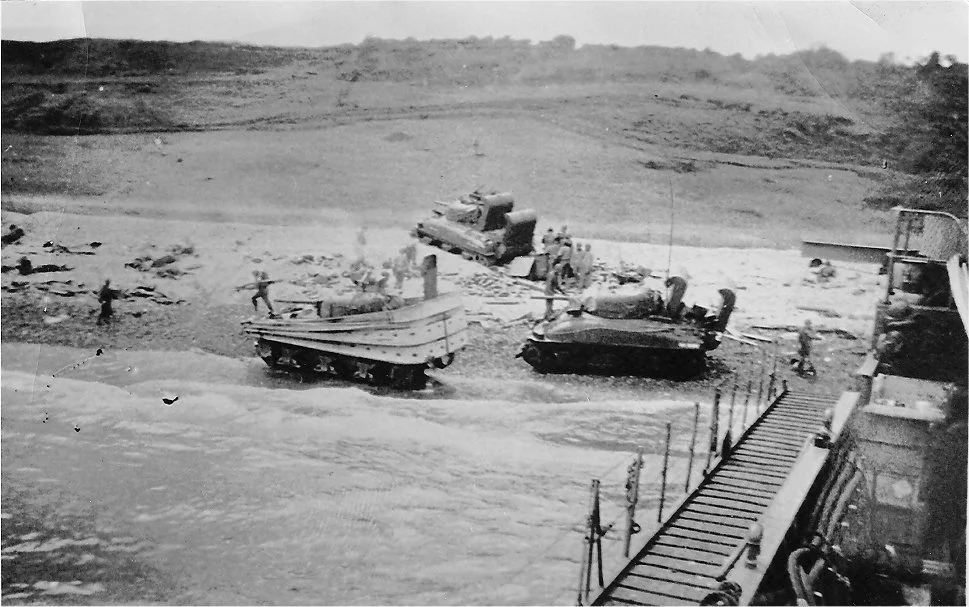
This installment digs into the facts behind that popular story, relying on Rockwell’s little known 1990 oral history which revealed a key element of the popular story was not entirely true. It also includes a never-before-published photo taken of a knocked out DD tank on Dog White beach sector.

The Duplex Drive Tanks of Omaha Beach, Part (d) The Debacle Off Easy Red and Fox Green
In the early hours of the 5th of June 1944, the 64 Duplex Drive Sherman tanks of the 741st and 743rd Tank Battalions left Weymouth Bay aboard 16 Landing Craft, Tanks. It was a rough crossing, testing both men and the landing craft. But far worse trials awaited the tankers the next morning as they had to fight a deadly battle with the seas off Omaha Beach before they could even come to grips with the enemy. This installment focuses on the ordeal of the 741st Tank Battalion, which was slated for the eastern half of Omaha Beach. Specifically, it details how the errors in planning and coordination stacked the deck against these men, and examines the full story behind the decision that saw 27 of their 32 tanks sink in the waters off Omaha Beach.

The Duplex Drive Tanks of Omaha Beach, Part (c) Embarkation Errors
As D-Day neared, the training of the DD tank crews and the LCTs that would carry them was completed. Final preparations were completed and the DD tanks were embarked and sailed to the departure ports, there to await the order to launch Operation NEPTUNE. Simultaneously, planning at the three higher echelons above the DD/LCT project matured and finally resulted in the publication of operation orders. Unfortunately, these orders conflicted with some of the preparations that had already been set into effect. When combined with errors in the embarkation process, the result was a cascading series of decisions and circumstances that would be hard to overcome on D-Day.

The Duplex Drive Tanks of Omaha Beach, Part (b) Confusion of Command
Faced with an acute shortage of both naval ships and time for pre-landing bombardment, the U.S. Army sought other means to give the leading waves an advantage in firepower. One of these solutions was the Duplex Drive tank, which through the use of flotation screens and add-on propeller kit, could be launched from offshore and swim to the beach. For the Omaha landings, however, the concept was met with cool disdain by the amphibious commander. As a result, the planning for employment of these tanks was vague, sketchy and disjointed. This installment examines how the planning - or lack of planning - set the confused conditions which contributed to the loss of so many DD tanks at Omaha on D-Day.
The Duplex Drive Tanks of Omaha Beach, Part (a) Limited Means and Makeshift Solutions
The first wave on Omaha Beach consisted of 64 Duplex Drive tanks embarked on 16 Landing Craft, Tanks. Their role was to provide critical fire support to the following waves of infantry and engineers. But things went wrong for one group, seeing 27 of their 32 DD tanks sink, while the other group landed its tanks directly on the beach. This article examines the decisions, plans and senior command attitudes in the weeks leading to D-Day which set the context and influenced the final launch-or-land decisions for the DD tanks.