Omaha Naval Bombardment. Part III: The Execution
“A good plan violently executed now is better than a perfect plan next week.” LTG G. S Patton
Updated & revised, 4 July 2026
The problem at Omaha was that a middling bombardment plan was executed in a halfhearted manner. It was not a combination for success. Before proving that assertion, I think it is important to provide context. Remember that later on 6 June, most of the bombardment ships heroically came to the aid of the troops struggling to secure the beachhead. The close-in fire of these ships broke the deadlock on the beach. These were good ships manned by good men, trying their best under difficult circumstances. And their efforts helped ensure victory at Omaha. Nevertheless . . .
. . . part of the reason those troops were in such dire straits was that those same ships failed to adequately perform their pre-H-Hour bombardment missions. Somewhere along the line, they failed to grasp the essentials of the bombardment phase of their D-Day missions. Whether this was a lack of training, lack of leadership or lack of focus on the key details of their mission remains to be seen. Regardless, their failure, combined with an inadequate plan, contributed to the agony of Omaha Beach
The Bombardment Group – Unwarranted Restraint
The heart of the bombardment plan was the Bombardment Group (CTG-124.9) consisting of vessels ranging from battleships down to escort destroyers. They would not provide the bulk of the planned projectiles, but they had the guns with the best rates of fire and the best accuracy. If anyone was going to get the job done it would be these ships. For that reason, we’ll review their performance first. A detailed summary of each bombardment ship’s fire missions will be posted as an addendum to this installment, but for now it will suffice to recap the results.
All told, the bombardment planned for sixteen of these ships to fire 5,697 projectiles—ranging from 14-inch down to 4-inch in diameter—between 0550 and 0630 hours (H-Hour). (Figure 1) Unfortunately, the ammunition expenditure figures are not available for two of the Royal Navy Hunt class escort destroyers.[1] Together those two were supposed to have fired 700 shells, but we have no data on what they did fire. The ships for which we do have complete data, were supposed to have fired 4,997 rounds but only actually fired 3452 (69% average expenditure).
But that data includes all missions, not just the beach neutralization mission. If we analyze solely for beach neutralization, we find an even worse ammunition expenditure rate. There should have been 3910 rounds fired, yet the beach neutralization missions saw significantly fewer rounds fired than planned, 2336. In fact, almost all the ships with this mission skimped on their bombardments to major degrees, with only two ships breaking this trend. The Carmick, fired its full authorization, and Georges Leygues fired significantly more rounds. In total, the beach neutralization mission saw just 60% of its allotted rounds fired, and even that poor showing would have been worse had not Leygues taken the initiative to fire an extra 117 rounds of 6-inch projectiles.
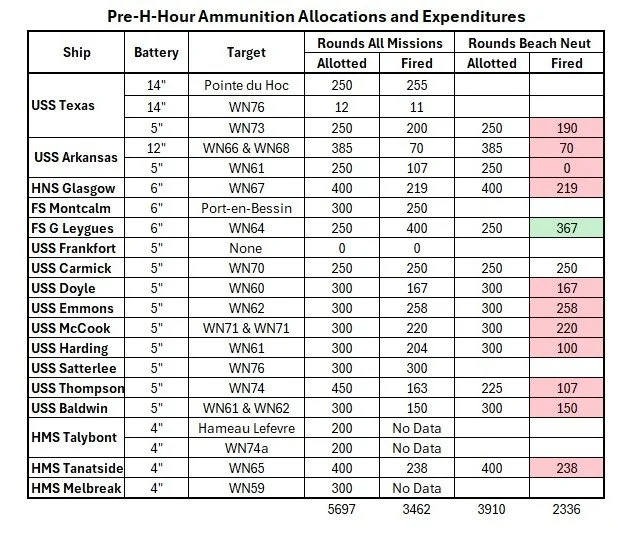
Figure 1. This table depicts the ammunition allocations and expenditures for the ships of the Bombardment Group for the H-40 to H-Hour bombardment. The right two columns include data for only those ships with beach neutralization fire missions.
That is significant. Forty percent of the projectiles slated for beach neutralization remained in the magazines at H-Hour. The beach neutralization mission was a failure on this basis alone. And that number may be even higher. McCook was assigned a single target at the D-1 exit, but reported firing on three separate targets without giving locations on the two extras; they may or may not have involved beach neutralization targets, which would subtract the rounds fired on them from the above calculations. Worse, the lowest expenditure rate by caliber was for the most powerful guns: 18% for the 12-inch guns of the Arkansas.[2]
As bad as these general statistics are, their significance can only be appreciated by considering how this played out at key invasion objectives. At first glance, the planned shelling of the defenses at the D-3 draw seemed to have every chance of success. Those defenses were supposed to be pummeled by 385 12-inch shells from the Arkansas, and 400 6-inch shells from the Glasgow. Firing from opposite fire support areas, the complementary gun-target lines could threaten the embrasures of gun emplacements on both sides of the draw. And while the 12-inch guns were not valued as highly for beach neutralization due to their rate of fire, this would have been an excellent opportunity to see how effective large caliber projectiles could be. But these ships made only a token effort. Arkansas fired only 70 rounds and Glasgow fired only 219; a 37% expenditure rate and a shortfall of 496 shells. Perhaps it is no coincidence that by nightfall, enemy resistance in the D-3 exit still prevented its opening.
It was a similar story farther east on the beach. Five ships were supposed to fire on the three resistance nests defending the E-3/F1 exits (WNs -60, -61 and -62). Arkansas was supposed to deliver 250 rounds from its secondary battery there, but had diverted that fire against a position in the vicinity of Port-en-Bessin. Four destroyers (Emmons, Baldwin, Harding and Doyle) were supposed to add 1200 more rounds to the targets for a total of 1450 5-inch projectiles. All told, they actually fired only 675 rounds—just 45% of the volume planned). In addition to defending those two draws, the resistance nests contained one 88mm anti-tank gun, four 75mm field artillery guns and one 50mm gun sited to enfilade the eastern half of the landing beaches. Three of those guns were in positions without overhead cover and should have been vulnerable to naval gunfire had it been properly applied (suitable gun-target lines and fuze/projectile combinations). But not one of these ships was in a position such that its trajectories could threaten the embrasures of those guns, and no time fuze was employed to neutralize the open-top positions.[3] These errors, combined with the failure to fire the full schedule of projectiles, must have contributed to the subsequent bloodshed on Fox Green and the late opening of the E-3 exit.
By way of comparison, the Carmick sent all 250 of its allotted rounds into WN70. At the risk of making too fine a point of the matter, this position was adjacent to the site of the penetration of the bluffs by the 116th RCT and 5th Rangers, and it is tempting to conclude the full bombardment here made a significant contribution to the success in that area.
All in all, the beach neutralization task had little chance of success with such a half-hearted expenditure of ammunition.
Positioning
The ships of the Bombardment Group filtered into the Omaha Transport Area as the convoys they escorted arrived. Designated ships moved part way down the swept lanes to support the minesweepers with counterbattery fire, if required, while the remainder held back a while longer. As the clock ticked toward 0550 hours (H-40) they moved forward towards their fire support positions.
Despite instructions to anchor, the Texas decided to use her engines to maintain position, fearing that as the tide reversed, the ship would swing about its anchor and complicate firing solutions. The Glasgow followed suit.
In the eastern fire support area, the Arkansas anchored at 0430 hours, followed by the Montcalm (0458 hours) and Georges Leygues (0506 hours). As the destroyers for that group were moving to their assigned firing positions, the German coastal artillery finally opened up at 0530 hours Fortunately these were the lighter caliber guns positioned in and around Port-en-Bessin (estimated to be 75mm). Arkansas initially replied with its 5-inch and 3-inch batteries against what it identified as target T129,[4] one half mile east of Port-en-Bessin at 0538 hours, and then with turrets I and II of her main battery at 0543 hours. Leygues joined this effort, firing 33 rounds. Emmons, being just 2500-3000 yards from the enemy battery at the time, also returned fire. Not to be outdone Baldwin and Harding joined the party, and probably Melbreak as well (her report contains few details, but she was the farthest ship east of the group and closest to the port). Doyle chipped in as well, although it targeted a battery one half mile west of Port-en-Bessin.
While the response was gratifyingly aggressive, the question is, was it wise? Did all those ships need to waste that much ammunition against one, possibly two light batteries? There seems to have been no coordination to this response, merely reaction, raising the question of what command and control was being exercised over these ships during the early stages of the invasion. The answer is that there apparently was none.
Alone among the eastern group, the captain of the Montcalm seems to have resisted the urge to dogpile on the Port en Bessin batteries in response to what he termed a “desultory fire.” Estimating the counter-battery fire from the other ships to be sufficient, he “decided to conserve my own ammunition.” It was a sound decision. [The captain of the Georges Leygeus stated his ship opened fire on the Port en Bessin batteries a minute after the Montcalm fired, but this is not correct. Based on the time sequence, he must have mistaken the the Texas’ 5-inch battery firing for the Montcalm’s 6-inch battery. The ships were almost in a line from the Leygues’ perspective, and being a 40 minutes before sunrise it could be difficult to determine which ship fired.] Within minutes the enemy batteries were silenced, at least temporarily, and everyone turned back to their primary pre-H-Hour targets, with only a few minutes delay in a couple of cases.
This incident did have one regrettable result, however. As noted above, when the Arkansas ceased fire with her 12-inch and 3-inch batteries at 0550 hours, its 5-inch battery continued this mission against target T129 until 0623 hours. This meant it did not fire the 250 rounds scheduled for target T43—which included the 88mm gun position in WN61. Forcing the E-3 draw would be just that much more difficult.
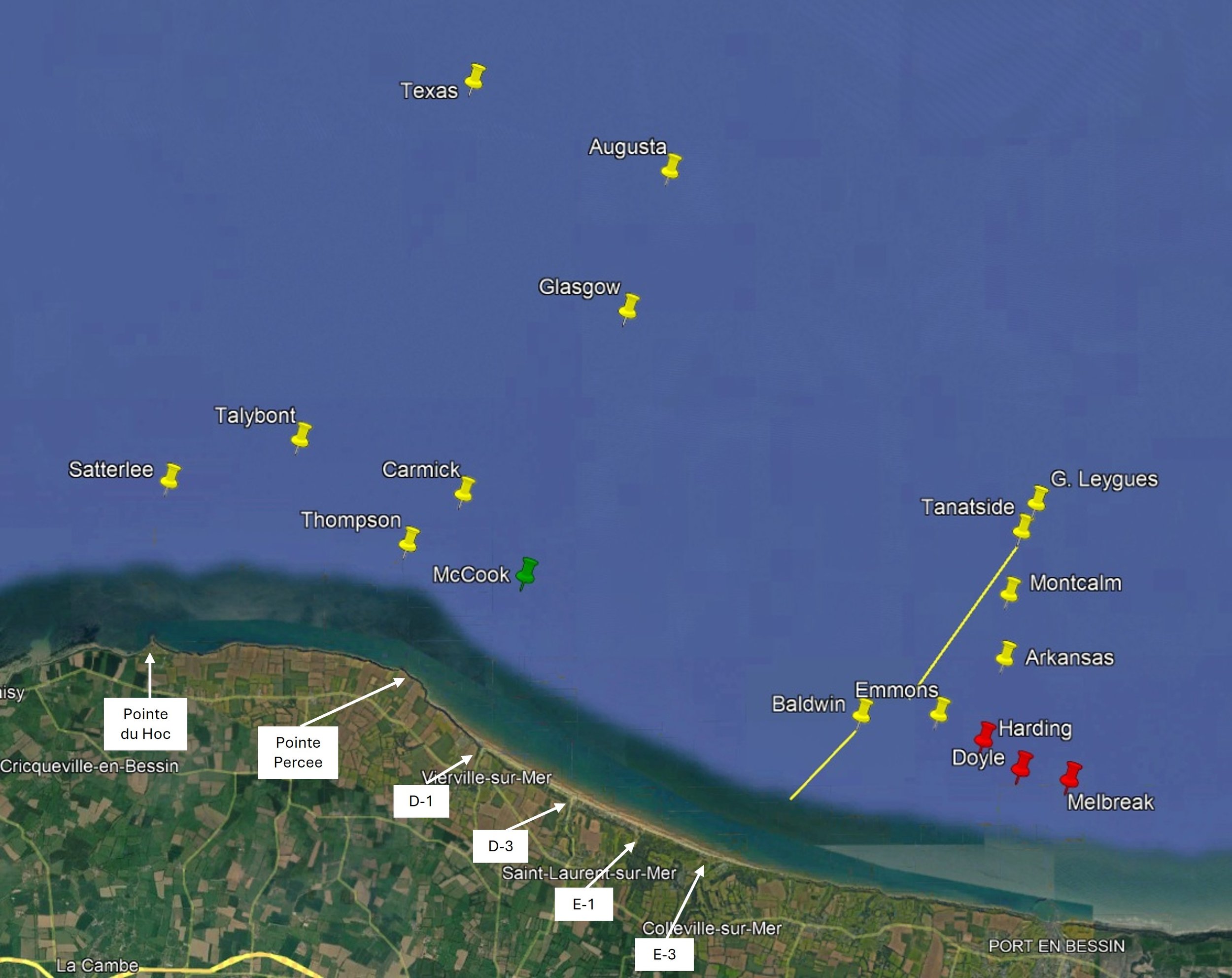
Figure 2. Bombardment Group ship positions during the pre-H-Hour bombardment. [Yellow pins: position located by range and bearing from a specified point. Green Pins: positions generally located by range from a specified point, but no bearing. Red pins: no firm data on position.]
Figure 2 shows the initial positions of the bombardment ships as well as can be determined. The ships of the eastern group provided little data on their positions, and as mentioned above, reports for two of those ships have not been located. In addition, some of the reports included contradictory data, with the Baldwin’s and Emmons’ positions swapped in one report.[5] This image does reinforce a point made in the previous installment: the location of the bombardment ships resulted in gun-target lines such that at least half the enemy casemates could not be effectively shelled, if the emplacements could even be seen from those positions. None of the eastern group of bombardment ships had a favorable line on any of the guns with enfilading fire west along the beach. It was much the same with the western group and the east-facing emplacements at that end of the beach.
The bombardment plan had given conflicting instructions on whether to anchor or not. In the main body of the CTF-124 order they had been given authority to “Anchor at discretion.”[6] In Annex E (Gunfire Support), however, the destroyers were directed to maintain maneuvering.[7] Both options had advantages and disadvantages, and the tradeoff basically came down to better firing data from a fixed position (especially as the targets became obscured) versus mobility to get into better firing positions (or evade enemy gunfire). A couple of ships opted for a middle course. Upon arriving at their assigned fire support positions, they dropped a dan buoy to mark the location. This provided a fixed point of reference as they tried to keep position with their engines, while maintaining ability to maneuver as necessary. Reports indicate only the Arkansas, Montcalm and G. Legyues anchored during the bombardment phase. For those ships which did not drop a dan buoy, they soon found that their Dead Reckoning Tracker was useless in trying to deal with the effects of tide and wind, making firing calculations that much more difficult.
Figure 1 does disclose an apparent failure. Annex E directed:
“Destroyers proceed down boat lanes and into inshore sectors of fire support areas maneuvering so as to maintain as heavy a volume of fire on beach targets as possible and adjusting speed so as to approach close to assault beaches as first waves beach.”[8]
Yet we can see from Figure 1, only two of the eleven destroyers continued to close on the beach during the pre-H-Hour bombardment period, and even then, one of them, the Tanatside, continued inshore primarily because it was well short of its assigned firing position when the bombardment began. Although we don’t have positional fixes for the Harding, Doyle and Melbreak, their reports did not mention maneuvering during this phase. Obviously, this failure to close into the shore would limit the destroyers’ ability to pick out emplacements, or observe the first wave so as to time their cease fires. On the other hand, by that stage the targets had mostly been covered in dust and smoke, and it was almost impossible to blindly maintain accurate firing solutions while maneuvering. That would indicate the better solution might have been to anchor—close in—to maintain better blind-firing solutions as dust rose. This error may have been due to the ships’ inexperience with actual shore bombardment.[9]
But did the guidance from the CTF-124 order to close the beach with the leading wave even make sense? Using the eastern fire support group as an example, this group of destroyers was spread out in a line to the east of the boat lanes—some very far to the east. So how could they adjust “speed so as to approach close to the assault beaches as the first waves beach?” If the ships had followed this instruction, four destroyers would all have converged on the area of the E-3/F-1 draws, and their movement primarily would have been laterally from the east, not directly inshore. While the general idea of closing the beach to maximize effects was fine, without proper positioning and a bit of deconfliction—which were lacking—it would have led to chaos. It sounded nicely aggressive and warlike, but it was impractical, if not counter-productive.
A Proper Mental Attitude
It appears the conduct of fire for the bombardment was largely impaired by the decisions of the captains, and their decisions were, in turn, influenced by a couple of external consideration.
First was a distinct definitional misunderstanding regarding the term “neutralize.” When providing counterbattery fire, the enemy position is neutralized when it stops returning fire. But when firing against beach defenses, such as troop shelters and casemates that haven’t yet opened fire, you can’t use the same criterion (lack of response from the defenses) as an indication when to cease fire. Since there would be no visible indication that the beach defenders are neutralized, the bombarding ship must continue to lay down a heavy volume of fire up to the last moment. That was an absolutely fundamental requirement, and was spelled out in the order (see the quote above). And yet, that distinction seems to have been lost on the captains of some of the ships.
Alongside that matter were two closely related problems. People firing heavy weapons tend to vastly overestimate their destructive power when they see the large, impressive detonations they cause. This is especially the case among the inexperienced—and virtually all the gunfire support ships involved were extremely inexperienced in shore bombardment. Troops in concrete bunkers, and even those in foxholes and trenches, are never as easily destroyed as offshore observers imagine. This applies not just to naval gunners, but army gunners and bomber pilots as well. Even more importantly, this applied to the fighter pilots circling above who were new to the job of spotting for the naval gunfire. Inexperienced observers simply assume (wrongly) that great big scary explosions near a target ‘must have’ destroyed it. One of the greatest lies of industrial-age warfare is, “believe me, the barrage will be so incredible you’ll be able to just walk on in.” That has rarely turned out to be true, and Omaha would be no exception.
That attitude was then inadvertently stoked by RADM Hall’s (Commander of Force “O”/CTF-124) continued adherence to the concept of destruction over neutralization (and to a degree RADM Kirk’s as well, Commander of the Western Naval Task Force). In both his base order and Annex E, Hall directed his large bombardment ships to lay down “counterbattery, destructive or neutralizing fire.” Destructive fire was never the objective, as Ramsay had repeatedly emphasized. Yet when Hall used that mesmerizing word ‘destruction’, it further primed his captains to think along the wrong lines, and apply the wrong fire techniques.
We have to look no further than the Harding for a perfect example of this. Harding was ordered to neutralize one single target: T41, which (along with T43 noted above) covered the WN61 position defending the east side of the E-3 exit, and was home of a 50mm gun (in an open-pit emplacement) and the 88mm antitank gun enfilading that half of the beach. And Harding had 300 rounds to do it. Initially Harding was distracted by the fire coming from the Port-en-Bessin area and lobbed 40 rounds in that direction starting at 0537 hours. Shifting fire to its assigned target T41 at 0547 hours, the ship ceased fire at 0605, under the belief the position had been “apparently destroyed.” It had fired only 100 rounds. The ship started looking for other targets, first seizing on target T33 (Melbrake’s assigned target). Harding tossed 20 rounds at it and again claimed the target complex was also destroyed. At 0610, Harding decided to shell a “fortified house in a draw west of Port-en-Bessin; target destroyed, 40 rounds expended.” At 0615 hours it shifted fire to what it described as an enemy field piece (no location reported) and sent 24 rounds in its direction. It claimed the crew was scattered and the gun was withdrawn, but “probably not destroyed.” At 0625 hours, as its high volume of fire on T41 should have been reaching its climax, Harding instead was focused back on Port-en-Bassin to engage a gun on the breakwater—a target Montcalm was tasked to suppress (the port’s defenses were Montcalm’s only task).
To summarize the Harding’s bombardment contributions, it fired just one third of its allotted ammunition at its assigned target, at which time it improbably decided the gun positions, shelters and entrenchments had been ‘destroyed.’ They were not destroyed. Whatever neutralizing effects those 100 rounds might have had, were wasted because the Harding had ceased fire on its assigned target fully 25 minutes before H-Hour, giving the defenders plenty of time to shake it off. Whatever the strengths of the Harding’s captain, he brought the wrong mental attitude to the task and lost focus on what his primary bombardment mission involved.
Nor was the Harding the only example of this. On the western flank, the Thompson was ordered to place 450 rounds on two targets in WN74. That was the highest allotment for any of the bombardment ships, as Thompson’s fire mission was supposed to last longer, from 0550 to 0715 hours. Recall from the previous installment, one of these two targets contained a pair of 80mm guns sited to enfilade the western half of the beach. The other target consisted of the general defensive works within the rest of the strongpoint, which did not immediately threaten the landing. At 0550 hours, Thompson opened fire for 30 minutes on the target that included the two gun emplacements. It then judged the target “apparently destroyed” and ceased fire, having expended 107 rounds. With 10 minutes left before H-Hour, Thompson shifted fire to the other target. This was a major error. Thompson was not forced to cease fire because the leading waves fouled its gun line; the target was west of the boat lanes and there was no interference. Nor was it forced to cease fire because of time limits; it was cleared to shoot until 0715 hours. Thompson was simply overly impressed by its own fireworks and decided it must have destroyed the target. With 10 minutes left before H-Hour, the gun crews had time to shake off the effects of the bombardment and re-man the guns. It isn’t certain when the guns went into action, but it wouldn’t be last heard from them.
After ceasing fire on the gun positions, Thompson shifted fire to the second target. It was a desultory effort, consisting of just 56 rounds fired over the next 40 minutes (with 30 minutes of it after H-Hour), but Thompson declared that target destroyed, too. In total, the ship had fired just 163 rounds of its allotted 450 during its bombardment window. That proved to be a false economy as the ship then noticed a gun firing on the beach. The coordinates Thompson reported for this ‘new’ gun were the same coordinates as the two 80mm guns it claimed had been destroyed at 0620 hours (though it didn’t make that point in its report). There’s no way of telling how long it (or both) had been firing before it caught Thompson’s attention. Thompson spent the next 40 minutes again trying to silence the gun(s), during which time the gun(s) continued to shell the troops on the beach. It took another 106 rounds before the ship again announced the position destroyed, rounds that would have been far more productive had they been expended before H-Hour, or in the 45 minutes as the initial waves landed, to silence those guns before the landings began.
It the 10 minutes between Thompson’s cease fire and H-Hour—when Thompson was supposed to be firing its most intense period of bombardment on the gun positions—the ship instead shifted fire to the target that did not threaten the waves as they beached. We don’t know when those guns were put into action, but the volume of flanking fire on the Dog Green beach sector would indicate the guns had not been neutralized by the Thompson’s aborted bombardment and were probably up and firing at or shortly after H-Hour. This would not have happened if Thompson had been focused on continuing its neutralization mission; instead it opted for a destruction mission, with no visible criterion to make such a judgement. And, once again, it’s worth noting that these guns were in earth field works (not concrete emplacements) and should have been vulnerable to Thompson’s 5-inch guns. But the ship had a poor angle of fire on them and had skimped on ammunition.
The failure of the Bombardment Group was the culmination of several factors, and was not simply due to too little time or too few guns as Hall claimed. Most of these have been discussed before, but to recap, these are the most important factors:
- Diversion of ships from either defensive (counterbattery) or offensive (beach defense neutralization) tasks, assigning them instead to targets that did not immediately threaten the landing.
- Too heavily weighting the defensive tasks. This primarily applies to wasting Texas’ main battery on Pointe-du-Hoc when a destroyer could have handled the mission. As a result, the heaviest guns in the force made no contribution to neutralizing the beach defenses. This could also apply to Montcalm; dedicating 6-inch (152mm) guns to neutralize 75mm guns was perhaps excessive and wasteful.
- Inadequate positioning of ships relative to the orientation of the defensive fortifications within the assigned targets.
- Failure to use the most effective shell types. For every one AA shell used, more than 6 common shells were fired, despite the former having better terminal effects. This proportion was in keeping with Hall’s order, and may have reflected limited stockage levels on hand in the UK. It also may have reflected the desire to retain AA shells for expected Luftwaffe attacks. Whatever the cause, it still hampered the bombardment.
- Passive command. Once the pre-H-hour bombardment began, it proceeded automatically, without active command involvement. While this would have been fine had the bombardment proceeded as planned, that is not what happened. Even though the Destroyer Squadron 18 commander (and his flagship Frankford) had been diverted to organizing the offshore screen and was not present inshore to control the destroyer force (a questionable decision), his deputy commander (captain of Satterlee) was present on the firing line. While Satterlee made several excellent decisions on D-Day, it made no attempt to stop the bombardment from veering off the tracks.
- There was a marked difference in attitude in prosecuting defensive as opposed to offensive tasks. As soon as a coastal artillery battery opened fire from the vicinity of Port-en-Bessin, every ship in the eastern fire support group aggressively responded. On the other hand, while prosecuting the beach neutralization task, only McCook and Leygues fired their entire allotted ammunition, with the rest firing only about a half.
- Synchronization with the leading wave. The intent was to increase the volume of fire to a maximum just before the leading wave beached. While bombardment times were specified in the order, the actual cease fire was supposed to be guided by the progress of the first wave. Only one ship, Baldwin, mentioned doing this. The others either ceased firing at the prescribed time, or prematurely switched to other targets. (The Satterlee deserves mention for taking the initiative to shell Pointe-du-Hoc in conjunction with the Rangers’ delayed landing. But as that was not its assigned target and occurred after the bombardment period, it doesn’t strictly fit in this discussion, however commendable).
As you can see, there were many factors in play. Some were the result of tradeoffs (such as the matter of anchoring versus maneuvering). Some were flaws in the planning and some were the result of decisions in the midst of gunfire. And there were factors that no one could affect (such as the six idle 5-inch guns—the equivalent of another one and a half destroyers—on the unengaged side of the battleships). They all combined to steadily erode the scale and effects of the bombardment.
Yet emerging from this are two overriding facts: 1) too few of the guns available were appropriately targeted on the beach defenses; and 2) only 60% of the projectiles that should have been fired, were.
So far we have discussed only the standard naval gunfire ships. It’s now time to turn our attention to the various craft used to complement the fire of their larger brothers.
The Self-Propelled Artillery
Given the lack of information about these howitzers on D-Day, there is little to be said. As you’ll recall from the previous installment, each of the 36 M7 self-propelled howitzers was allotted 100 rounds to fire as its LCT followed the leading waves toward the beach. That should have totaled a healthy 3,600 rounds hitting the defenses in the 25 minutes prior to H-Hour. It would have been a considerable addition to the bombardment, amounting to two thirds of what the naval gunfire ships were supposed to shoot (keeping in mind the differences in caliber). Of course, this potential was offset by the their limited accuracy aboard the bobbing LCTs.
There is scant information on the 58th Armored Field Artillery (AFA) Battalion’s action on D-Day. The unit history mentions the battalion training to fire from LCTs, but completely omits mention of doing so on D-Day.[10] Similarly, Hot Steel, The Story of the 58th Armored Field Artillery Battalion, also omits this.[11] However, Fran Baker, the editor of Hot Steel, does have records indicating the battalion fired 774 rounds from its LCTs on 6 June.[12]
The 62ND AFA Bn opened fire as planned beginning at 0600 hours at 8,000 yards range. A total of 349 rounds were fired from the LCTs.
“On the initial run-in for firing several LCT’s proceeded well within 3,000 yards of the beach while still firing. All the LCT’s were subject to small arms and cannon fire at this time but no damage to craft or wounds to personnel were suffered.” [13]
The battalion commander (LTC Donal Bennett) had almost nothing to say about firing from the LCTs in his report, merely noting “Battalion fired on beach defenses prior to H-hour.”[14]
Based on 18 howitzers in each battalion, the 58th would have fired roughly 43 rounds per howitzer while afloat, and the 62nd fewer than 20. These numbers are well below the 100 rounds allocated per howitzer by the CTF-124 order.[15]
There is no clear indication whether these battalions conducted their shoots by direct lay, or if they used the clock method (as discussed in the previous installment). But we can possibly make an educated guess. If firing in direct lay, the rear howitzers would have their sight-lines blocked by the howitzers ahead of them in the LCTs, which would prevent them from aiming and therefore firing. If that were the case, then only the ten howitzers at the front of the LCTs could have fired for each battalion, bringing the rounds-per-gun up to a somewhat more reasonable 77 rounds for the 58th and 35 for the 62nd.
The hard reality, however was that these battalions delivered significantly less ordnance than planned. Instead of 3600 high explosive projectiles, they delivered only 1123, or just 31% of the expected firepower. So, the Army was no better at delivering ‘drenching fire’ than was the Navy.
The Rockets
Hopes were not necessarily high for the LCT(R) group since CAPT Sabin, heading the Gunfire Support Group, had rated their preparedness as poor due to the late arrival of their craft and their lack of training. Determining their actual performance on D-Day is difficult, as the reports are vague and contradictory.
One the Navy side, optimism was the tone. LCDR Carr was the commander of the LCT(R) flotilla, and his report was positive.
- His craft used radar with a position prediction indicator (PPI) screen to judge range to the shore. All but one craft used ranging shots to confirm the radar. These ranging shots were not as useful as hoped, as the shallow waters nearing the beach caused the rockets to detonate as if they were striking dry land (misleading the observer—looking from thousands of yards off shore—to believe he was in range).
- Complicating this, the Officers in Charge (OiCs) of the craft stated they could not actually see their targets due to the dust and smoke.
- Despite the above, the OiCs believed they “fired on target in all instances.”
- As reported by the OiCs, the time of firing for the craft ranged from H-7 to H+2, which conflicted with the much earlier time recorded in some Army reports.
- The OiCs also reported the first wave’s estimated range to the shore varied from 200 to 2000 yards, (which indicates synchronization failed badly in the longer cases).
The claim that they believed they “fired on target in all instances” is plainly incompatible with the details concerning misleading ranging shots, inability to see their targets and their first experience with using radar for fire control.
Despite his skepticism, Sabin struck a mixed, but mostly positive tone in his report:
“Rocket craft took up their positions, some late. The fire, however, was generally accurate and, it is believed effective.”[16]
Later in the same report he warmed up to them even more:
“Rocket fire was excellent in general. Rockets from two of the craft appeared to be short. Many rockets exploded shortly after launching. Conversation with a few Army personnel who landed early indicated they considered the rocket fire their best cover.”
It isn’t apparent how he could judge the fire to be “excellent in general” as the targets were obscured. Still, his final comment was equally upbeat:
“Rocket craft are the most useful and important of the close gunfire support craft. Properly trained and used, they can be of great assistance. It is recommended that additional high speed, shallow draft, short range rocket craft be developed.”
As complimentary as that last quote sounded, his caveat of ‘properly trained and used’ reveals he was talking about the hypothetical value of the craft, not the effectiveness as witnessed on D-Day. In fact, the last sentence recommended a type of rocket craft completely different from the ones he employed. Skepticism here is also warranted by the fact that the LCT(R)s were sent back to the UK the very next day (D+1). The CTF-122 plan directed they be returned when they exhausted their ammunition, but each craft had an entire second set of rockets, and were supposed to have reloaded and been ready to fire again by H+210, at targets designated by CAPT Sabin (per the CTF-124 plan). But Sabin did not employ them later on D-Day, or in the following days to assist the push along the coast west from Vierville towards Grandcamp-Maisy. Instead, they were sent away. That is probably the clearest judgement on their effectiveness.
After the war, Sabin took a different tone. While claiming the rocket barrages provided a morale boost to the invading troops, he also noted that:
‘‘ . . . due to excessive dispersion, however, the rockets inflicted very little damage on the enemy.’’ [17]
He also mentioned in passing that “approximately six thousand rockets left their pads” during the assault; he didn’t point out that was three thousand fewer than were supposed to have launched. Two pages later he revealed that after H-Hour he still had two fully loaded LCT(R)s at hand, indicating two of the rocket craft had not arrived in time to launch; he did not explain why the remaining 1000 rockets did not fire.
The Army perspective of the rockets’ effectiveness was more in line with Sabin’s later, non-official writings. The 16th RCT reported the rocket craft fired too early, corroborating evidence of the synchronization failure, especially since most of this wave landed late.[18] It didn’t mention where the rockets struck, but noted their targets were fully in action when the troops landed. The Army’s Omaha Beachhead stated:
“The rockets, according to most reports from the assault troops, made a heartening display but failed to hit defensive positions-an opinion which cannot be accepted as final and which runs counter to naval reports.”[19]
But even some Navy reports called the rocket accuracy into question. The LCTs from the group landing DD tanks in the 116th RCT sector mentioned the rockets, but two of those reports thought they were witnessing a series mines detonating in the water and on the beach, or mortar or artillery fire, indicating the barrages landed too short. A third LCT recognized the explosions for rockets, and reported they landed all around the craft as it beached 75 yards from the waterline – another poorly synchronized and short barrage.[20]
Fragmentary reports from German defenders were just as uncertain, although their comments were recorded decades later and may not be entirely accurate. Each of their positions should have been hit by a rocket barrage. Henrik Naub was a machine gunner in WN71 and made no mention of rockets being employed.[21] Hein Severloh (in WN62) graphically described the horror of the barrage of gunfire and rockets, but noted:
“Nevertheless, the shells of this barrage mostly hit the base too high and caused little damage.”[22]
Similarly, Gustav Winter, who manned the ‘concrete panzer’ in WN68, described a terrible bombardment by large caliber shells, no doubt the abbreviated shelling by the Arkansas and Glasgow. He did not, however, mention a rocket barrage.[23]
Essentially, we have no idea how accurate the rocket barrages were or how effective the impacts. Despite the optimism of Navy observers who were looking at a smoke-clouded shore, the sparse reports from American and German troops alike seem to indicate that their effectiveness was minimal.
But in some respects, this distracts from another key point, and that is the difficulty of synchronizing these barrages with the landing of the leading wave. For one thing, the term ‘leading wave’, which the LCT(R)s were supposed to key on, referred to the tanks that landed from LCT(A)s and (HE)s, and they should have touched down at H-Hour. In theory the first infantry (Wave 2) should have landed one minute later. But the Navy’s boat waves were not up to the task of keeping such a tight schedule. Sabin, who was close inshore observing his various gunfire support craft, candidly stated “there was a general mix-up of all craft.”[24] Boat divisions lost formation, craft were swept to wrong beach sectors or steered toward misidentified landmarks, and many in the leading waves landed late. To be truly effective, the LCT(R)s needed to synchronize their firing closely with the first wave of tanks and the first wave of infantry. And this was simply impossible as the small assault craft were incapable of performing their role to the required degree of precision.
There were many reasons for this, including the sea conditions, the excessively long distance between the Transport Area and the beach, and the generally inexperienced crews of the small craft (more on that in a later series). The simple fact is that the effectiveness of the rocket craft depended on precise clockwork functioning of several parts, none of which—to include the LCT(R)s—were up to the job on 6 June. Rocket craft had proven effective in the Pacific, but Hall’s command hadn’t yet gotten the bugs worked out.
I tend to consider these LCT(R)s to have had little physical effect on the defenses. Their noise and concussions may have contributed something to the general neutralizing effect, though even that is questionable due to the synchronization problem. Nevertheless, Hall spoke well of the concept in his report, without, however, actually commenting on their effectiveness on D-Day.
The LCG(L)s
Not a lot was expected of the LCG(L)s. Converted from LCT hulls, they were not particularly good gunnery platforms and had no fire control systems other than direct sights. By naval gunnery standards, their two 4.7-inch guns were just a bit smaller than the 5-inch guns of the destroyers. But these flat-bottomed craft could get close inshore where it should be easier to locate and target specific features. In short, they might come in very handy—with a bit of luck. The LCG(L)s were tied to the LCT(A)/(HE)s of the first wave, being tasked to escort these craft from the Line of Deployment to the beach, providing neutralizing fire on specific targets on the way in.
According to the plan, three LCG(L)s would fire on four targets in WN72 and WN73 (the D-1 exit). One LCG(L) would fire on WN65 (E-1 exit) and the final LCG(L) would strike WN61 (at the E-3/F-1 exits). As a result, both of the casemates that had 88mm guns would be targeted by an LCG(L). Each craft had an allotment of 120 rounds (except one with 150) and was to fire from H-20 until times ranging from H-4 to H-Hour. Like the destroyers, however, they were ordered to continue firing until the lead wave of LCT(A)/(HE)s landed or fouled their gun line, in case the LCTs were either early or late.
Unfortunately, they too performed poorly. It started with two of the LCG(L)s slated for the D-1 draw (#426 and #449) mistakenly ending up at Utah beach. Sabin’s report claimed #426 arrived back at Omaha in time to fire on schedule, but #426’s action report contradicts that, stating it arrived at Omaha at 0745, after proceeding at emergency speed, but having to stop and rescue survivors in the water. The #449 craft remained off Utah.
As a result, the bombardment of the defenses at the D-1 draw would be reduced by 240 rounds (66%). The #424 craft did arrive on station, on time and opened fire at 6000 yards, and closed the beach to an unspecified distance. It ceased fire at 0640 hours, having fired only 66 rounds. Thus, instead of being hit by 360 rounds of 4.7-inch fire, the D-1 defenses received barely more than one sixth of that number. (This area had already been shorted 140 5-inch rounds from McCook’s and Texas’ abbreviated bombardments.)
The #811 craft opened fire on its target (a group of pillboxes in WN65) at 0610 hours at a range of 4000 yards and closed the beach on the flank of the LCT(A/(HE)s until reaching 1000-500 yards. The OiC was apparently confused as to his mission, believing it was a point target instead of the complex of guns and machine guns. As a result, after observing two hits and one probable hit on his target, he ceased fire. He only fired 47 of his allotted 120 rounds.
The final LCG(L) was the #687 craft, which had target T43 (WN61) in its sights, and had 150 rounds to fire (30 more than the rest of the LCG(L)s). It opened fire at 0609 hours at a range of 4,000 yards and closed to 1,000 yards. In his report, the OiC stated his mission was neutralization, and apparently, he had the correct interpretation of that word as he fired for the full duration of his timeframe, and expended 110 rounds, despite the obscuring dust. His report, however, illustrated the weakness in the design of the LCG(L)s in this phase. The #2 gun was directly behind the #1 gun and, being at the same level could not fire over it. So, when the craft was headed directly toward the target as it escorted the LCT(A)/(HE)s to the beach, it could only fire one gun. He attempted to solve this problem by sailing on a zig-zag course which would permit the #2 gun to bear for part of the time. This was complicated by the need to avoid fouling the gun lines of the Harding and the Baldwin which were firing at the same target. Again, planning needs to consider these details.
But generally speaking, the LCG(L)s were a disappointment, expending only 223 of an allotted 630 rounds. Under-firing seemed to have been the common affliction among the bombarding vessels, be they ships or craft or howitzers.
Both CAPT Imlay (Deputy Commander of Assault Group O-1) and CAPT Sabin (Commander of the Gunfire Support Group) doubted the value of the LCG(L)s in the landings, focusing on their lack of fire control systems and a decision not to link those craft with spotters ashore, which precluded them from being directed on known targets.[25]
The Control Vessels
There were six patrol craft that acted as control craft offshore at Omaha. The vessels were PC-461 Class, 173-foot submarine chasers. Although doctrinally sub chasers, they were classified as patrol craft and numbered as such (e.g., PC-552). (Not be confused with a smaller 110-foot class of submarine chasers used as secondary control craft on D-Day.)
As primary control craft, four of the six PCs had the job of locating their beach sectors and positioning themselves at the Line of Departure to guide the boat waves to the correct beaches. The remaining two craft were reserve control vessels, and they would start at the Line of Departure, and accompany the lead waves to 2000 yards offshore and take position there.
As these six ships mounted 3-inch guns, they were incorporated into the bombardment plan and each craft was given a target to fire on and allotted 50 rounds (AP) for the job.
On D-Day, one PC (PC-552) did not fire as it was too busy trying to rescue soldiers whose DD tanks had sunk. It isn’t known whether PC-567 fired, as the only report from that ship was from the embarked Dispatching Officer, and he made no mention of firing, probably because he was busy with other duties. I assume the ship did fire; there was nothing to distract it from that task as was the case with PC-552. We know from a crewman’s personal account that PC-553 did fire, and while he mentioned hitting their pillbox seven times, he did not mention how many rounds were expended. PCs -568, -618 and -1225 did fire, with the first two closing to 2000 yards and the latter remaining 4000 yards offshore. They fired 51, 19 and 50 rounds respectively. Two craft ceased fire 12 minutes early due to smoke-obscured targets, and the third kept up the fire until H+10.
It’s impossible to establish how much effect the PCs had on German defenses. After the pre-H-Hour bombardment, these ships reported some excellent pinpoint shooting and destruction of quite a number of enemy positions (without slighting the honor of the sailors involved, it isn’t clear how much of those claims were the result of accurate observation or ‘enthusiastic estimation’). Nevertheless, as far as the pre-H-Hour bombardment is concerned, there is no way to judge their effect.
The Elephant in the Screen
Hidden in plain sight in Kirk’s operation plan was Task Group 122.5, the Reserve Fire Support Group, consisting of one light cruiser, 17 destroyers and the heavy cruiser Augusta. That’s a very large reserve and a whole lot of firepower standing idle, especially when you’ve been complaining you don’t have enough bombarding ships.
The truth is they weren’t exactly idle and these ships were filling necessary roles. First, they were mostly deployed in the WNTF flank screen facing Cherbourg. The E-Boat raid on RADM Moon’s Exercise Tiger convoy had made Kirk understandably nervous about what surprises might come from Cherbourg and the Brittany ports. And if Kirk was nervous, Moon was doubly so.
And second, they were standing by to replace bombarding ships that had used up their ammunition allowance. Naval gunfire was going to be very important in the coming days, and they could not simply exhaust all the ships’ magazines in the first few hours. As no one wanted a ship to completely ‘run dry’ on ammunition, the plan stated if a ship fired 70% of its magazines, it would be pulled out of line and placed in the screen until it could be sent with a return convoy to the UK for replenishment. Once it was pulled out of the bombardment force, a ship from the Reserve Gunfire Group would stand in and replace it. Only one ship at Omaha fired off 70% on D-Day, the Satterlee.
Still, seventeen destroyers and two cruisers seem a bit excessive as a reserve. It’s difficult to believe one, or two, or even three couldn’t have been added to Hall’s bombardment force. From this perspective, 80+ years later, it is impossible to judge all of the considerations Kirk had to weigh, and it wouldn’t be wise to flatly say he erred in this allocation of ships. But it is reasonable to wonder if some adjustment shouldn’t have been made.
On the other hand, two factors do argue against the allocation of an additional ship or two from the Reserve Fire Support Group. First, Hall clearly did not get nearly the volume of fire expected from the ships he did have, and there would be no guarantee any reinforcement would have been handled any more effectively. And second, Hall’s failure to deconflict positioning and gun-target lines in the fire support areas was such that adding one or two more ships may have actually been counterproductive.
There was one small, surprise gift from the Reserve Fire Support Group. In the early hours of 6 June, the heavy cruiser USS Augusta with its nine 8-inch guns and eight 5-inch guns sailed into the Transport Area off Omaha. Although Augusta was Kirk’s WNTF command ship (with his Army counterpart, LTG Bradley aboard), it was also dual-hatted as part of the Reserve Fire Support Group. In my previous installment I questioned why it hadn’t been given a bombardment task in any of the plans. It turns out that at some point late in planning, the subject must have come up and it was included.
Augusta arrived at the western swept lane hours earlier, but didn’t proceed into Fire Support Area 3 until 0550 hours. At 0617, it dropped anchor and a minute later opened fire. Its action report did not identify the target, and the ship only expended twenty-one 8-inch rounds over a five-minute period, ceasing fire at 0613 hours. It opened fire again at 0635 hours (again at an unidentified target), expending 30 rounds before ceasing fire eight minutes later. Having taken a symbolic lick at the enemy, the ship then repositioned back into the Transport Area, anchoring next to Hall’s command ship (the USS Ancon). It hadn’t been much, and it probably didn’t help much, but it couldn’t have hurt. It was a bit disappointing, though.
Questions and Answers
There are four major questions this series has attempted to answer.
The first is why Admiral Ramsay and General Montgomery did not adopt an invasion model more akin to that used in the Central Pacific. I believe the first installment answered that question thoroughly. I’ll merely leave the final word to Unteroffizer (Corporal) Henrik Naube, of the German 352nd Infantry Division, manning a machine gun in WN71:
“I am also puzzled as to why the Americans did not damage our positions more fully before the landing. I imagine that there is a balance for an attacker to keep, between a lengthy bombardment which does a lot of damage but also signals that an attack is coming soon, and on the other hand a last-minute preparatory bombardment which forces the defenders to take cover but without letting them prepare for the attack. Nevertheless, considering their capability, I am surprised that their aircraft did not attack us more fully overnight on the evening of the 5th June or at first light on the 6th, when the bombs from their heavy bombers fell wide. I think that would have disrupted our defences and still prevented us from reacting in time by bringing up reserves and so on.”[26]
Henrik’s second sentence shows a better understanding of the difficult tradeoffs involved in selecting the bombardment length than did a number of senior officers in the Allied command. As for his third sentence, well, that provides an excellent segue to the next installment, which will examine the planned air bombardment.
The second question was whether the bombardment plan was reasonably sound, which was addressed in the second installment of this series. That analysis identified several flaws in the multiple layers of bombardment planning, most of which concerned conflicting instructions and unclear guidance. The major flaw appeared to be the failure to make the most of the assets on hand, such as the Frankford not being used, the targeting of Texas at Pointe du Hoc and the diversion of ships to non-critical targets during the brief bombardment window. The result was a significant diversion of firepower from the critical beach neutralization task. The best illustration of this lopsided allocation of firepower unwittingly comes from Hall’s own report on the operation. He proudly bragged that the defensive counterbattery mission was so effective that only a single shot was fired at the fleet and it missed.[27] That was a factually incorrect statement, but the general sentiment is on point: the German coastal artillery had virtually no impact on the invasion. That fact stands as a clear indictment of how Hall apportioned guns-to-tasks. The fact that he succeeded so completely at the counterbattery task—while failing so badly at the beach neutralization task—is clear evidence he put far too many of his critical and limited assets into the former task and badly shorted the latter.
It’s almost as if he never believed the beach neutralization task was achievable, and as a result did not tackle the job as seriously as he did the counterbattery task. If so, his doubts created a self-fulfilling prophecy, with too few guns committed, too few rounds fired and too few captains vigorously prosecuting their beach neutralization task.
And that neatly leads to our third question: was the bombardment plan executed effectively? No. It was not. With 40% of the Bombardment Group’s planned projectiles left unfired at H-Hour, there is no question execution was a failure. The self-propelled howitzers firing from LCTs fired an even lower percentage of their shells, and with much less accuracy. And no one can make even an educated guess what effect the rockets had. Finally, the LCG(L)s and control craft suffered from many of the same problems, with the added point that there were so few of them.
The failure of the bombardment at Omaha was not so much due to the lack of bombarding ships or time (though a bit more of each would have been very nice to have) as it was due to poor allocation of ships to tasks, and extremely poor execution.
Had intelligence spotted movement of the artillery of the German 352nd Infantry Division into position behind the beach, that would have presented Hall and his gunfire planners an entirely different set of challenges. His bombardment group would have been clearly inadequate to shell the numerous battery positions scattered inland in addition to their other tasks. Presumably this would have resulted in some of the Reserve Fire Support Group’s ships shifted to Omaha. And while this was the reality they ended up facing on D-Day it is outside the scope of this analysis: how well was the bombardment, as planned, executed?
And that leaves us the fourth and final question. Could the bombardment have succeeded had it been better planned and executed? That’s difficult to say, if for no other reason than how to measure success? Where on the sliding scale of ‘attritted defenses’ is the success line?
We do know that even in its anemic form on D-Day, the bombardment did have some significant effects. All three of the German defenders I cited earlier testified that a soldier in their separate groups broke down in fear. Eyes bled from the concussions. Hearing was lost. Concrete walls ‘rippled and cracked.’ Two of them described nearby concrete positions destroyed. The end of one position was blown open, exposing defenders to the beach. Gustav Winter, manning the concrete panzer, said his turret was penetrated by a Sherman tank shell that killed his loader. Yet when examined after D-Day, it was found intact, indicating he abandoned the fight. Similarly, Henrik Naub in WN71 reported that the Volksdeutsch[28] troops in the neighboring bunker killed their German NCO rather than continue the fight. So even this truncated bombardment had effects, both physical and moral. It wasn’t enough in that truncated form, but it hinted at what more could have been accomplished had it been fully prosecuted.
Had the bombardment been almost doubled—that is, had all the allotted ammunition been fired—and had the ships better synchronized their cease firing with the landing of the first waves, there is little doubt it would have been far more effective. Had the LCT(R)s been better trained, more accurate and better synchronized, the effectiveness would have been even greater. And had the self-propelled artillery fired its full allotment, how much greater the general effects might have been, despite their accuracy problems?
But how much more effective and would it have been ‘enough?’ That’s impossible to quantify, and everyone will draw their own conclusion. As for me, I won’t commit the typical error of predicting it would have been a ‘walkover.’ In an era of dumb bombs and unguided projectiles, there were strict limits to what a bombardment could achieve. But I do think it is obvious that the losses among the American invaders would have been considerably less had the bombardment been better planned and more violently executed. Maybe, just maybe, it would have been successful enough that we would not feel obliged to think the adjective ‘bloody’ must precede Omaha.
Spin and Scapegoat
Hall never did admit that his view of the tactical environment was faulty, and he never let slip the slightest hint how poorly his pre-H-Hour bombardment misfired. In his after action report he repeatedly hammered home his belief that he hadn’t enough time or ships for the bombardment, and he similarly criticized Ramsay’s decision that neutralization was all that could be achieved. Hall repeatedly stated that slow, aimed fire for destruction of beach defenses over a prolonged time should have been used. This despite the fact that such a delay likely would have resulted in a defeat of the invasion. Hall suffered from the blindered perspective of a man focused on the first 100 yards, and was incapable of seeing any larger ramifications. He was so fixed in his opinion that he didn’t see the flaw in his own assertion. He blamed the ineffectiveness of his pre-landing bombardment on inability to spot the enemy positions. So how would a longer and more deliberate (aimed fire) bombardment succeed when he nothing to aim at?
In fact, Hall was left in an untenable position. On the one hand, he blamed the ineffectiveness of his bombardment on the lack of ships, time and the inability to spot the emplacements. On the other hand he had to portray his command’s efforts as effective and successful. He attempted to rationalize this internal contradiction with this carefully crafted disclaimer:
“Naval gunfire support was effective against the targets on which it was directed. Unfortunately the pre-landing bombardment was not accompanied by air bombardment as was planned, consequently many enemy position were left untouched.”[29]
This was wildly at variance with the facts. As worded, it clearly implied that the naval and air bombardments were focused on different targets. Hence the failure of the air bombardment left many targets untouched. Absolutely false. As figure 3 graphically demonstrates, every air target duplicated naval bombardment targets. Not a single target was assigned to the bombers alone. If any target had been left untouched, then Hall’s force had to have failed to engage it as well. But they didn’t fail to engage those targets. What they failed to do was to engage them fully, skillfully and in proper synchronization with the first wave.
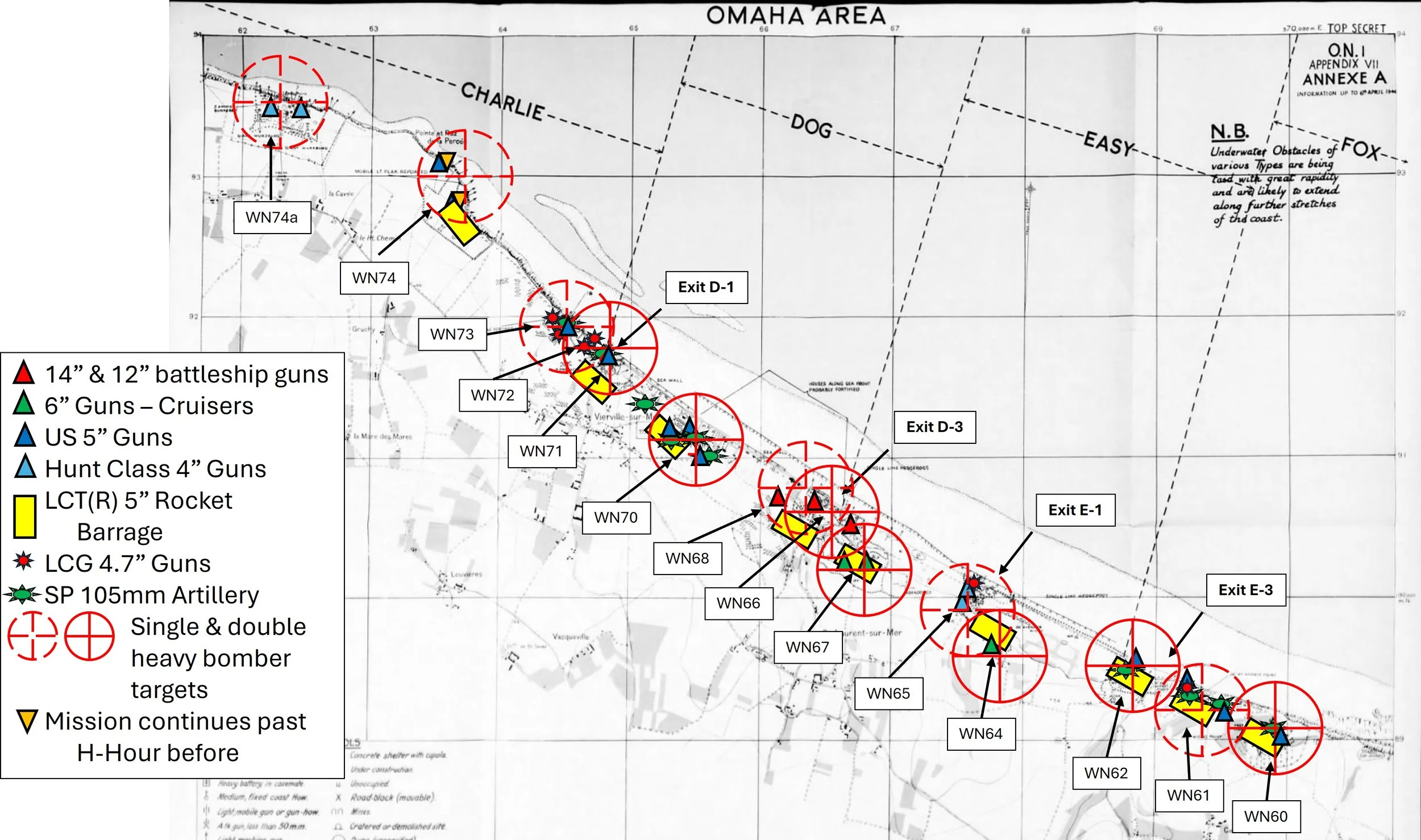
Figure 3. This combined targeting chart shows that all 13 air bombardment aimpoints requested by the Army coincided with naval bombardment targets. Therefore none of the defenses should have been left untouched, as RADM Hall stated, due to the delay in releasing bombs. Every position still should have been neutralized by what Hall characterized as his effective naval bombardment.
Hall was also absolutely incorrect when he stated his “gunfire support was effective against the targets on which it was directed.” That was an inexcusable exaggeration. It possibly could have been at least more effective, had his captains vigorously prosecuted their bombardment missions. But they didn’t.
This failure has generally been papered over by the subsequent critical role played by the destroyers later in the morning when they stepped up and provided excellent support to the troops pinned on the beach. That (deservedly) heroic story, when coupled with the constant references to the ‘bomber failure’ scapegoat, has kept historians from digging more deeply for over eight decades.
But now we know better.
A Word of Gratitude.
I would like to express my thanks to the incomparable Michel Sabarly, one of the true experts on the Normandy landings. He was kind enough to volunteer to visit the French archives to dig up the various invasion reports for the two Free French cruisers that operated in the Omaha Assault Area in CTG 124.9. Those reports filled a major gap in my research and hopefully will make the valiant contributions of those ships better known to a readership which sometimes fails to realize that these landings were a truly Allied effort.
Mercie, mon ami.
Coming Next
- Shortly following publication of this post, I’ll publish an addendum summarizing the experiences of each of the ship’s in the pre-H-Hour bombardment, for those who would like to look into the details more closely.
- In the next two to three weeks I’ll post an installment analyzing the planned air bombardment for Omaha, focusing on the practical limits of using strategic bombers on tactical targets, and what the likely outcome might have been had the weather not interfered.
FOOTNOTES
[1] Action reports for the Hunt class escort destroyers are available, but have scant detail and do not mention ammunition expenditure.
[2] The 14-inch guns of the Texas were larger, but were not involved in the beach neutralization mission.
[3] CTF-122 operation order prohibited use of the still-secret radar proximity fuze, but mechanical time fuzes were allowed. The hope may have been that the high trajectory rockets would eliminate these open positions, but given the poor training of those ships, it was an unrealistic dream.
[4] This would appear to actually have been T128 based on the description ‘one half mile east of Port-en-Bessin.’ T129 was about 3 miles east of Port-en-Bessin.
[5] For instance, the Doyle’s position is shown based on its reported bearing and distance from its target. However, it also reported its estimated distance to the beach, which would place it significantly closer to the nearest shoreline.
[6] Commander Assault Force Omaha (CTF124), Operation Order No. BB-44, pg. 11. NARA, RG 313, Entry Number P111, Box 81.CTF 124 OpOrd, pg. 11
[7] Ibid. Annex E (Gunfire Support Plan), pg 4.
[8] Ibid.
[9] Commander Assault Force “O”, Action Report – Assault on Vierville-Colleville Sector, Coast of Normandy, dtd 27 July 1944, pg 101. When commenting on joint exercises in the Slapton Sands area, Hall stated, “In the case of the U.S. destroyers, this was definitely limited by the low ammunition allowance possible.”
[10] History of the 58th Armored Field Battalion, on file at the Ike Skelton Combined Arms Research Library’s Digital Library (call no. UA30.2 (58th) .H5 RARE).
[11] Baker, Fran, ed. Hot Steel, The Story of the 58th Armored Field Artillery Battalion, Delphi Books, 2014.
[12] Correspondence with the author, 26 February, 2026
[13]After action report, 62nd Armored Field Artillery Battalion, 19 Nov thru 31 Aug 43, June, Sept, Dec, 1944, Jan 1945. See the Unit Journal entry for 6 June 1944, pg. 60 of the .pdf. On file at the Ike Skelton Combined Arms Research Library’s Digital Library.
[14] Ibid. See Narrative of the Battalion Commander, dtd 4 July 1944, pg. 51 of the .pdf
[15] Opcit. CTF124 Operation Order No. BB-44, Annex E (Gunfire Support Plan), Appendix 2, pg. 17.
[16] Commander, Gunfire Support Group (CTG124.8), Action Report – Operation Neptune, 3 July 1944, pg. 18. NARA, RG 38, Nara Catalog Id: 4697018
[17] Stillwell, P., ed, Assault on Normandy,First Person Accounts From the Sea Services. Naval Institute Press, Annapolis, MD, 1994, pg. 59.
[18] See, for example, the After Action Report of the 3rd Battalion, 16th Regimental Combat team for the 30-minute late landing of their craft, and the 16th Regimental Combat Team’s S-3 Combat for the early (“off schedule”) firing of the rockets.
[19] Armed Forces in Action Series, Omaha Beachhead (6 June – 13 June 1944), Battery Press, Nashville, 1984. pg. 41.
[20] LCT587, LCT589 & LCT590
[21] Henrik Naube, Eckhertz, Holger. D DAY Through German Eyes - The Hidden Story of June 6th 1944: Book One (p. 45). DTZ History Publications. Kindle Edition. (Omaha Beach, The Resistance Nest Machine gunner
[22] Severloh, Hein. WN 62 - Memories of Omaha Beach: Normandy, June 6, 1944 (German Edition) (p. 74). Kindle Edition.
[23] Gustav Winter, Eckhertz, Holger. D DAY Through German Eyes - More hidden stories from June 6th 1944: Book Two (D DAY - Through German Eyes 2) (p. 5). DTZ History Publications. Kindle Edition.
[24] Sabin’s (CTG124.8) action report, pg. 16.
[25] For Imlay’s comments, see Deputy Commander Task Group 124.3, Report on Operation Neptune, 1 July 1944, pg 10, and for Sabin’s, see pg. 37 of his report (footnoted earlier in this article)
[26] Eckhertz, Holger. D DAY Through German Eyes - The Hidden Story of June 6th 1944: Book One. DTZ History Publications. Kindle Edition. p. 67.
[27] Commander Assault Force “O’ (Commander Eleventh Amphibious Force), Action Report - Assault on Vierville-Collevile Sector, Coast of Normandy, dtd 27 July 1944, pg 7. In fact, several ships reported near misses at ranges that precluded the beach defenses as their sources. One of his destroyers, Baldwin, was actually hit by two shells from a shore battery of 75mm or 88mm.
[28] These were foreign nationals categorized as ethic Germans, but not citizens of Germany. The were a lower racial category and often included Poles who had no allegiance to Germany, but had been conscripted.
[29] See Hall’s 1st endorsement (dtd 25 Sept 1944, pp 18-19) to Deputy Commander Assault Force O-2’s Action Reo0rt – Operation Neptune, dtd 4 July 1944. NARA, RG 38, NARA Catalog Id: 4697018